Writing

Back To The Forest?

Back To The Forest?

I bet the inmate in upstate New York had no idea what was outside his prison walls when he decided to escape into the Adirondack wilderness last summer.  He probably thought the Adirondacks was like a really big Central Park.  He probably thought it was the perfect break.  Fleeing into the Adirondack Mountain wilderness near the Canadian border had to mean certain success and freedom.

I was in the Adirondacks on the day the inmate broke out of the Ray Brook Correctional Facility in Ray Brook, New York.  My car was stopped three times at one of the many roadblocks. My trunk was checked, and I was questioned.  The locals at the grocery store laughed about the break because when prisoners escape up there, they usually turn themselves in after a couple of nights in the woods.  It was no different with this guy. After only one day of being out, he was found walking down the street in Saranac Lake. The Adirondack woods was no place for him.

Other inmates have run away in the past and have turned themselves in after being lost, wet, hungry, and eaten alive by bugs. They said they had no idea it was so much better in prison than “out there.”  Instead of a tame Central Park type woods, they found a dense, sometimes impenetrable place filled with bears, bogs, and millions of mosquitoes, gnats and black flies — the wilderness.

In primeval times when we were hunters and gatherers, the concept of  “wilderness” didn’t exist. Nature was nothing to be afraid of ; it was where we lived.  It was home.  We were wholly connected to the natural world. That’s all there was and for us it was a “Garden of Eden.”  As agriculture evolved and we became homesteaders and farmers instead of hunters and gatherers, we thought of ourselves as separate from the natural world and the concept of wilderness was born.

Wilderness became the other, a place to be feared and conquered. Wilderness means in Old English, a place of wild deer.  Satan inhabited the forest. Druids practiced their “pagan” rites and witches lived there. By the Middle Ages wilderness meant a place where hermits, insane people, and savages lived.  It was a place uncivilized, and therefore to be avoided and feared.

Wilderness became something we needed to control and dominate, and we did this through cultivation, which we esteemed more highly than our old way of living.  Land became something to be owned by a group or an individual.   Cutting down forests, plowing, planting and taming the land became our vocation.

Dominating the natural world instead of being a part of it was promoted and valued as our human right by both politicians and priests. Priests quoted from the bible the passage stating that man shall have dominion over the entire world. God created the natural world for man’s use and pleasure.   Politicians supported that idea, seeing how it could work to their political advantage. Europeans believed it was Christianity’s duty to convert the “pagans” to Christ and thus we rationalized stealing the Native Americans’ land in North America, colonizing Africa, South America, and the Middle and Far East. We wanted to rule over men as well as nature.

This monumental change in our perception of our relationship with nature put us out of our “Garden of Eden” and into a power struggle for dominance over nature.  Ever since, we have struggled with the dichotomy of our need to be reconnected with nature and our need to dominate it.  Yet, we still yearn for nature and consequently protect and preserve it. And this is why we write about and concern ourselves with conservation, ecology, and pollution.  We have a strong desire to save wild places and preserve virgin forests, because we need to know there exists the real possibility of reconnection with nature. Wild places are an extension of ourselves.  We’ve not traveled as far as we think from our primeval days when we lived in nature and not merely beside it.

In the nineteenth century many people wanted to “get back to nature”.  They wanted to reconnect with wild places, calling them “sublime.”  The Romantic poets wrote about nature’s wonder, beauty, and ability to take one’s mind into the spiritual realm. Wordsworth wrote To a Butterfly, I Wandered Lonely as a Cloud, The Sparrows Nest, and To the Cuckoo — all poems about the love and the beauty inherent in nature– nature created by God and therefore inherently good. Nature became idealized as something transformative – being in nature became a new type of spiritual experience. Where previously man’s spiritual experiences had been limited to church and prayer, now they were outdoors in nature, God’s world.   The idea of living and sleeping close to nature never minding the bugs, dirt, and the inconveniences became a fad, particularly of the comfortable classes. Getting away from the modern, fast paced Victorian life style and its conveniences such as indoor plumbing, comfortable furniture, and insulated, warm houses became a way of seeing life and the world differently. Paulina Brandreth, a nineteenth and twentieth century writer and hunter writes, “One of the chief beauties about hunting or fishing rests in the fact that both create within the individual an enthusiasm that is tonic to mind and body alike.”

People who lived outdoors in shacks and makeshift tents because they had no other choice were called poor. But people who chose (the operative word) to spend their summers living in tents and lean-tos were called campers. Mildred P. Stokes Hooker (1881-1970) and her family were among those first campers.  Hooker’s book, Camp Chronicles about spending seventy summers at her family’s camp on the Upper St. Regis Lake, New York, gives an intimate look at what camping was like at the turn of the last century.

During the first several years her family, including infants and toddlers, lived in tents.  Balsam branches covered in quilts were their beds and the lake was their bathtub.   They had to take along all their food supplies for the summer or buy them from local farmers.  Hooker’s upper class mother took forty chickens to kill for their meals and Hooker’s father rented cows for milk from a farmer. Her father kept the cows on a nearby island so they couldn’t escape.

They were not the only ones camping 120 years ago.  Other families, primarily from New York and wealthy, spent their summers in similar accommodations until their Great Camps were built.   It was common for the men in these camping families to hire guides who would take them out hunting and fishing for game they would use to feed themselves and their families. Sometimes groups of men with guides would spend a week or two off in the woods and mountains killing as many deer, bear, and other game they could. Days were spent feasting on roasted venison haunches and scores of grilled and baked trout, partridge, pheasant and sadly the now extinct American Passenger Pigeon. Game and fish were so abundant that they were considered in unlimited supply and a guide’s reputation grew from the number of game he killed. According to Paul Schneider in his book The Adirondacks, one of the Adirondack’s greatest guides, Alvah Dunning, killed eight moose in five days and during one winter he and three others killed 100 moose. It was not uncommon to catch fifty to sixty trout on fly rods in a couple of hours. Another guide, named Elijah Simonds, was believed to have killed more than 2,000 deer, 3,000 foxes, 150 bears, 12 wolves and 7 panthers during his guiding career.

Slowly these nineteenth century campers built simple or elaborate cabins and icehouses. Some camps had servant’s quarters and stables. Some civilized their wilderness environment a lot and some not too much.  Either way the whole idea was to experience the “freedom” of living out of doors in the great north woods –to experience a different culture than the staid upper class Victorian culture they normally lived.

The idea of combining and relating culture with nature was not a new one.  Muir, Emerson, Thoreau and Hawthorne wrote about it.  Winslow Homer, Albert Bierstadt, and Frederick Church painted it — man’s effect upon wilderness, man’s perception of nature. Whenever a human being goes into nature, he brings culture along.   Even a stroll through the woods changes those woods, leaving footprints and human scent where before there were neither.  Thoreau believed that nature and humans had a sympathetic relationship–one where nature responds to us as we respond to nature.  He writes, “Shall I not have intelligence with the earth?  Am I not partly leaves and vegetable mould myself?”   Or Emerson who wrote, “ Nature is so pervaded with human life that there is something of humanity in all, and in every particular.”

That is what those early campers were after, a sympathetic relationship with nature.  While they wanted some creature comforts, i.e. ice and wooden dwellings instead of canvas ones, they didn’t want to destroy the very essence they were after in living in the wilderness for the summer.   They wanted to experience and understand nature and their undeniable connection to it.  They believed as Paul Gruchow, author of The Necessity of Empty Places, believes, “We will not come to any deep understanding of our place in nature except as we delve into its basic documents, and these documents are our wild places.”

We need to keep in touch with the wildness within us, the animal side of our nature.  That is one reason why we have preserved wild places all over the world.  Places where we know wildness exists, places we have not tamed and developed into skyscrapers, roadways, and farm fields.  Knowing wild places exist buoys us when we are in places uncomfortably manmade, like shopping malls and parking lots.  This need for connection and communion with the natural world fuels a camping, fishing, hunting, and boating industry worldwide. In the United States alone, millions of us spend millions of dollars a year on tents, boats, fishing equipment and guns. We have an innate need and desire to be in nature whether it is an ocean, lake, desert, wood or mountain.  The visit makes whatever is lacking or ailing in us whole and well.  We are restored, freed.

For those wealthy Victorian campers connecting with nature meant freedom from some of the social strictures of upper class society.  Hooker’s mother wrote in her diary,  “I do like the freedom of this place in the way of dress.  Even calls are made in flannel suits and gentlemen wear knickerbockers and coarse stockings.”   Dressing for dinner was banned at some camps while at others women “bedecked in diamonds and men in ‘boiled’shirts paddled their canoes to the Vanderbilt’s for dinner.”  For some, too much social freedom while in the wilderness was too much wildness.

For Martha Reben, wildness and wilderness were her salvation.  Reben was a tuberculosis patient at a sanatorium in Saranac Lake, New York. Her father had sent her there from their home in New York City when she was diagnosed at age sixteen.  Her mother had died of the disease ten years earlier.  Reben had endured three dangerous and painful operations over her three-year stay and still was no better.  She was dying.  One day as she was reading the local newspaper, she chanced upon an ad looking for a TB sufferer who would like to try an experimental “treatment” in the Adirondack woods.  This “treatment” was to spend a summer in the woods camping beside a pond and being taken care of by an Adirondack guide named Fred Rice.  She answered the ad and after some convincing of Mr. Rice and her father, she was accepted as Rice’s first experimental patient for the summer of 1931.  It worked.  By the end of that summer Reben was remarkably better.

For the next ten years, Reben spent spring, summer, and fall camping along the banks of Weller Pond.   Although she eventually was cured of TB, she never completely recovered her strength because of the lung damage she had incurred from the disease and the operations.  Still in her book, The Healing Woods, she writes that she wouldn’t have lived another year without her summers spent camping on Weller Pond.   There she learned how to live out of doors, to use a compass, to fish and to write on an old typewriter.  She wrote about what she saw at Weller Pond much as Thoreau wrote about Walden Pond.   She made pets of raccoons and birds.  She slept at the edge of the pond with the water literally lapping at the legs of her bed.  She learned the constellations and how to read the wind and sky for weather clues. When she had to leave in November before the pond froze, she cried.  While many people would find the realities of life beside a wilderness pond more reality than they would like to experience, Reben found there the reality of a new life.

Some of us try to get into a wilderness forest and some of us try to get out. It all depends on our perspective. As for me, the next time I hike along Heart Lake with the chipmunks scolding my passing and me preoccupied with my thoughts and suddenly an osprey swoops down six feet away to retrieve her prey, I’ll be as startled as the escaped Adirondack inmate, but I’ll also be amazed. And if a Great Blue Heron and I surprise each other along the banks of the Rocky Falls Brook, he’ll squawk and I’ll scream and after the shock wears off, we’ll both thrill at the meeting.

adirondack mountains adirondacks adventure Animals Appalachian Mountains backpacking Commentary death Environment Family forest hiking Home Humor hunting Inspiration Kids Life Lifestyle Literature Love mothering mountains Musings nature Opinion outdoors Personal Philosophy Places Random Thoughts Reflections Relationships Romance rural Spiritual Spirituality Teaching writing Thoughts Travel Women women and nature woods Writers Writing

Snippets from the ADK — Circles — Returning But To a Different Place

College of Liberal Arts Building, Towson University

College of Liberal Arts Building, Towson University

When I walked through the university parking garage; the old anxiety reared its head for a heartbeat. I breathed, walked on.  I am back on campus, but this time to pick up a key for my new office.  When I envisioned my perfect job more than a year ago, I’d imagined teaching writing full-time in the English department in the beautifully new and light filled College of Liberal Arts building. It would mean teaching with colleagues who love reading and writing in an open, free environment.  I would have weeks to myself in the summer where I could be in my beloved Adirondacks. I would have time and energy to think, to write, to be.

And here I am sitting in my new office, real wood furniture, no window but next to an old friend and colleague I’ve known for 15 years. Surreal to make this circle back to where I began teaching 14 years ago.  I check out my classrooms in this huge  290,000 sq.ft building.  Three out of four classes will meet in small conference room style rooms with tables grouped in a large rectangle and ringed with comfy, swivel office chairs. I smile. The intimacy and dynamic I’ d imagined right before my eyes.

Next week, we begin a 15 week journey together — these 84 students and I.  Joyful anticipation!


Snippets — Renewing in the ADK

Two Hornbeck's on the shore of Lake Champlain

Two Hornbeck’s on the shore of Lake Champlain

I usually write essays, drafted and tinkered with over many weeks — sentences and words agonized over and then agonized over once again.

Now after 5 weeks in the ADK, I want to write only snippets. Too much has happened in these past weeks.  I could write a bulleted report of my doings but that would not only be boring but would only scratch the surface of my experience, would leave out the most important part — how I came to be more of who I am, not restored after the terror of the past three plus years, but  renewed.

Over these weeks, I have discovered through moving my body and mind and soul through experiences as diverse as restorative yoga, paddling rivers, hiking mountains, grading students’ essays, chatting with friends, attending concerts and theater, shopping, eating, and visiting with family and friends that I am different from when I left Stewartstown, PA.  I am my old self and my new self.  The anxiety, pain, and fear that was my daily and hourly experience has vanished, and I am in a foreign land, one in which I want to stay, permanently. If I had to sum up my new place, it would be with one word — perspective.  My perspective has shifted, shifted to a place that I plan on staying for quite awhile. It feels so  good to be here, seeing and feeling from this place that current or future conditions can’t shake so ferociously.


The Magic Tray

The 'magic' tray we used in our Young Writers' Club

The ‘magic’ tray we used in our Young Writers’ Club

There once was a class of writing students who were terribly behaved around food of any kind. After school they acted as if they’d been starved for days, rushing up and edging one another out-of-the-way so they could get at the table laden with bags of Oreos, Chips Ahoy, and Synder’s pretzels. One would imagine they had just come off a 10 day trek on the Gobi desert by the way they ripped open the plastic loops holding the Deer Park water bottles. As they gingerly negotiated the classroom desks getting back to their own, their 13-year-old hands overflowed with eight or ten cookies (Were they hypoglycemic?), three or four pretzels (Were they salt deprived?) Then once seated (and that was a tricky business if they’d pushed their chairs back under their desks) each child stacked and sorted their loot in his or her own way upon the napkin I’d placed there. Some stacked their cookies six high, some in short stacks of two or three. Either way they wiped out the snacks on the snack table within minutes. It was a frantic and chaotic business at the start of each and every club meeting.

Reminding them to share and slow down made absolutely no difference. These young writers were deaf to me and to the other two teachers who coordinated this Young Writers’ afterschool program for middle school adolescents who actually love to write. This love of writing made them anomalies of their Title I middle school. They were the smart ones, the ones who lived and loved to read and write and talk about fiction and poetry with one another. One often overheard them discussing their latest work, “I based this story off the Anime series Sazae-san”. They were a polite and serious group of over-achievers so their uniquely sensitive behavior juxtaposed to their Darwinian behavior when it came to cookies was hard to fathom. Why did they greedily and without regard for one another attack the snacks I brought each week? Were they truly that hungry? Or was it something else?

We teachers tried sending them to the snack table one or two at a time, but this strategy left the last students with the broken bits and only one or two whole cookies a piece. We said over and over again, “Remember your friends are hungry, too. Only take two cookies and two pretzels at a time.” This sort of worked. But as soon as our attention shifted to working with the student writers individually, their club-mates stealthily made their way to the snack table and grabbed as many cookies and pretzels as they could without our noticing. When at last we did notice, we saw that the original two cookies and two pretzels on each student’s desktop had suddenly been replaced with Oreo cookie towers ten high and mountains of fifteen Synder’s thin pretzels. Empty containers tipped sideways their crumbs spilled out on the floor were all that was left behind from the snack invaders.

After many months of watching this weekly drama unfold and our attempts to contain and modify their attacks failing each and every time, I decided to come up with a plan. I wasn’t sure what this plan would be, but I was determined to change this uncivil and uncivilized behavior. But how?

That very weekend of my resolution, I was going to visit and help my father sort out and clean out closets and drawers at his home, the home in which I’d grown up. The home that was crammed full of 50 plus years of stuff. My mother had died a few months earlier, and I was helping my dad sort things out. His desire to ‘clean out’ was his way of mourning and moving through my mother’s passing. They had been married for 60 years. As we worked together on the kitchen cabinets, we came upon the tray cabinet which held 3 dissimilar trays, one circular plastic coated gold leaf, one chipped painted metal, and one clear plexiglass with the initials “SVCC”.

As we worked, my dad often asked, “Do you want this vase?”; “Do you need a cookbook?” “Should we throw this away or give it to Good Will?” So as we looked at the trays, he said, “I want to keep the gold one, but you can have the other two if you want them?” “Okay,” I said, “I think I’ll take both. We could use them at home.” And so I left that Sunday afternoon with two trays, one with chipped paint and the other a brand new looking plexiglass.

The metal cream-colored tray with a chipped scene of red and blue winding flowers and two black unicorns was ancient. When it was new and un-chipped, my mother had used it as our ‘sickroom’ tray when she brought me toast and tea after a night spent with a fever or vomiting or both. We never saw or used it at any other time. The plexiglass tray, on the other hand, was a prize won by my mother at a golf tournament. My mother was crazy about golf and had played for 50 years. Although she was never a great golfer, she was an impassioned one, playing and practicing several times a week. This prize was from the country club at which she had played hundreds of times. It was one of the very few golf prizes she had ever won. In fact, it was one of the best prizes she had ever won.

And so that next week when I awoke as usual at 4:00 AM thinking about work or children or both, it suddenly came to me, an epiphany, “Use a tray for our Young Writers’ club”. Yes – I would serve them their snacks, water, and napkins on a tray. In this way, they would be honored and taught at the same time. I was so excited to try it. But which tray to use? The ones at our home were in constant use, and I wanted to leave a tray at the school which was an hour’s drive away. Surely not the chipped one; these children didn’t deserve a battered looking tray. That left the plexiglass with the initials SVCC aka Saucon Valley Country Club. As an otherwise unmarked, simple rectangle with 2 inch sides (those sides would help eliminate things falling off as I moved about the classroom), it was perfect. I couldn’t wait to try it.

The other two teachers thought the tray was a good idea too and were eager to try it. So that Wednesday, I brought the usual Oreos, Chips Ahoy, pretzels, and water along with the unusual, my tray. As the teachers and I unloaded the snacks, I explained to the children that I would be serving them their snacks on this tray. They watched as I opened the cookie containers and the pretzel bag and placed them in the middle of the tray. Next I stacked the napkins in one corner and lined up the water bottles in the other. It all fit, perfectly! With the two slotted handles, it was easy to carry the tray around the room stopping at each child’s desk and asking, “Would you care for a snack?” That first time, they looked questioningly at me as they stretched out their hand to the cookie container, asking out loud or silently with their eyes, “how many?”   In response, I said, “Let’s take two cookies now, and I’ll be around again a little later.” The effect was instant. These grabbing, gobbling children became 19th century drawing room aristocrats, ever so slowly and carefully taking one or two cookies, a napkin, a pretzel, and water. As if we’d always had our snacks in this way, they spontaneously said, “yes, please” when offered the tray and “thank you” as I moved on to the next student. It was magic to see and hear their transformation from ruffians to refined gentlefolk.

Now eight months later, the tray has worked even better than I’d imagined. It brings out the best parts in our young writers, the civil, caring part. They love the tray and being waited on. Now when the students want more, they ask if I’m coming around again soon. And so this tray won by my mother at a golf tournament at a fancy country club has traveled to a very different place, a place filled with children who love to write. Each week as I set up the tray with snacks, I thank my mother for giving me this great idea. Because of an afternoon spent cleaning out her kitchen cabinets, I discovered a simple and elegant way to change our student’s weekly snack attack. Who’d have thought it?

Into the Wilderness

ADIRONDACK  MOUNTAIN STREAM

ADIRONDACK MOUNTAIN STREAM

Amelia M. Murray, the maid of honor to Queen Victoria, camped in the Adirondack Mountains in 1855 with the Governor of New York, Horatio Seymour, his niece, and three guides.  While on

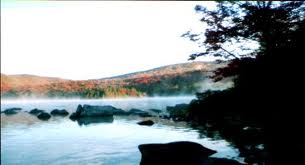
Adirondack Autumn Landscape Where Amelia Murray Hiked

Adirondack Autumn Landscape Where Amelia Murray Hiked

her five-day trip, she learned how to sleep on a hemlock bed, to bathe in Saranac Lake, and to hike sixteen miles in one day through a dense forest filled with “gigantic timber felled by storms…deep bogs and slippery rocks.”  She did all this while wearing a corset, which greatly restricted her breathing capacity, and very unsensible shoes.

Although she was a refined English lady, she carried her fair share — “a basket and a bundle.”  Throughout her diary account of the trip, she makes light of the dirt, rain, thunder, damp bedding and clothes.  She brags about her “London portable soup” which she had brought from England a year earlier and claimed was still in “good preservation” although one should “add lemons and a good store of sugar, brown and white” before eating it.  Amazing.  Her account is enthusiastic, joyous, and chatty.

She was a woman of privilege, an English lady.  Yet she was able to escape “polite society” long enough to have an adventure out of doors in the company of the genteel (the Governor) and not so genteel (the guides).  Although she writes after the trip that it took her “three days at Utica …to recruit and repose” herself, she had had a fine time and welcomed the chance to do it all again.

What is this need, this trenchant desire we have to be in the “wilderness”, to connect with the natural world?  Why would an elegant and refined lady of the 1800s who had probably never ventured much further than a stroll down an English country lane seek the untamed woods of New York State?  She sought adventure, yes, but more than that, I think.  She sought to discover a part of her that had not been tested, had lain dormant.  She wanted to test her fearlessness, her courage, her adaptability.  Normally, tests of fearlessness and courage are associated with men as men’s goals.  Men are supposed to like adventuring; they want to be tested in nature.  Isn’t that what the armed forces ads used to say, “Come see the world. Come adventuring with us.”?  But women need to be tested too. Even girls of thirteen seek adventure.

Last Sunday, my daughter Campbell announced she wanted to go fishing with me down by Cross Mill in Cross Mill stream about one and half miles away.  I thought she was kidding.  Even

Campbell, age 12, my outdoor girl.

Campbell, age 12, my outdoor girl.

though it was sunny and warm for February, 55 degrees, there were still patches of snow about, and I knew the water would be icy cold.  She persisted.   After packing an old red school backpack with a water bottle, water shoes, a towel, and a fishing rod, she pronounced herself ready to ride her bike down to the stream.  I couldn’t convince her to walk, arguing unsuccessfully that the roads are narrow and winding and in some places cars fly by at forty miles an hour. Ultimately, I agreed to her riding the bike as long as she stayed with me.  I wanted to walk.  We spent three hours walking and riding to and from the stream and playing in the water.  We waded in the frigid creek, our feet aching and numb.  We skipped rocks, looked for crayfish.  I snoozed in the sun on the brown picnic tabletop in between commenting to Campbell about her solo rock skipping contest.  On the way home, we spotted a male pheasant a few feet away, scurrying through the bushes by the side of the road.

Why had Campbell wanted to go? Did my daughter latch onto the idea of riding off with fishing rod, towel and water bottle because she needed to get away, needed to be out of doors?  Or did she want to go adventuring in order to test her mettle by  riding her bike to a place she hadn’t fished before and wading in frigid February water?  I doubt she could answer these questions or would even want to.  She’s thirteen.  She just wanted to go.

She just wanted to go like Opal Whiteley, a writer who grew up in Oregon in the early 1900’s.

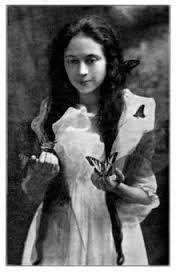
Opel Whiteley, Nature Writer

Opel Whiteley, Nature Writer

Whiteley wrote in her diary at about age seven, “I like to go in among the rushes where the blackbird s with red upon their wings do go.  I like to touch fingertips with the rushes.  I like to listen to the voices that whisper in the swamp.  I do so like to feel the mud ooze up between my toes.”  Campbell could identify with that.  This desire to connect with nature and to seek sensory experiences in it is common to most of us.   My daughter and Opal Whiteley aren’t the only young girls who’ve found adventure and joy in nature.

Hannah Hinchman, a contemporary writer and visual artist, created an enchanted world in the woods near her home when she was a teen.  She spent whole days attired in a wood nymph dress dancing among tall oaks and pines, performing rituals she had “learned “ from the woodland fairies.  She “wanted these adventures to form an unassailable world, composed only

Hannah Hinchman, out door writer and artist.

Hannah Hinchman, out door writer and artist.

of pure things.”  As she grew older she abandoned her woodland fairies and her fantastical view of nature, yet nature continues to be her solace.  “If I were about to pull the trigger and happened to hear a red-winged blackbird, I doubt that I could complete the act.”

Sometimes this desire to connect to nature becomes a pathological need, a self-medication for mental or physical illness or ordinary loneliness.  When I was enduring and battling a brutal divorce, I used to run long and often on the Panther Branch trail in Maryland.  The two mile trail curves through the woods around house-sized boulders, decaying deadfall, and foot high maiden hair ferns edging the stream and winding up to the top of a hill.  I used my runs there as therapy, going over and over all the terrible lies and injustices.  I recounted the same sad incidents and betrayals in my head; the dialogue never changed.  “He said this; can you believe it? And then he did that on top of everything else.  Doesn’t he even care about his children?”

As I ran, I ran, literally and figuratively, through this dialogue every time.  I spoke sentences, paragraphs in my mind as if I were speaking to a therapist or friend.  As I hit the chest high boulder with the red columbine I would begin my diatribe.  I couldn’t stop it; it rolled on and on of its own free will.  After the divorce was final, I still began this ugly conversation whenever I got to the red columbine boulder.  I did it unintentionally, unconsciously, until I consciously put an end to it.

Sadly, after I’d resolved my divorce and the ugly voices, I no longer wanted to go to the place.  The Panther Branch trail, which had been my solace, my comfort, my dumping ground became my nemesis, a reminder of bitterness, hurt and anger.  I felt as if I’d deposited every vengeful thought and desire in its rocks and branches and they were all there waiting for me.  I didn’t go back for years and then only occasionally.

For me, the Panther Branch became a place that was lovely on the surface but underneath was seething with unpleasantness.

Why do we attach meaning to place?  Does it make it more real, make it more our own?  I heard a psychologist say that artists are often depressed because they try to find meaning in every single thing, and when they can’t find it, they become despondent.  Most of us don’t go that far, yet most of us do attribute some meaning to place.

Places are the tangible stage sets for our happiest and saddest moments, celebrations, rituals and events. Hospital bedsides, altars, and babies’ rooms are the backdrops for life’s most poignant moments. Some cultures construct places to house these significant events – churches, burial mounds and grounds, concert halls, and court rooms. Others, like Native Americans, believe some natural outside places hold deep significance; these places contain spirits or powers that other places do not.  They are hallowed or evil, full of the universe’s energy or places of death.

Place enriches or diminishes what happens within it.  Sipping tea in front of a roaring fire is not the same as drinking tea at the local Seven Eleven store.  Place can change our mood, alter our interactions with one another in positive or negative ways.   Having a conversation in a basketball court or in a room full of whining children is not the same as having a conversation beside a woodland stream or in a quiet, candle lit room.  “Place subtends and enfolds us, lying perpetually under and around us.  Place…is the bedrock of our being-in-the-world,” writes Edward S. Casey, author of  Getting Back Into Place.

I just came back from spending two days in New York City.  I love New York.  I love its

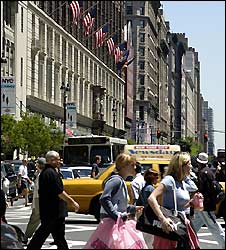
Manhattan Street Scene

Manhattan Street Scene

overabundance.  It’s so full of everything human, overflowing with everything people make. Art, buildings, fashion, food, noise, dirt.  People are everywhere.  On foot, in cars, on bicycles — talking, driving, and honking.  Walking around the city is like walking a human obstacle course; you are blasted with people, color, and noise — snippets of intimate conversations, a man on a space age motorized walker rolling along the sidewalk, pigeons under foot, shop window after shop window stuffed with every conceivable and inconceivable object.  Food markets, their cases over laden with hundreds of cheeses, ten types of proscuitto, twenty pates, truffles, black or white, sauced or canned, marinated or plain. The stimulation becomes overwhelming; the noise eventually becomes too noisy and then it’s time to go home.

After 48 hours of being high on the over-stimulation, I crashed and felt like Amelia M. Murray.  I needed three days at home in the woods in rural Pennsylvania “to recruit” myself.  Just like Murray, I wanted an adventure, a taste of the unfamiliar.  And when it was over, I wanted to repose — in my own place.