Travel

How to Feed a Bald Eagle

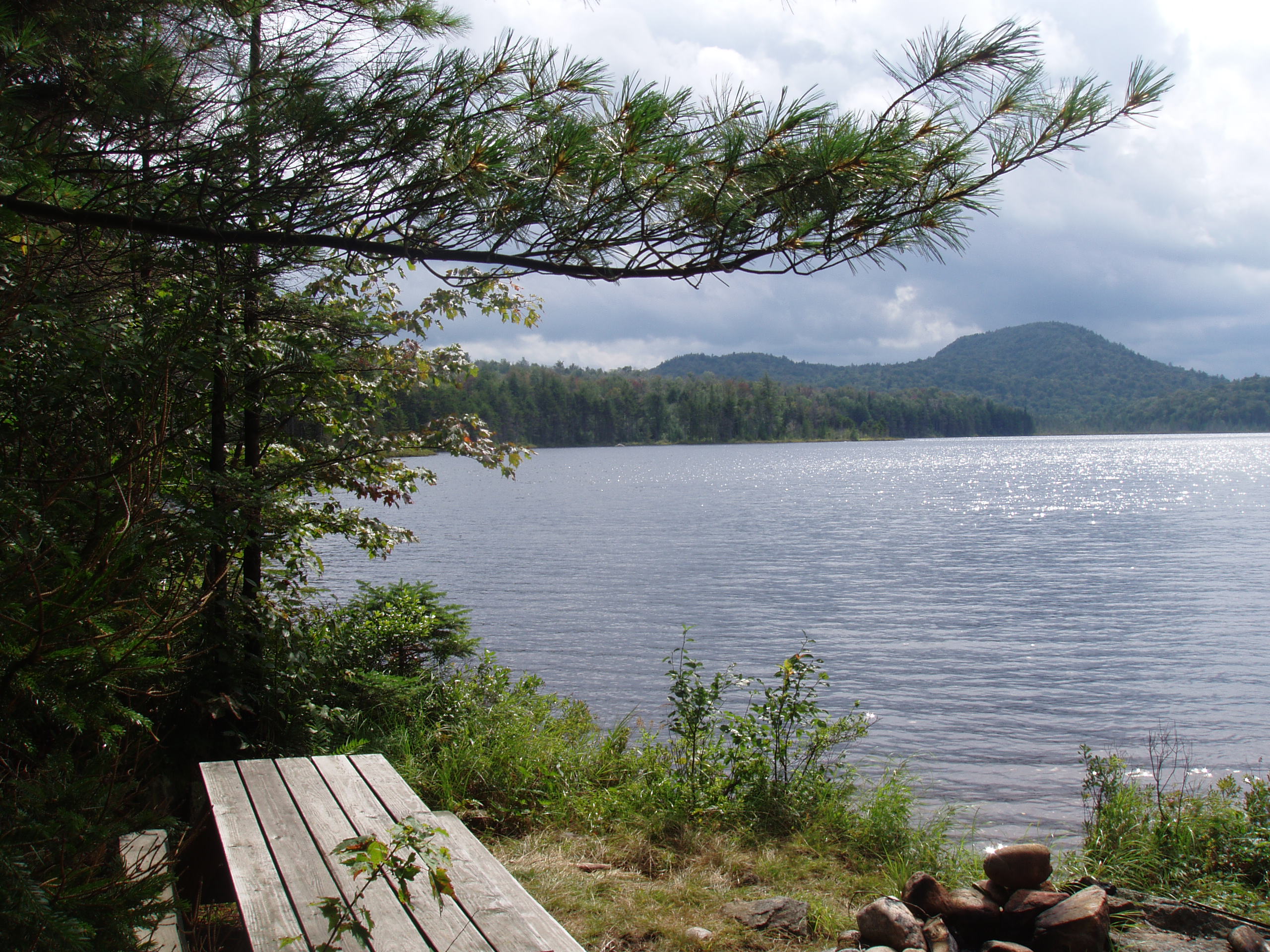
We were on Round Pond in Camp Massawepie located in the Adirondack Park, New York.  Massawepie means place of big fishes in native nomenclature. And we were out for a wonderful day of brook trout fishing in this gem of a place. A 3700 acre Boy Scout camp amid an ancient maze of six kettle ponds and eskers the receding glacier left behind some 13,000 years ago. A trout angler’s dream! Anyone with a NY state fishing license can fish here when the Boy Scouts aren’t in residence.

We were just settling into trolling on the east side of Round Pond when Kevin had a fish on. As he reeled, I kept saying quietly, “don’t let him get away”. Kevin reeled in the 6 inch trout, and we were both disappointed. At Massawepie, trout must be at least 12 inches long to be keepers. Kevin took out his hemostat and carefully dislodged the hook from the trout’s mouth. Then Kevin gently placed the little fish back in the pond. We could see that the trout was struggling a bit, not diving straight back down from whence he came. 

Suddenly, a huge bald eagle coasted down in front of us, aiming right for the little trout. With one big swoosh the bald eagle swooped in, reached its long, curved talons just under the water and grabbed the floundering trout.

We couldn’t believe it! We have fished many ponds and lakes in the Adirondacks, and only once before have we had an eagle come within 1000 ft of us. Usually, they’re flying way overhead or perched on a tree a quarter mile away.

Since both male and female eagles look alike, I’ll call this one she.  After her amazing catch, we thought she’d fly far away.  Instead, she flew two thirds up a nearby white pine tree and began to tear and eat her feast in front of us.  At first, we were afraid to paddle our small solo canoes too close, but as we came closer the eagle didn’t seem to mind.

After she’d finished eating, she flew a circle around this 5 acre pond and then settled into the top branch of another white pine. There she perched and watched us. Soon Kevin caught another brookie – unfortunately, it wasn’t the required 12 inches, so he released it. This time we turned our phones’ videos on just in case we had a repeat performance. And we did!

Once again, the eagle flew towards where Kevin had released the trout, made a circle and came dead on tracking the fish, lowering her legs and turning her talons sideways so she could skim the water, and grab the struggling trout. Then as before, she returned to what we now called her ‘dining white pine tree branch’ and quickly ate every scale. Afterwards, she once again flew in a circle around us and alighted on the same look-out pine across the pond.

“Can you believe this”? Kevin asked me.

“Unbelievable”, I said.

“If we catch another small one, let’s hold onto it and release it between our two boats and see if she will come in for a grab between us. Then we could get an amazing video”, said Kevin.

“What a great idea. Yes, let’s do it. This is truly incredible”, I said.

I was so excited to try out this experiment. The eagle seemed completely unafraid of us, so I thought she would get close, and we would get an amazing close-up video.

Within minutes Kevin had a fish on. As he reeled it in, I silently wished for another small one. And it was – another 6 incher. Kevin carefully released the small trout into the water. We were about 20 feet apart. As the fish floundered on the surface between us, the eagle watched us and then flew in a half circle around us swooping just above the water between our canoes and then suddenly up and away without the trout.

‘I think she is afraid. Let’s back -paddle and see if she’ll come back”, said Kevin.

Quickly we paddled backwards so we were now about 35 feet apart.   The trout was still floundering just below the surface. Soon the eagle circled, flew down and this time gracefully, smoothly scooped up her trout. We each got the whole scene on our phones, yayee.

As we watched her fly back to her dining tree, we followed. This time we paddled right underneath her and videoed her tearing and eating. She wasn’t bothered by our presence one bit.

Since we still didn’t have our limits of three 12 inch fish a piece, we began to fish again. We’d each caught one 12 incher, and they were on stringers trailing beside and behind our boats. I was concerned that our eagle would go after them. She certainly wasn’t very afraid of us. Birds of prey and snapping turtles often go after fish on stringers. They are an easy meal especially for snapping turtles.

Last summer Kevin had a bald eagle try to do just that – swoop in and try for one. Fortunately, Kevin frightened him away with some yelling and flaying of arms. Happily, this eagle never tried to swoop in for the fish on our stringers. Why would she? We were practically handfeeding her.

“Do you think this eagle comes here regularly”? asked Kevin.

“It seems like it, doesn’t it? Maybe when she sees someone fishing here, she stops by to get a free meal”, I said.

“I bet she wonders why we let so many go”, said Kevin. “She probably thinks we’re pretty stupid.”

As we continued fishing and sometimes releasing, the eagle swept down and retrieved five of our ten released trout.  Happily, some got away, but five did not. When she swooped in for the fifth trout, she caught it and flew southwest away from her dining tree and away from Round Pond. We didn’t see her again that afternoon.

Ninety minutes later, we had caught our limit – three 12 to 16 inch brook trout a piece. So, we paddled to shore, hauled our boats up and over the esker, then down the trail to the parking lot.  As we stowed our gear in the back of our Subaru and put our boats on the roof rack, an older gentleman called from his nearby pick up, “Did you see the bald eagle”?

We both said, “Yes”! And we told him our story.

He said, “That eagle has a nest a quarter mile southwest of the pond.

Kevin said, “That’s where she flew away to. We thought she might have a nest in that direction.”

The old man laughed and said, “Yes, she does. She’s been around the past few summers. She’s a smart one all right, watches for someone fishing so she can snag a free meal for herself and her eaglets.”   

All the way home, we kept marveling to one another about what had happened. That morning, we had gone off to have a normal, fun-filled fishing day.  Incredibly, we’d had a mind-blowing adventure with a bald eagle.  

We had fed a bald eagle five trout over the course of a couple hours. Amazing. Every time she circled around our heads, we could hear and feel the whoosh, whoosh, whoosh of her wings. So beautiful and so powerful. We could see her turn her talons sideways so she could pick up the trout between them. She barely skimmed the water as she gracefully picked up the trout. Then up, up, up and away to her white pine branch 50 feet above us. Incredibly, we had been able to watch this five times. Astounding.

For many months, we’d return to and recount this wilderness adventure often rewatching our videos with each other and our friends. Now years later, our remarkable bald eagle adventure remains at the top of our wildlife experiences in these beloved Adirondacks.
Dipping Our Toes into the Bouquet River With a Juvenile Great Blue Heron

Last September (2024), we were hot and sticky after putting in a rather large perineal flower bed around two sides of our little 1889 farmhouse.  It was too late to go for a paddle on the lake, so Kevin suggested we drive up the road to Jersey Street and wade and sit in the Boquet river.  This stretch of the river is ideal for wading or sitting in chest high water as it flows and cascades over layer upon layer of granite slabs and shelves. You can be in 3 inches or 3 feet simply by choosing which slab or pool you wish to enjoy. The water is clean: the Boquet River Association says, it’s the cleanest river in New York state.

According to the Nature Conservancy, New York’s 47-mile Boquet River is a major tributary to Lake Champlain, which provides world-class recreational fishing and supports verdant land for farming. It’s also the state’s steepest river, with a vertical drop of over 2,700 feet from its source on Dix Mountain to where it empties into Lake Champlain in Willsboro. The river is thought to have been re-named Boquet by the 17th century French interpreter and explorer, Charles Boquet. Sadly, the native name has been lost to history.

We were the only ones there when suddenly and quietly; a young Great Blue Heron landed just 8 feet from where we are sitting. We froze. Herons are shy birds and do not get close to humans. She was about 2 feet high, very thin and thinly feathered as if she hadn’t quite grown into her adult splendor. Her feathers were light blueish grey, her legs also greyish. Her medieval/renaissance sword-like beak about 6 – 8 inches long.

The great blue heron is my totem/talisman. Whenever something important or especially meaningful has happened or is happening in my life, a great blue heron always seems to show up – flying overhead or standing nearby. I always think of these sightings as positive, a kind of supporting affirmation and connection for whatever experience I am facing. I call them my Great Blue Heron days.

We were sitting on a shelf with overflowing water, our legs and feet over the edge, enjoying the feel of cascading water flowing over them.  The heron stood there looking up and down stream and then she looked directly at each of us – one at a time. She did not blink or appear to be frightened in any way. It was as if she were our pet, along for a cool – down herself. A day by the river side, a lazy swim in the riffles.

She did not move about as if to hunt: Great Blue herons eat fish. But she did do something so marvelously unexpected, we had to hold our breath, so we didn’t gasp or laugh and frighten her away. She picked up her left foot, squeezed her toes together and dangled them over the edge of our little waterfall. She dipped in and out of the water, touching it lightly, then holding her foot in the water for seconds at a time. She seemed delighted with the feel of the flowing water cascading over her toes and foot. She turned her foot this way and that, testing which way the water felt best. Every so often, she would gaze at us (her eyes are on the side of her head). She did this for several minutes.

Then just as suddenly and quietly as she’d arrived, she flew up and left for better fishing in the deeper pools farther downstream. We could see her, but she completely ignored us as she busily concentrated on the flow in front of her. She stayed there until we left 10 minutes later. And she was still there as we drove our car over the bridge back towards our home.

It is 17 months since my sister, Evie’s death, and I am still very much in mourning. Sitting and wading in the Bouquet brought back memories of Evie and her family playing with us in the Bouquet river at Split Rock Falls and up on the Bouquet’s north branch at Shoe Box Falls. Both of our families whooped and jumped and splashed together on two perfect blue sky Adirondack summer days. The joy of water and laughter and sliding down rock slabs – so cooling after our trudge into Shoe Box. The exhilaratingly ice-cold water at the base of Split Rock made for squeals of delight and blue chattering lips. My sister so young and full of energy. I could not imagine that several years later she would become sick and then die of metastatic breast cancer. She was a super active positive woman who like the steep, fleeting Bouquet river covered a lot of ground in her brief time here. I deeply miss her and think about her every single day.

So, on this Great Blue heron day, I wanted to believe that this young heron’s visit was a sign from Evie, an unexpected visit in a place that I love – the watery Adirondacks. I think of Evie and me sitting side by side on other rivers and streams enjoying the tactile pleasure of water flowing over rocks and over us. We both loved that. Then I think about how this river water journeys on and on: different water but the same journey – just like my sense of my sister. She is here just not the same kind of here as before.

Black Spots

THAYER LAKE, THE BRANDRETH PROPERTY

THAYER LAKE, THE BRANDRETH PROPERTY

PREFACE — My essay, Black Spots, tells the story of my adventure at a 15,000 acre camp in the Adirondack Mountains in New York.  My partner, Kevin and I, camped, paddled, and fished in the middle of the wilderness for a couple of days with permission of the Nature Conservancy who had just purchased a portion of this family’s original tract.

                                                           BLACK  SPOTS

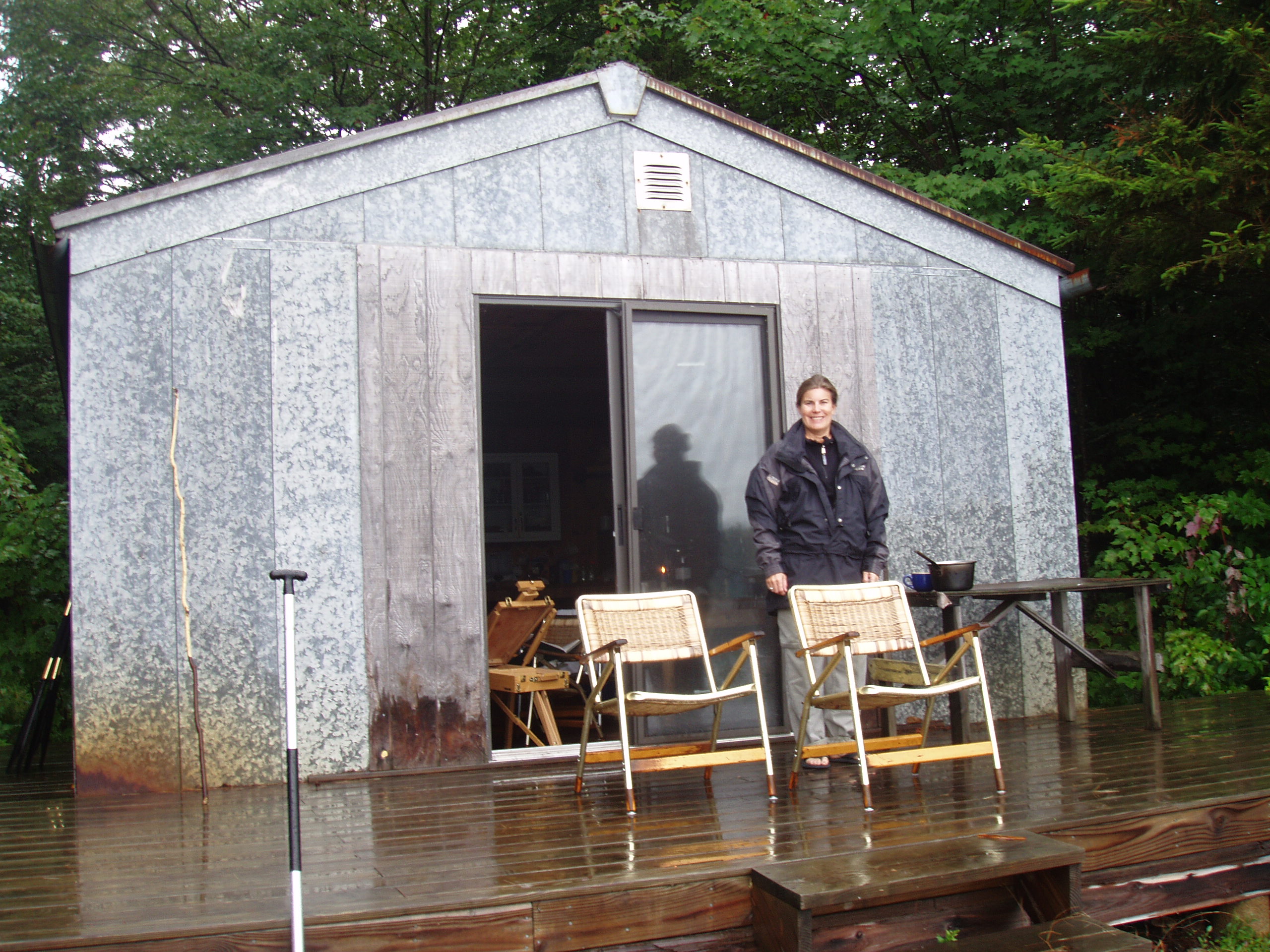
KATIE IN FRONT OF OUR QUONSET HUT

KATIE IN FRONT OF OUR QUONSET HUT

Late last August I went to the Brandreth family tract in the Adirondack Mountains of New York.  The same Brandreth as Paullina Brandreth, an early twentieth century hunting and fishing writer who wrote under the pseudonym of Paul Brandreth.  I had read her book, Trails of Enchantment, and couldn’t believe my luck when Kevin, a friend and landscape painter, invited me to spend a week there in a Quonset hut type cabin  on Thayer Lake, one of several ponds on the property.  The Nature Conservancy had recently purchased the 15,000 acre  property and they were eager to show it off.  I was to write about and Kevin was to paint the reclaimed property that had been in the same family for over one hundred years.

As we drove on the twisting private dirt road fifteen miles into the cabin, we surprised two bears who were feeding on the blackberries that were growing on the verge between the road and the woods.  When they heard our truck, they ran as fast as they could down the road, leaped into the heavy brush, and disappeared.  All we saw were two large round bear bottoms dashing away ahead of us.  People hunt bear here. The woods, thick with alders, are perfect bear habitat and difficult to see or walk through. In fact, you can’t see more than a few feet into the woods on either side of the road.

We stopped at a couple of ponds along the way, one whose water was so clear it was hard to believe that it was dead, a victim of acid rain.  Acid rain works like bleach does on fabric.  It irradiates everything: all color, design, and life. But just as the fabric looks spotless, so does the water.  Spotless and lifeless.

We passed Shingle Shanty Pond where Paullina Brandreth had had a lean-to they used for

SHINGLE SHANTY POND

SHINGLE SHANTY POND

hunting expeditions.  When you own, hunt, and fish on over 24,000 acres its nice to have shelter here and there.  I planned on kayaking its 100 acres, searching around the perimeter in hopes of finding the remnants of her camp.  Two hours after we had begun bumping and winding  up and down over the hilly woods, we arrived at Thayer Lake and our Quonset cabin.  We had expected a dilapidated, primitive structure filled with mice and spiders.  To our delight we would be living, sleeping, and cooking in a steel twenty by fifteen foot building with a pine table and matching chairs, aluminum cots with thin mattresses, two folding deck chairs, and a deck overlooking the one mile long lake.  We also had a clean, new privy 25 yards away and a barbecue pit style fireplace just off the deck, feet from the water. We had arrived in paradise.

As if it had been choreographed by a Wild Kingdom producer, two loons, a male and female, swan up to within 30 yards of our place.  As they swam they called their tremolo, “hahahahahaha” back and forth to one another and to us, we hoped.  The pair stayed for fifteen minutes yodeling and diving, dipping their heads and watching — watching us. After unpacking the truck and making our beds, we carried the red camp canoe into the water and paddled out onto the lake.  We paddled to the middle, stopped, and just sat.  Silence.  We were in it, deep in the north woods, surrounded by 100,000 acres of wilderness.  The dirt track on which we had arrived was our only way out unless we wanted to hack our way through thousands of acres of dense brushy woods so thick with dead fall, alders, black flies and mosquitoes that we would need a machete and  several bottles of bug dope.

After paddling the shore line, we decided upon a likely location for catching some small mouth bass.  We were told the lake was full of them, and so we had visions of a dinner of  crisply grilled bass, baked potatoes, and  steamed string beans accompanied by a couple of glasses of shiraz.  Since we only had one fly rod,  I had planned on doing the paddling while Kevin, an expert fisherman, did the fishing and catching.  But after a couple of casts, Kevin insisted I try, saying it was easy and small mouth bass are  fun to catch.

I am a worm fisherwoman and proud of it.  Back home on the Gunpowder River in Maryland, I catch lots of rainbow trout and brown trout on my spinning reel baited with worms dug up on the river bank. A fly rod is baited with a fly and has a much longer line than a spinning reel and rod.  One must cast back and forth and then out, making the fly appear to the fish as if it is a real insect just waiting to be caught and eaten.  I tried it  after much cajoling, and incredibly, a bass attacked my bait.

My line went out, and my rod bent over U shaped towards the water’s surface.  I had a bass.  I actually had a bass! But as I reeled it in, Kevin announced that he’d forgotten the net so I’d “just have to tire it out” before bringing it along side the canoe.  I followed his patient directions as I broke my tension with loud high pitched “oooh’s”, imploring every other second, “What should I do now”?  Miraculously, the bass stayed on and tired.  Carefully, I hauled him up and over the gunwale and into the bottom of our canoe.

I was ecstatic. I couldn’t believe I’d done it and without a net.  I wanted to try  again.   I cast sloppily, but the bass didn’t mind; they jumped onto my bait at almost every cast.  Getting them tired and into the boat was harder.  As soon as they got close to the boat, they swam away from it as fast as they could.  I had to be ready to give them line, but not too much, or they would be able to jump up out of the water and get off of the hook.  Every one of them jumped, at least once.  And every time, I squealed like a child at an amusement park.  After I had caught six and kept four, we called it quits.  We couldn’t eat more than two a piece.

As we paddled to shore, the loons called from the other end of the lake.  This time their calls sounded primordial like a bevy of ghosts wailing loudly, plaintively.  Their “hoooo-lii” echoed ten times over the water, woods, and hills, sending shivers up our  backs and raising the hair on our arms.  .

COMMON LOON WITH BABY

COMMON LOON WITH BABY

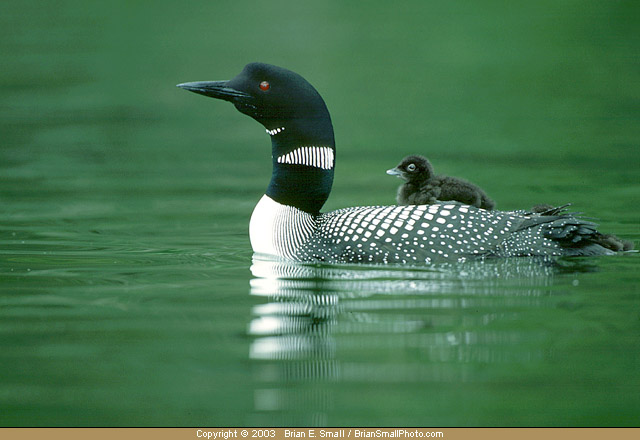
Common Loons are large birds, 32 inches long with a wing span of 46 inches.  They are described by the Audubon Society as “black-headed, with a heavy, dagger like black bill,  a white and black striped necklace, prominent white checkers on their back, and white underpants.” Their eyes are red.  They eat mostly fish, sometimes diving 240 feet  for them  and staying submerged for fifteen minutes.  Because they can stay submerged for so long, Eskimos and Native Americans thought them capable of magic.

Back at the shore in front of our cabin, we pulled the canoe out of the water and changed into fleeces and long pants.  It was chilly, about 55 degrees. I opened the shiraz as Kevin sharpened his knife.  We chatted back and forth about our day, how lucky we were to be here, such a nice cabin and no sign of mice.  We’d had bright sunshine and seventy degrees with only a slight breeze.  The water in Thayer Lake was still warm.  We could swim in it tomorrow.  The loons came floating back, looking us over quietly this time.  Kevin spread a wooden board on a flat rock and began to filet the bass.

As he cut, he explained that bass smell bad when you gut them, so he was just going to avoid that and simply filet their sides for the only meat we would eat anyway.  Why make a mess when you didn’t have to.  After cutting the filets from the first fish he stopped and looked at them closely.  “Katie, look at this.  The fish has parasites.”

I looked and sure enough hundreds of little black spots as small as the head of a straight pin dotted the meat.  “Why don’t you clean another one and see if it has any?”

Kevin did and the second one had them and so did the third and the fourth.  “I guess the whole lake is infested with them.”

I didn’t want to give up my image of wilderness camping, the image of fishing and eating our catch. “Maybe they’ll be alright if we cook them.  The parasites will die won’t they?”

“Katie we’re not eating these fish.” And we didn’t.  It’s funny how black spots in fish can change everything.

We thought we were in a pristine environment, fishing in immaculate water. Water we could

BLACK SPOT PARASITES ON FISH PERFECTLY NATURAL

BLACK SPOT PARASITES ON FISH PERFECTLY NATURAL

drink, water cleaner than we’d ever seen.  But now that notion was dashed.  Our small mouth bass had little black spots all through them.  We imagined the worst and blamed man, acid rain, and pollution. We made grilled chicken instead and sipped our wine wondering how this lake in the middle of no where could have  become contaminated with parasites.

Ironically, we were all wrong.  Humans didn’t cause the parasites. After our trip, we found out from a local Adirondack fisherman and the Michigan Department of Natural Resource’s web site that Black Spot is not man made.  Black spot is a  naturally occurring parasite that is commonly found in earthen bottomed lakes and ponds.  It has nothing to do with pollution. The parasites only infest fish with certain diets, not humans swimming in their waters. Even when a fish is heavily infested, he is no danger of dying or becoming sick.  These parasites are not harmful to humans and die when the fish is cooked.  So we could have eaten the fish, even though they looked pretty unappetizing with all those hundreds of tiny black parasites imbedded in their flesh.

Has our postmodern culture  conditioned us to believe that we are the cause of everything that seems harmful because we see the havoc we have caused in more populated places?  Well, we’re not always the cause of harm, and parasites are a natural  part of the natural world.

BRANDRETH PROPERTY

BRANDRETH PROPERTY

If being in the wilderness for a few days taught us anything about our place in the natural world, it taught us that we are a part of the whole.  We’re not the center or the biggest part or the most important part.  We’re just a part.  We don’t affect everything.  In the wilderness, we affect very little unless we bring along dynamite and heavy equipment.  Without any props, we fit right in — we aren’t too loud or too rough.  We eat and sleep and make love like everything else in the woods.  And that is what we’d come for after all– to fit in and to be a part of the wild with or without parasites.

Into the Wilderness

ADIRONDACK  MOUNTAIN STREAM

ADIRONDACK MOUNTAIN STREAM

Amelia M. Murray, the maid of honor to Queen Victoria, camped in the Adirondack Mountains in 1855 with the Governor of New York, Horatio Seymour, his niece, and three guides.  While on

Adirondack Autumn Landscape Where Amelia Murray Hiked

Adirondack Autumn Landscape Where Amelia Murray Hiked

her five-day trip, she learned how to sleep on a hemlock bed, to bathe in Saranac Lake, and to hike sixteen miles in one day through a dense forest filled with “gigantic timber felled by storms…deep bogs and slippery rocks.”  She did all this while wearing a corset, which greatly restricted her breathing capacity, and very unsensible shoes.

Although she was a refined English lady, she carried her fair share — “a basket and a bundle.”  Throughout her diary account of the trip, she makes light of the dirt, rain, thunder, damp bedding and clothes.  She brags about her “London portable soup” which she had brought from England a year earlier and claimed was still in “good preservation” although one should “add lemons and a good store of sugar, brown and white” before eating it.  Amazing.  Her account is enthusiastic, joyous, and chatty.

She was a woman of privilege, an English lady.  Yet she was able to escape “polite society” long enough to have an adventure out of doors in the company of the genteel (the Governor) and not so genteel (the guides).  Although she writes after the trip that it took her “three days at Utica …to recruit and repose” herself, she had had a fine time and welcomed the chance to do it all again.

What is this need, this trenchant desire we have to be in the “wilderness”, to connect with the natural world?  Why would an elegant and refined lady of the 1800s who had probably never ventured much further than a stroll down an English country lane seek the untamed woods of New York State?  She sought adventure, yes, but more than that, I think.  She sought to discover a part of her that had not been tested, had lain dormant.  She wanted to test her fearlessness, her courage, her adaptability.  Normally, tests of fearlessness and courage are associated with men as men’s goals.  Men are supposed to like adventuring; they want to be tested in nature.  Isn’t that what the armed forces ads used to say, “Come see the world. Come adventuring with us.”?  But women need to be tested too. Even girls of thirteen seek adventure.

Last Sunday, my daughter Campbell announced she wanted to go fishing with me down by Cross Mill in Cross Mill stream about one and half miles away.  I thought she was kidding.  Even

Campbell, age 12, my outdoor girl.

Campbell, age 12, my outdoor girl.

though it was sunny and warm for February, 55 degrees, there were still patches of snow about, and I knew the water would be icy cold.  She persisted.   After packing an old red school backpack with a water bottle, water shoes, a towel, and a fishing rod, she pronounced herself ready to ride her bike down to the stream.  I couldn’t convince her to walk, arguing unsuccessfully that the roads are narrow and winding and in some places cars fly by at forty miles an hour. Ultimately, I agreed to her riding the bike as long as she stayed with me.  I wanted to walk.  We spent three hours walking and riding to and from the stream and playing in the water.  We waded in the frigid creek, our feet aching and numb.  We skipped rocks, looked for crayfish.  I snoozed in the sun on the brown picnic tabletop in between commenting to Campbell about her solo rock skipping contest.  On the way home, we spotted a male pheasant a few feet away, scurrying through the bushes by the side of the road.

Why had Campbell wanted to go? Did my daughter latch onto the idea of riding off with fishing rod, towel and water bottle because she needed to get away, needed to be out of doors?  Or did she want to go adventuring in order to test her mettle by  riding her bike to a place she hadn’t fished before and wading in frigid February water?  I doubt she could answer these questions or would even want to.  She’s thirteen.  She just wanted to go.

She just wanted to go like Opal Whiteley, a writer who grew up in Oregon in the early 1900’s.

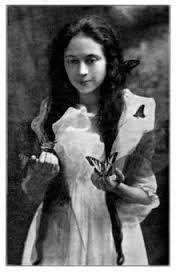
Opel Whiteley, Nature Writer

Opel Whiteley, Nature Writer

Whiteley wrote in her diary at about age seven, “I like to go in among the rushes where the blackbird s with red upon their wings do go.  I like to touch fingertips with the rushes.  I like to listen to the voices that whisper in the swamp.  I do so like to feel the mud ooze up between my toes.”  Campbell could identify with that.  This desire to connect with nature and to seek sensory experiences in it is common to most of us.   My daughter and Opal Whiteley aren’t the only young girls who’ve found adventure and joy in nature.

Hannah Hinchman, a contemporary writer and visual artist, created an enchanted world in the woods near her home when she was a teen.  She spent whole days attired in a wood nymph dress dancing among tall oaks and pines, performing rituals she had “learned “ from the woodland fairies.  She “wanted these adventures to form an unassailable world, composed only

Hannah Hinchman, out door writer and artist.

Hannah Hinchman, out door writer and artist.

of pure things.”  As she grew older she abandoned her woodland fairies and her fantastical view of nature, yet nature continues to be her solace.  “If I were about to pull the trigger and happened to hear a red-winged blackbird, I doubt that I could complete the act.”

Sometimes this desire to connect to nature becomes a pathological need, a self-medication for mental or physical illness or ordinary loneliness.  When I was enduring and battling a brutal divorce, I used to run long and often on the Panther Branch trail in Maryland.  The two mile trail curves through the woods around house-sized boulders, decaying deadfall, and foot high maiden hair ferns edging the stream and winding up to the top of a hill.  I used my runs there as therapy, going over and over all the terrible lies and injustices.  I recounted the same sad incidents and betrayals in my head; the dialogue never changed.  “He said this; can you believe it? And then he did that on top of everything else.  Doesn’t he even care about his children?”

As I ran, I ran, literally and figuratively, through this dialogue every time.  I spoke sentences, paragraphs in my mind as if I were speaking to a therapist or friend.  As I hit the chest high boulder with the red columbine I would begin my diatribe.  I couldn’t stop it; it rolled on and on of its own free will.  After the divorce was final, I still began this ugly conversation whenever I got to the red columbine boulder.  I did it unintentionally, unconsciously, until I consciously put an end to it.

Sadly, after I’d resolved my divorce and the ugly voices, I no longer wanted to go to the place.  The Panther Branch trail, which had been my solace, my comfort, my dumping ground became my nemesis, a reminder of bitterness, hurt and anger.  I felt as if I’d deposited every vengeful thought and desire in its rocks and branches and they were all there waiting for me.  I didn’t go back for years and then only occasionally.

For me, the Panther Branch became a place that was lovely on the surface but underneath was seething with unpleasantness.

Why do we attach meaning to place?  Does it make it more real, make it more our own?  I heard a psychologist say that artists are often depressed because they try to find meaning in every single thing, and when they can’t find it, they become despondent.  Most of us don’t go that far, yet most of us do attribute some meaning to place.

Places are the tangible stage sets for our happiest and saddest moments, celebrations, rituals and events. Hospital bedsides, altars, and babies’ rooms are the backdrops for life’s most poignant moments. Some cultures construct places to house these significant events – churches, burial mounds and grounds, concert halls, and court rooms. Others, like Native Americans, believe some natural outside places hold deep significance; these places contain spirits or powers that other places do not.  They are hallowed or evil, full of the universe’s energy or places of death.

Place enriches or diminishes what happens within it.  Sipping tea in front of a roaring fire is not the same as drinking tea at the local Seven Eleven store.  Place can change our mood, alter our interactions with one another in positive or negative ways.   Having a conversation in a basketball court or in a room full of whining children is not the same as having a conversation beside a woodland stream or in a quiet, candle lit room.  “Place subtends and enfolds us, lying perpetually under and around us.  Place…is the bedrock of our being-in-the-world,” writes Edward S. Casey, author of  Getting Back Into Place.

I just came back from spending two days in New York City.  I love New York.  I love its

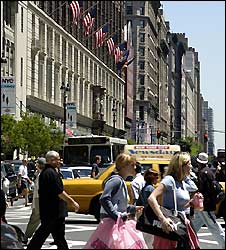
Manhattan Street Scene

Manhattan Street Scene

overabundance.  It’s so full of everything human, overflowing with everything people make. Art, buildings, fashion, food, noise, dirt.  People are everywhere.  On foot, in cars, on bicycles — talking, driving, and honking.  Walking around the city is like walking a human obstacle course; you are blasted with people, color, and noise — snippets of intimate conversations, a man on a space age motorized walker rolling along the sidewalk, pigeons under foot, shop window after shop window stuffed with every conceivable and inconceivable object.  Food markets, their cases over laden with hundreds of cheeses, ten types of proscuitto, twenty pates, truffles, black or white, sauced or canned, marinated or plain. The stimulation becomes overwhelming; the noise eventually becomes too noisy and then it’s time to go home.

After 48 hours of being high on the over-stimulation, I crashed and felt like Amelia M. Murray.  I needed three days at home in the woods in rural Pennsylvania “to recruit” myself.  Just like Murray, I wanted an adventure, a taste of the unfamiliar.  And when it was over, I wanted to repose — in my own place.