women and nature

Back To The Forest?

Back To The Forest?

I bet the inmate in upstate New York had no idea what was outside his prison walls when he decided to escape into the Adirondack wilderness last summer.  He probably thought the Adirondacks was like a really big Central Park.  He probably thought it was the perfect break.  Fleeing into the Adirondack Mountain wilderness near the Canadian border had to mean certain success and freedom.

I was in the Adirondacks on the day the inmate broke out of the Ray Brook Correctional Facility in Ray Brook, New York.  My car was stopped three times at one of the many roadblocks. My trunk was checked, and I was questioned.  The locals at the grocery store laughed about the break because when prisoners escape up there, they usually turn themselves in after a couple of nights in the woods.  It was no different with this guy. After only one day of being out, he was found walking down the street in Saranac Lake. The Adirondack woods was no place for him.

Other inmates have run away in the past and have turned themselves in after being lost, wet, hungry, and eaten alive by bugs. They said they had no idea it was so much better in prison than “out there.”  Instead of a tame Central Park type woods, they found a dense, sometimes impenetrable place filled with bears, bogs, and millions of mosquitoes, gnats and black flies — the wilderness.

In primeval times when we were hunters and gatherers, the concept of  “wilderness” didn’t exist. Nature was nothing to be afraid of ; it was where we lived.  It was home.  We were wholly connected to the natural world. That’s all there was and for us it was a “Garden of Eden.”  As agriculture evolved and we became homesteaders and farmers instead of hunters and gatherers, we thought of ourselves as separate from the natural world and the concept of wilderness was born.

Wilderness became the other, a place to be feared and conquered. Wilderness means in Old English, a place of wild deer.  Satan inhabited the forest. Druids practiced their “pagan” rites and witches lived there. By the Middle Ages wilderness meant a place where hermits, insane people, and savages lived.  It was a place uncivilized, and therefore to be avoided and feared.

Wilderness became something we needed to control and dominate, and we did this through cultivation, which we esteemed more highly than our old way of living.  Land became something to be owned by a group or an individual.   Cutting down forests, plowing, planting and taming the land became our vocation.

Dominating the natural world instead of being a part of it was promoted and valued as our human right by both politicians and priests. Priests quoted from the bible the passage stating that man shall have dominion over the entire world. God created the natural world for man’s use and pleasure.   Politicians supported that idea, seeing how it could work to their political advantage. Europeans believed it was Christianity’s duty to convert the “pagans” to Christ and thus we rationalized stealing the Native Americans’ land in North America, colonizing Africa, South America, and the Middle and Far East. We wanted to rule over men as well as nature.

This monumental change in our perception of our relationship with nature put us out of our “Garden of Eden” and into a power struggle for dominance over nature.  Ever since, we have struggled with the dichotomy of our need to be reconnected with nature and our need to dominate it.  Yet, we still yearn for nature and consequently protect and preserve it. And this is why we write about and concern ourselves with conservation, ecology, and pollution.  We have a strong desire to save wild places and preserve virgin forests, because we need to know there exists the real possibility of reconnection with nature. Wild places are an extension of ourselves.  We’ve not traveled as far as we think from our primeval days when we lived in nature and not merely beside it.

In the nineteenth century many people wanted to “get back to nature”.  They wanted to reconnect with wild places, calling them “sublime.”  The Romantic poets wrote about nature’s wonder, beauty, and ability to take one’s mind into the spiritual realm. Wordsworth wrote To a Butterfly, I Wandered Lonely as a Cloud, The Sparrows Nest, and To the Cuckoo — all poems about the love and the beauty inherent in nature– nature created by God and therefore inherently good. Nature became idealized as something transformative – being in nature became a new type of spiritual experience. Where previously man’s spiritual experiences had been limited to church and prayer, now they were outdoors in nature, God’s world.   The idea of living and sleeping close to nature never minding the bugs, dirt, and the inconveniences became a fad, particularly of the comfortable classes. Getting away from the modern, fast paced Victorian life style and its conveniences such as indoor plumbing, comfortable furniture, and insulated, warm houses became a way of seeing life and the world differently. Paulina Brandreth, a nineteenth and twentieth century writer and hunter writes, “One of the chief beauties about hunting or fishing rests in the fact that both create within the individual an enthusiasm that is tonic to mind and body alike.”

People who lived outdoors in shacks and makeshift tents because they had no other choice were called poor. But people who chose (the operative word) to spend their summers living in tents and lean-tos were called campers. Mildred P. Stokes Hooker (1881-1970) and her family were among those first campers.  Hooker’s book, Camp Chronicles about spending seventy summers at her family’s camp on the Upper St. Regis Lake, New York, gives an intimate look at what camping was like at the turn of the last century.

During the first several years her family, including infants and toddlers, lived in tents.  Balsam branches covered in quilts were their beds and the lake was their bathtub.   They had to take along all their food supplies for the summer or buy them from local farmers.  Hooker’s upper class mother took forty chickens to kill for their meals and Hooker’s father rented cows for milk from a farmer. Her father kept the cows on a nearby island so they couldn’t escape.

They were not the only ones camping 120 years ago.  Other families, primarily from New York and wealthy, spent their summers in similar accommodations until their Great Camps were built.   It was common for the men in these camping families to hire guides who would take them out hunting and fishing for game they would use to feed themselves and their families. Sometimes groups of men with guides would spend a week or two off in the woods and mountains killing as many deer, bear, and other game they could. Days were spent feasting on roasted venison haunches and scores of grilled and baked trout, partridge, pheasant and sadly the now extinct American Passenger Pigeon. Game and fish were so abundant that they were considered in unlimited supply and a guide’s reputation grew from the number of game he killed. According to Paul Schneider in his book The Adirondacks, one of the Adirondack’s greatest guides, Alvah Dunning, killed eight moose in five days and during one winter he and three others killed 100 moose. It was not uncommon to catch fifty to sixty trout on fly rods in a couple of hours. Another guide, named Elijah Simonds, was believed to have killed more than 2,000 deer, 3,000 foxes, 150 bears, 12 wolves and 7 panthers during his guiding career.

Slowly these nineteenth century campers built simple or elaborate cabins and icehouses. Some camps had servant’s quarters and stables. Some civilized their wilderness environment a lot and some not too much.  Either way the whole idea was to experience the “freedom” of living out of doors in the great north woods –to experience a different culture than the staid upper class Victorian culture they normally lived.

The idea of combining and relating culture with nature was not a new one.  Muir, Emerson, Thoreau and Hawthorne wrote about it.  Winslow Homer, Albert Bierstadt, and Frederick Church painted it — man’s effect upon wilderness, man’s perception of nature. Whenever a human being goes into nature, he brings culture along.   Even a stroll through the woods changes those woods, leaving footprints and human scent where before there were neither.  Thoreau believed that nature and humans had a sympathetic relationship–one where nature responds to us as we respond to nature.  He writes, “Shall I not have intelligence with the earth?  Am I not partly leaves and vegetable mould myself?”   Or Emerson who wrote, “ Nature is so pervaded with human life that there is something of humanity in all, and in every particular.”

That is what those early campers were after, a sympathetic relationship with nature.  While they wanted some creature comforts, i.e. ice and wooden dwellings instead of canvas ones, they didn’t want to destroy the very essence they were after in living in the wilderness for the summer.   They wanted to experience and understand nature and their undeniable connection to it.  They believed as Paul Gruchow, author of The Necessity of Empty Places, believes, “We will not come to any deep understanding of our place in nature except as we delve into its basic documents, and these documents are our wild places.”

We need to keep in touch with the wildness within us, the animal side of our nature.  That is one reason why we have preserved wild places all over the world.  Places where we know wildness exists, places we have not tamed and developed into skyscrapers, roadways, and farm fields.  Knowing wild places exist buoys us when we are in places uncomfortably manmade, like shopping malls and parking lots.  This need for connection and communion with the natural world fuels a camping, fishing, hunting, and boating industry worldwide. In the United States alone, millions of us spend millions of dollars a year on tents, boats, fishing equipment and guns. We have an innate need and desire to be in nature whether it is an ocean, lake, desert, wood or mountain.  The visit makes whatever is lacking or ailing in us whole and well.  We are restored, freed.

For those wealthy Victorian campers connecting with nature meant freedom from some of the social strictures of upper class society.  Hooker’s mother wrote in her diary,  “I do like the freedom of this place in the way of dress.  Even calls are made in flannel suits and gentlemen wear knickerbockers and coarse stockings.”   Dressing for dinner was banned at some camps while at others women “bedecked in diamonds and men in ‘boiled’shirts paddled their canoes to the Vanderbilt’s for dinner.”  For some, too much social freedom while in the wilderness was too much wildness.

For Martha Reben, wildness and wilderness were her salvation.  Reben was a tuberculosis patient at a sanatorium in Saranac Lake, New York. Her father had sent her there from their home in New York City when she was diagnosed at age sixteen.  Her mother had died of the disease ten years earlier.  Reben had endured three dangerous and painful operations over her three-year stay and still was no better.  She was dying.  One day as she was reading the local newspaper, she chanced upon an ad looking for a TB sufferer who would like to try an experimental “treatment” in the Adirondack woods.  This “treatment” was to spend a summer in the woods camping beside a pond and being taken care of by an Adirondack guide named Fred Rice.  She answered the ad and after some convincing of Mr. Rice and her father, she was accepted as Rice’s first experimental patient for the summer of 1931.  It worked.  By the end of that summer Reben was remarkably better.

For the next ten years, Reben spent spring, summer, and fall camping along the banks of Weller Pond.   Although she eventually was cured of TB, she never completely recovered her strength because of the lung damage she had incurred from the disease and the operations.  Still in her book, The Healing Woods, she writes that she wouldn’t have lived another year without her summers spent camping on Weller Pond.   There she learned how to live out of doors, to use a compass, to fish and to write on an old typewriter.  She wrote about what she saw at Weller Pond much as Thoreau wrote about Walden Pond.   She made pets of raccoons and birds.  She slept at the edge of the pond with the water literally lapping at the legs of her bed.  She learned the constellations and how to read the wind and sky for weather clues. When she had to leave in November before the pond froze, she cried.  While many people would find the realities of life beside a wilderness pond more reality than they would like to experience, Reben found there the reality of a new life.

Some of us try to get into a wilderness forest and some of us try to get out. It all depends on our perspective. As for me, the next time I hike along Heart Lake with the chipmunks scolding my passing and me preoccupied with my thoughts and suddenly an osprey swoops down six feet away to retrieve her prey, I’ll be as startled as the escaped Adirondack inmate, but I’ll also be amazed. And if a Great Blue Heron and I surprise each other along the banks of the Rocky Falls Brook, he’ll squawk and I’ll scream and after the shock wears off, we’ll both thrill at the meeting.

adirondack mountains adirondacks adventure Animals Appalachian Mountains backpacking Commentary death Environment Family forest hiking Home Humor hunting Inspiration Kids Life Lifestyle Literature Love mothering mountains Musings nature Opinion outdoors Personal Philosophy Places Random Thoughts Reflections Relationships Romance rural Spiritual Spirituality Teaching writing Thoughts Travel Women women and nature woods Writers Writing
Finding My Place

Written shortly after moving up north to the Adirondacks during Covid, 2020

Finding my place. That’s what I’ve been dong these past 4 months. Since moving to our home in the Adirondack Mountains because of Covid, I’ve been pinching myself most mornings when I look out our bedroom window at the 100 plus year old white pine. I like to think the farmers who built our small white clapboard house over 100 years ago planted it as a symbol of their good fortune. The Champlain Valley was prime farm and iron ore mining country at the turn of the last century.

Now it’s home to vacationers, second homeowners, and year round residents. Some of the year round residents have been here for generations or like us, they discovered this amazing landscape over the past 30 years, fell in love and stayed.

We’ve owned our little home since 2007 and have longed to move up here full-time. This year of the Covid has made that possible. This terrible pandemic forced most of us, who could, to work remotely. As college professors we were teaching online last spring and figured we’d be teaching remotely through the fall and possibly winter. We thought, why not move to our Adirondack home for the duration. We made arrangements for our months away, packed up a lot of stuff and were off. It was intense.

Now that the dust has settled, I’m figuring out how I want to live up here in the north woods. We’re far away from interstate commutes, crowded streets and cities. I haven’t worn ‘work’ clothes except for my zoom teaching stints. And then, it’s jeans below and silk blouse/jacket above. 

I walk in the woods most days and gaze at the high peaks from a hill behind our house.  Chickadees come up close – one almost hit me in the head the other day as I was walking on the trail behind our house. Then it perched within an arm’s length, unafraid and chirping. Amazing.

Now, we get our ‘groceries’ at our new CSA, Essex Farm. Each Saturday, I take my bags and put on my mask to ‘shop’ at the farm. We have separate time slots because of the Covid which means I don’t have to rush or worry about distancing. There is a large pavilion with tables full of produce and staples like pastry flour, bread flour, corn meal, rolled oats plus two refrigerator trucks/containers of more produce, eggs, chicken, milk, yogurt, cream. It’s a full diet CSA.

I’m picking up and then googling strange veggies like Kohlrabi, celeriac, Daikon radishes, Delicata and Kabocha squash. I’ve taken something called Schmaltz (chicken fat) from the freezer. Who would think six months ago, I’d be simmering lamb bones for hours to make a delicious stock for lamb stew and later chicken stew. Now I have time to cook! And I love it!

Cooking was not my favorite activity for the many years I worked fulltime and raised my twin daughters. It was a job, not a pleasure.  Now when I wake up at my 4:00 AM worry time, I think about what I’ll cook. Hmm. How about a pork shoulder roast with farm sauerkraut, apples and mashed tiny white and red potatoes. How about a combination of chopped leeks, red onion, garlic, shallots, and broccoli in white wine over pasta? How about mashed Delicata squash or roasted and halved squash filled with ground lamb and spices Indian style. The roasted chickens are to die for and with buttered and parsley new potatoes, steamed kale or carrots or brussel sprouts or cauliflower, ahhh. You get the idea. The possibilities are endless.

Because I have all this food in our frig and freezer, I don’t have to run to the store for missing ingredients. I use what I have and make actual grocery store runs to TJ’s in Vermont every two months. When I’m stuck, I use Google, and I use my imagination. It’s so much fun. I look forward to 4:00 or 4:30 each afternoon when I put on my butterfly apron and begin to chop and cook. For now my place is in the kitchen, practicing my culinary skills and listening to our white pine rustle in the evening wind.

Snippets — Renewing in the ADK

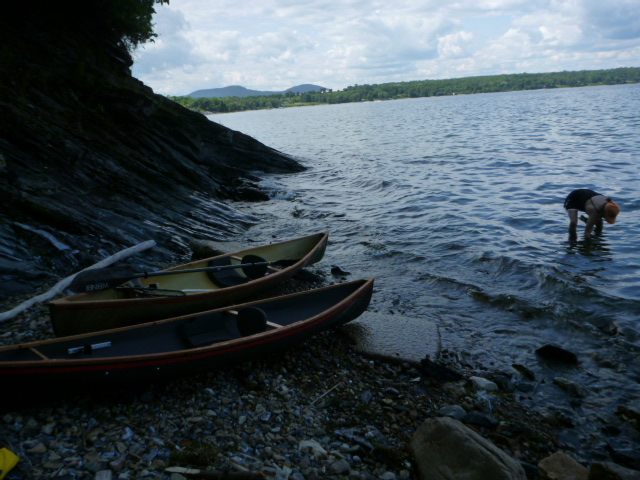
Two Hornbeck's on the shore of Lake Champlain

Two Hornbeck’s on the shore of Lake Champlain

I usually write essays, drafted and tinkered with over many weeks — sentences and words agonized over and then agonized over once again.

Now after 5 weeks in the ADK, I want to write only snippets. Too much has happened in these past weeks.  I could write a bulleted report of my doings but that would not only be boring but would only scratch the surface of my experience, would leave out the most important part — how I came to be more of who I am, not restored after the terror of the past three plus years, but  renewed.

Over these weeks, I have discovered through moving my body and mind and soul through experiences as diverse as restorative yoga, paddling rivers, hiking mountains, grading students’ essays, chatting with friends, attending concerts and theater, shopping, eating, and visiting with family and friends that I am different from when I left Stewartstown, PA.  I am my old self and my new self.  The anxiety, pain, and fear that was my daily and hourly experience has vanished, and I am in a foreign land, one in which I want to stay, permanently. If I had to sum up my new place, it would be with one word — perspective.  My perspective has shifted, shifted to a place that I plan on staying for quite awhile. It feels so  good to be here, seeing and feeling from this place that current or future conditions can’t shake so ferociously.


Black Spots

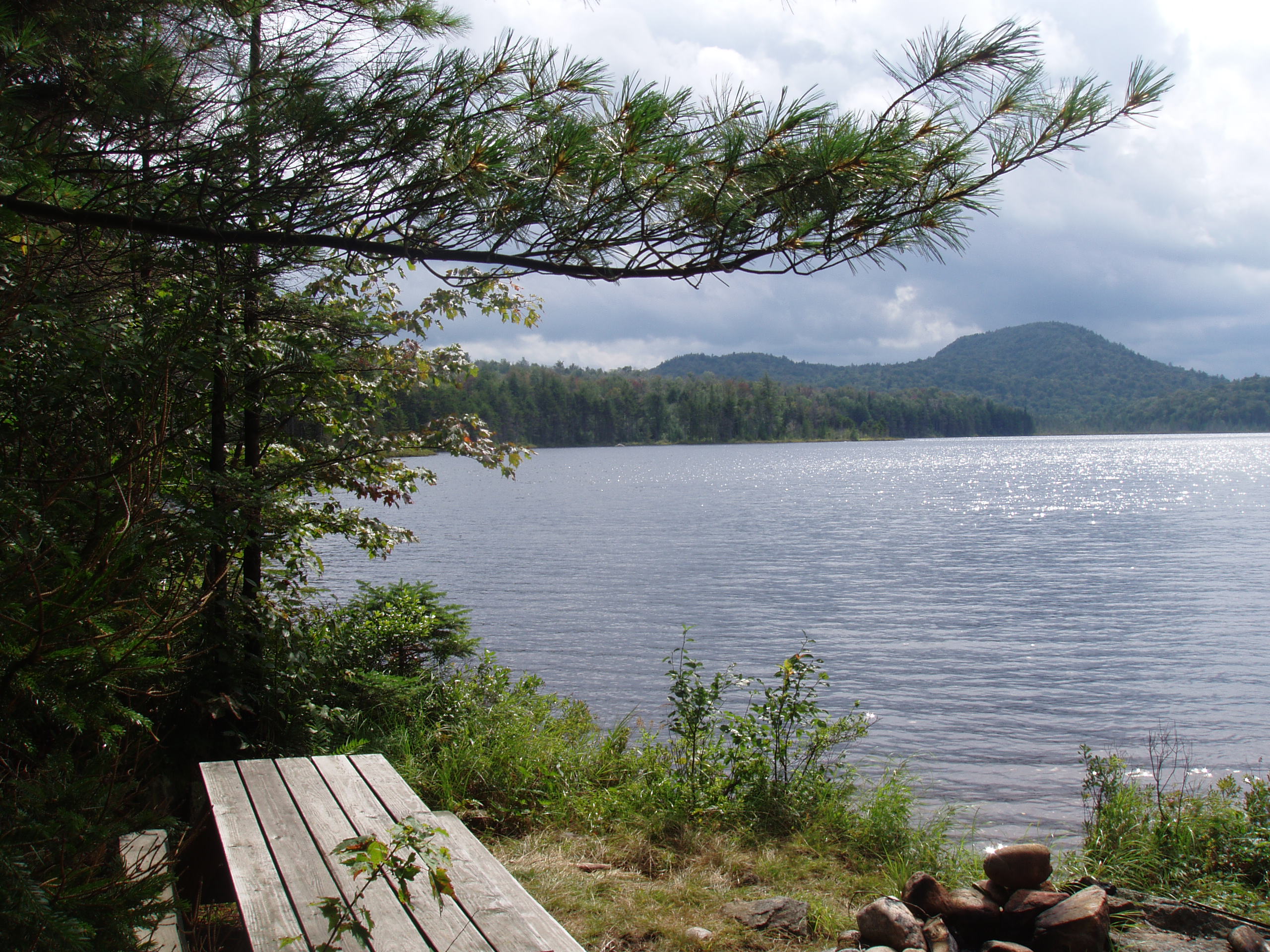
THAYER LAKE, THE BRANDRETH PROPERTY

THAYER LAKE, THE BRANDRETH PROPERTY

PREFACE — My essay, Black Spots, tells the story of my adventure at a 15,000 acre camp in the Adirondack Mountains in New York.  My partner, Kevin and I, camped, paddled, and fished in the middle of the wilderness for a couple of days with permission of the Nature Conservancy who had just purchased a portion of this family’s original tract.

                                                           BLACK  SPOTS

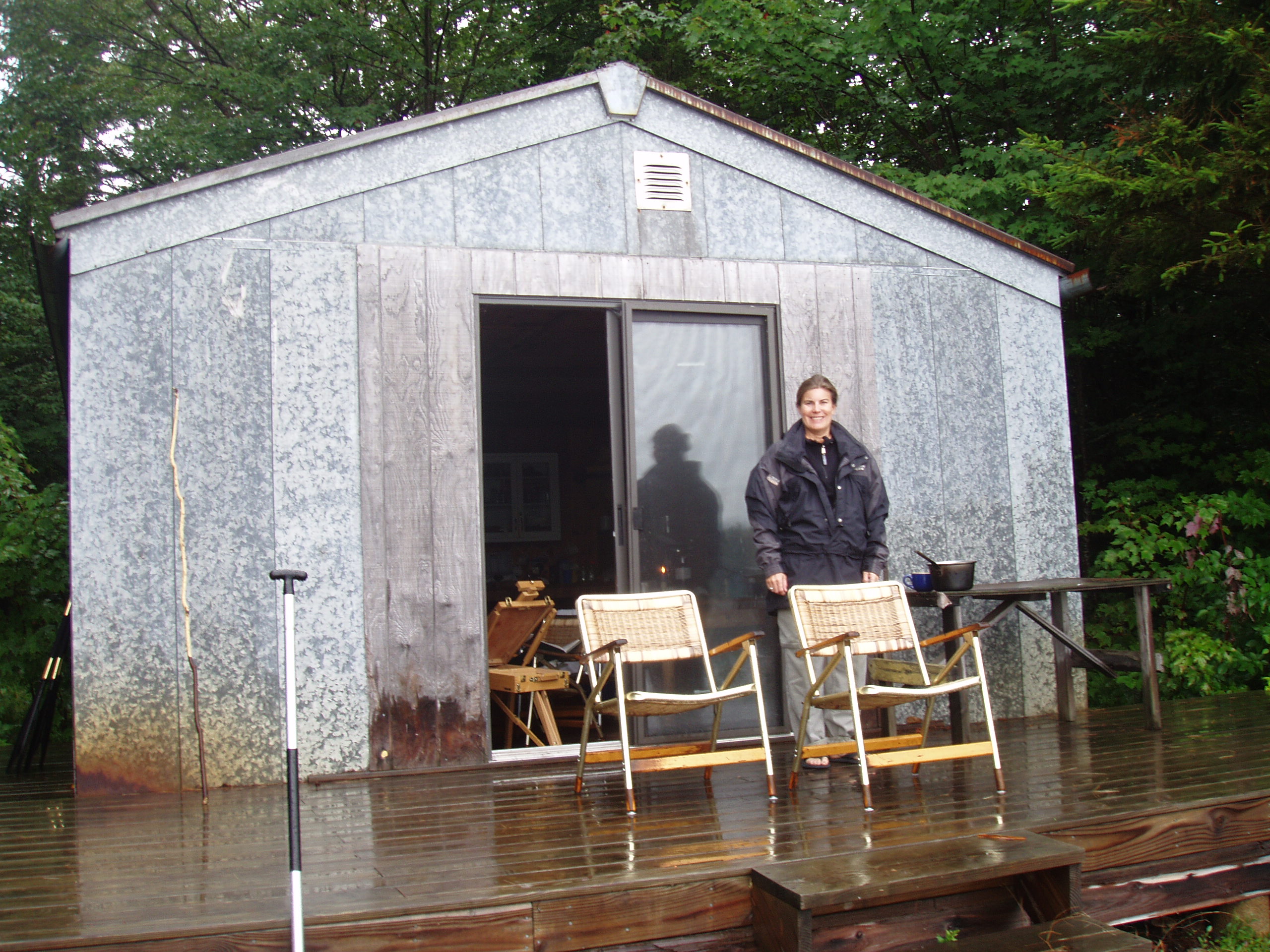
KATIE IN FRONT OF OUR QUONSET HUT

KATIE IN FRONT OF OUR QUONSET HUT

Late last August I went to the Brandreth family tract in the Adirondack Mountains of New York.  The same Brandreth as Paullina Brandreth, an early twentieth century hunting and fishing writer who wrote under the pseudonym of Paul Brandreth.  I had read her book, Trails of Enchantment, and couldn’t believe my luck when Kevin, a friend and landscape painter, invited me to spend a week there in a Quonset hut type cabin  on Thayer Lake, one of several ponds on the property.  The Nature Conservancy had recently purchased the 15,000 acre  property and they were eager to show it off.  I was to write about and Kevin was to paint the reclaimed property that had been in the same family for over one hundred years.

As we drove on the twisting private dirt road fifteen miles into the cabin, we surprised two bears who were feeding on the blackberries that were growing on the verge between the road and the woods.  When they heard our truck, they ran as fast as they could down the road, leaped into the heavy brush, and disappeared.  All we saw were two large round bear bottoms dashing away ahead of us.  People hunt bear here. The woods, thick with alders, are perfect bear habitat and difficult to see or walk through. In fact, you can’t see more than a few feet into the woods on either side of the road.

We stopped at a couple of ponds along the way, one whose water was so clear it was hard to believe that it was dead, a victim of acid rain.  Acid rain works like bleach does on fabric.  It irradiates everything: all color, design, and life. But just as the fabric looks spotless, so does the water.  Spotless and lifeless.

We passed Shingle Shanty Pond where Paullina Brandreth had had a lean-to they used for

SHINGLE SHANTY POND

SHINGLE SHANTY POND

hunting expeditions.  When you own, hunt, and fish on over 24,000 acres its nice to have shelter here and there.  I planned on kayaking its 100 acres, searching around the perimeter in hopes of finding the remnants of her camp.  Two hours after we had begun bumping and winding  up and down over the hilly woods, we arrived at Thayer Lake and our Quonset cabin.  We had expected a dilapidated, primitive structure filled with mice and spiders.  To our delight we would be living, sleeping, and cooking in a steel twenty by fifteen foot building with a pine table and matching chairs, aluminum cots with thin mattresses, two folding deck chairs, and a deck overlooking the one mile long lake.  We also had a clean, new privy 25 yards away and a barbecue pit style fireplace just off the deck, feet from the water. We had arrived in paradise.

As if it had been choreographed by a Wild Kingdom producer, two loons, a male and female, swan up to within 30 yards of our place.  As they swam they called their tremolo, “hahahahahaha” back and forth to one another and to us, we hoped.  The pair stayed for fifteen minutes yodeling and diving, dipping their heads and watching — watching us. After unpacking the truck and making our beds, we carried the red camp canoe into the water and paddled out onto the lake.  We paddled to the middle, stopped, and just sat.  Silence.  We were in it, deep in the north woods, surrounded by 100,000 acres of wilderness.  The dirt track on which we had arrived was our only way out unless we wanted to hack our way through thousands of acres of dense brushy woods so thick with dead fall, alders, black flies and mosquitoes that we would need a machete and  several bottles of bug dope.

After paddling the shore line, we decided upon a likely location for catching some small mouth bass.  We were told the lake was full of them, and so we had visions of a dinner of  crisply grilled bass, baked potatoes, and  steamed string beans accompanied by a couple of glasses of shiraz.  Since we only had one fly rod,  I had planned on doing the paddling while Kevin, an expert fisherman, did the fishing and catching.  But after a couple of casts, Kevin insisted I try, saying it was easy and small mouth bass are  fun to catch.

I am a worm fisherwoman and proud of it.  Back home on the Gunpowder River in Maryland, I catch lots of rainbow trout and brown trout on my spinning reel baited with worms dug up on the river bank. A fly rod is baited with a fly and has a much longer line than a spinning reel and rod.  One must cast back and forth and then out, making the fly appear to the fish as if it is a real insect just waiting to be caught and eaten.  I tried it  after much cajoling, and incredibly, a bass attacked my bait.

My line went out, and my rod bent over U shaped towards the water’s surface.  I had a bass.  I actually had a bass! But as I reeled it in, Kevin announced that he’d forgotten the net so I’d “just have to tire it out” before bringing it along side the canoe.  I followed his patient directions as I broke my tension with loud high pitched “oooh’s”, imploring every other second, “What should I do now”?  Miraculously, the bass stayed on and tired.  Carefully, I hauled him up and over the gunwale and into the bottom of our canoe.

I was ecstatic. I couldn’t believe I’d done it and without a net.  I wanted to try  again.   I cast sloppily, but the bass didn’t mind; they jumped onto my bait at almost every cast.  Getting them tired and into the boat was harder.  As soon as they got close to the boat, they swam away from it as fast as they could.  I had to be ready to give them line, but not too much, or they would be able to jump up out of the water and get off of the hook.  Every one of them jumped, at least once.  And every time, I squealed like a child at an amusement park.  After I had caught six and kept four, we called it quits.  We couldn’t eat more than two a piece.

As we paddled to shore, the loons called from the other end of the lake.  This time their calls sounded primordial like a bevy of ghosts wailing loudly, plaintively.  Their “hoooo-lii” echoed ten times over the water, woods, and hills, sending shivers up our  backs and raising the hair on our arms.  .

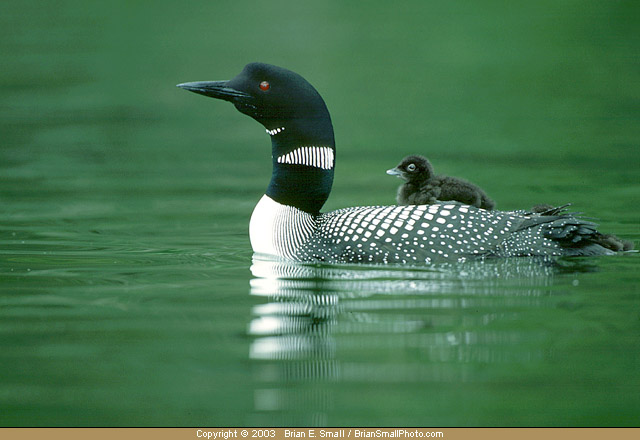
COMMON LOON WITH BABY

COMMON LOON WITH BABY

Common Loons are large birds, 32 inches long with a wing span of 46 inches.  They are described by the Audubon Society as “black-headed, with a heavy, dagger like black bill,  a white and black striped necklace, prominent white checkers on their back, and white underpants.” Their eyes are red.  They eat mostly fish, sometimes diving 240 feet  for them  and staying submerged for fifteen minutes.  Because they can stay submerged for so long, Eskimos and Native Americans thought them capable of magic.

Back at the shore in front of our cabin, we pulled the canoe out of the water and changed into fleeces and long pants.  It was chilly, about 55 degrees. I opened the shiraz as Kevin sharpened his knife.  We chatted back and forth about our day, how lucky we were to be here, such a nice cabin and no sign of mice.  We’d had bright sunshine and seventy degrees with only a slight breeze.  The water in Thayer Lake was still warm.  We could swim in it tomorrow.  The loons came floating back, looking us over quietly this time.  Kevin spread a wooden board on a flat rock and began to filet the bass.

As he cut, he explained that bass smell bad when you gut them, so he was just going to avoid that and simply filet their sides for the only meat we would eat anyway.  Why make a mess when you didn’t have to.  After cutting the filets from the first fish he stopped and looked at them closely.  “Katie, look at this.  The fish has parasites.”

I looked and sure enough hundreds of little black spots as small as the head of a straight pin dotted the meat.  “Why don’t you clean another one and see if it has any?”

Kevin did and the second one had them and so did the third and the fourth.  “I guess the whole lake is infested with them.”

I didn’t want to give up my image of wilderness camping, the image of fishing and eating our catch. “Maybe they’ll be alright if we cook them.  The parasites will die won’t they?”

“Katie we’re not eating these fish.” And we didn’t.  It’s funny how black spots in fish can change everything.

We thought we were in a pristine environment, fishing in immaculate water. Water we could

BLACK SPOT PARASITES ON FISH PERFECTLY NATURAL

BLACK SPOT PARASITES ON FISH PERFECTLY NATURAL

drink, water cleaner than we’d ever seen.  But now that notion was dashed.  Our small mouth bass had little black spots all through them.  We imagined the worst and blamed man, acid rain, and pollution. We made grilled chicken instead and sipped our wine wondering how this lake in the middle of no where could have  become contaminated with parasites.

Ironically, we were all wrong.  Humans didn’t cause the parasites. After our trip, we found out from a local Adirondack fisherman and the Michigan Department of Natural Resource’s web site that Black Spot is not man made.  Black spot is a  naturally occurring parasite that is commonly found in earthen bottomed lakes and ponds.  It has nothing to do with pollution. The parasites only infest fish with certain diets, not humans swimming in their waters. Even when a fish is heavily infested, he is no danger of dying or becoming sick.  These parasites are not harmful to humans and die when the fish is cooked.  So we could have eaten the fish, even though they looked pretty unappetizing with all those hundreds of tiny black parasites imbedded in their flesh.

Has our postmodern culture  conditioned us to believe that we are the cause of everything that seems harmful because we see the havoc we have caused in more populated places?  Well, we’re not always the cause of harm, and parasites are a natural  part of the natural world.

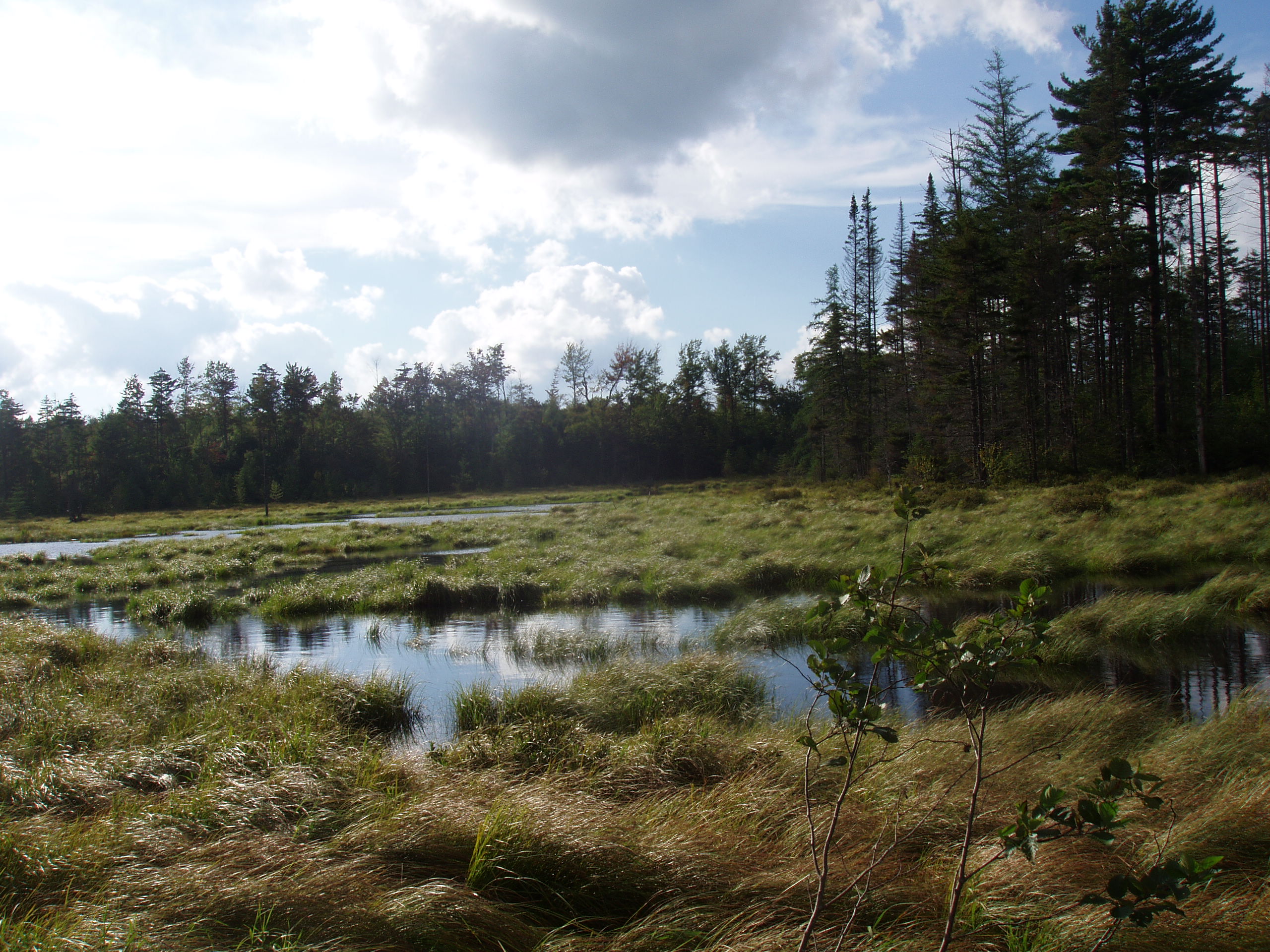
BRANDRETH PROPERTY

BRANDRETH PROPERTY

If being in the wilderness for a few days taught us anything about our place in the natural world, it taught us that we are a part of the whole.  We’re not the center or the biggest part or the most important part.  We’re just a part.  We don’t affect everything.  In the wilderness, we affect very little unless we bring along dynamite and heavy equipment.  Without any props, we fit right in — we aren’t too loud or too rough.  We eat and sleep and make love like everything else in the woods.  And that is what we’d come for after all– to fit in and to be a part of the wild with or without parasites.

Adventure Calls

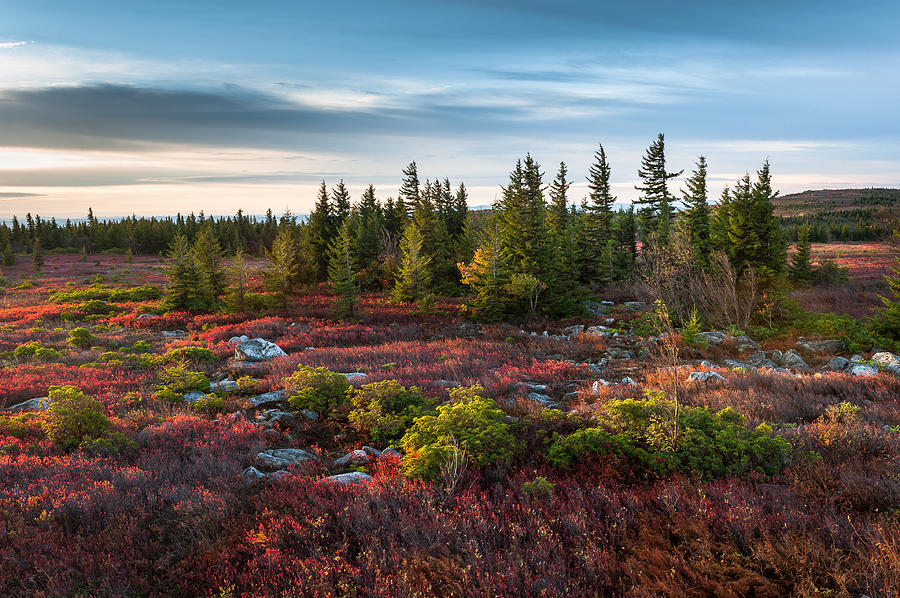
dolly-sods-wilderness-area-west-virginia-mark-vandyke

Dolly Sods West Virginia


Adventure Calls

After I’ve been cooped up in my office for too long, I yearn for an adventure that doesn’t involve hosiery or cell phones.  I long for the rush of a wilderness adventure with all its real and imagined dangers.  One where I’m camping along the Yukon River in Alaska one hundred miles from anywhere, watching grizzly bears come down to scoop up twenty-five pound salmon with their paws.  Or one where I’m backpacking in the Appalachian Mountains and a black bear sniffs around my tent.  But I don’t want too much danger.  Not like the adventure two mountain bikers had in California when they encountered a mountain lion while mountain biking.

They were riding along a narrow brushy mountain trail, talking about life and the scenery when suddenly a mountain lion leaped out and swatted one of the women off of her bike.  The mountain lion chomped down on her head, dragging her into the brush as her friend grabbed hold of her legs and pulled, screaming at the predator.   Luckily another biker came along and heard the screams.  He ran into the brush, picked up his bike, and threw it at the mountain lion all the while yelling as loudly as he could.  It worked. The lion slunk away and the injured woman was flown to shock trauma.  Later that same day rangers found the remains of another man also taken by a mountain lion, perhaps the same one.  The fellow who saved the day told the National Public Radio correspondent that he’d never go mountain biking alone or in that part of the mountains again.  I wouldn’t either; that’s too much adventure for me.

I think we forget that there is danger in the wilderness, in the woods and in the mountains of this country.  We’ve developed so much of it into cities, towns, farms, and suburbs that we forget another world is out there. And it’s not tame.  I’ve been reading Annie Dillard’s, Living Like Weasels.  She tells a story about a naturalist whom a weasel bites on the hand:   “The man could in no way pry the tiny weasel off, and he had to walk half a mile to water, the weasel dangling from his palm, and soak him off like a stubborn label.”   What a terrifying picture I had in my head after reading that.  Or the story I read in Adirondack Life magazine about a group of college students who tried to ascend 46 Adirondack high peaks (over 4000 feet) during a nineteen day Christmas vacation.   They didn’t make it.  One of them fell on a steep slop and luckily only sprained an ankle.  Still it took all day to get him out with the others carrying his equipment through snow so deep they “found themselves walking on the tops of small trees.”  People die in the Adirondack Mountains in the winter.

I don’t want a wilderness adventure that intense.  I don’t want to be traumatized or injured.  I don’t want to come out damaged, psychically or physically.  I want a wilderness adventure that will reconnect me with nature, one where I will be astonished and amazed, exhilarated and perhaps a little bit frightened.  I want a wilderness adventure like the one I had backpacking in the Dolly Sods Wilderness Area.

It is Memorial Day weekend and my husband, our dog, Jo, and I go backpacking every Memorial weekend in Dolly Sods.  Dolly Sods, West Virginia is a special place because it looks exactly like the northern Canadian tundra although it is only five hours away from Baltimore, Maryland. Timbering and fire changed the entire ecology of the mountain’s ridge in the 1800’s.  Before that happened, Dolly Sods was covered with seven to nine feet of humus and a red spruce and hemlock forest where, according to the Dolly Sods web site, “the average tree was four feet in diameter.”  After the forest fires and timbering, the rich land became a thin rocky soiled moor covered with bogs, streams, and dwarfed, bent evergreens about six feet high and 100 years old.  In 1975 Congress designated it a wilderness area. Congress didn’t need to tell us it was a wilderness.  We already know.

We love going to Dolly Sods at the end of May because anything is possible.  Sometimes it’s warm and the wild azaleas are blooming, fragrant flame orange.  Sometimes we hike across glacier-like snowfields three acres wide and two feet deep.  We have to be prepared for snow or rain or mosquitoes and 75 degrees.

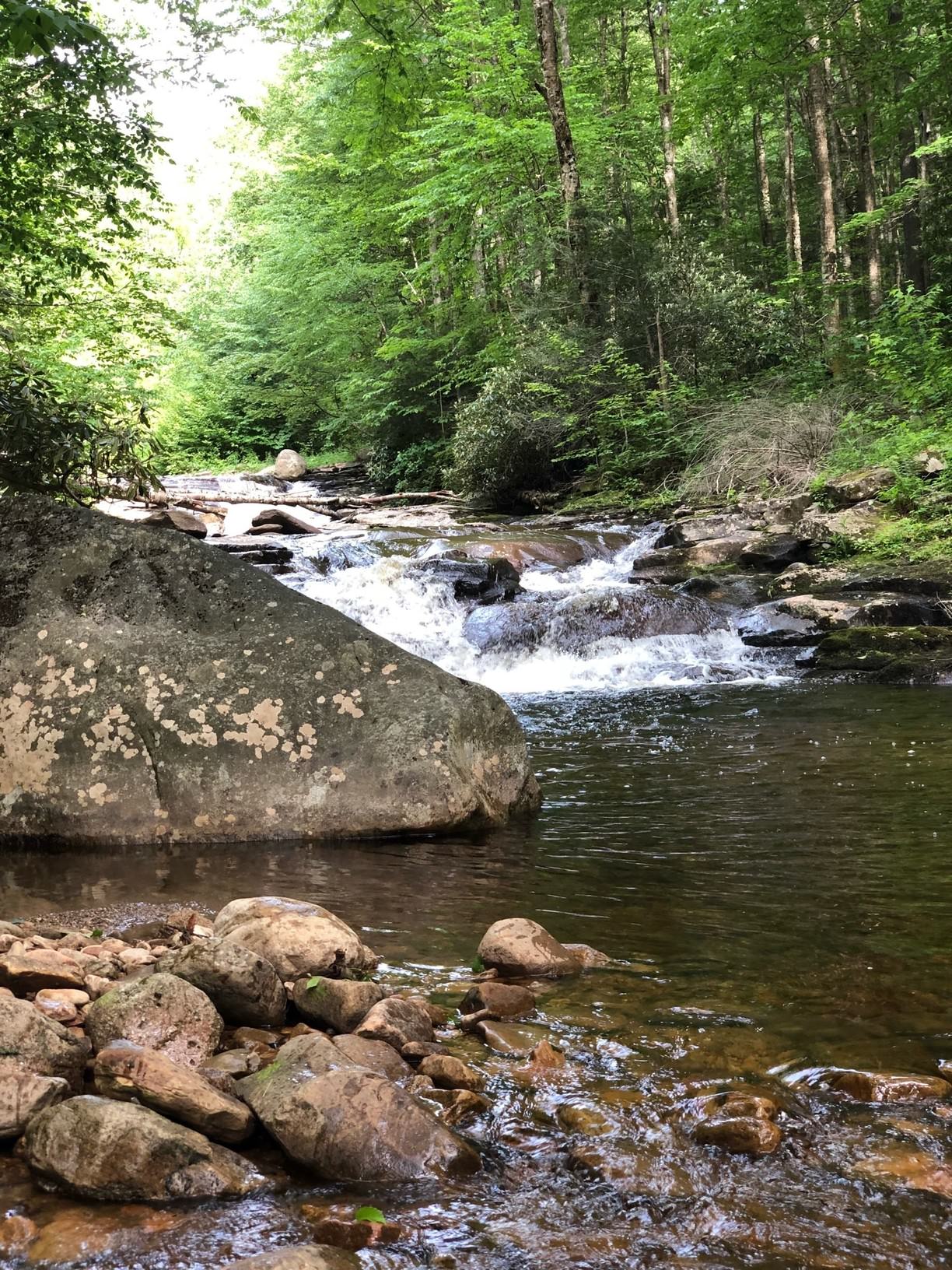
We arrive mid afternoon and hike down the Blackbird Knob Trail a couple of miles to Red Creek.  Red Creek is about twelve feet wide and in most places no more than six inches deep.  We camp by its banks, eat freeze-dried shrimp, and  homemade spaghetti and drink cabernet.    We are back in heaven.

Dolly Sods Brook Stream

Red Creek

The next day we hike five miles further along the trail through the forest and back out into open land.  I love the openness and the views especially after the cloister of the woods.  We camp again beside water, this time a small brook with steep 3 ½ foot clay banks

At about 5:00 AM I wake up.  I feel as if I’m floating, as if I’m sleeping on a waterbed.  And in a way I am.  It’s pouring, and the floor of our tent is sitting on an inch of water.  I awaken my husband.  About an hour later at first light, the rain becomes a drizzle. We gulp down some granola and water, pack up our camp and walk to the water’s edge.  The brook has risen to the top of both banks and it’s rushing, not with too much force but enough to knock us over.  We hike up stream and find a spot where the water looks calm but is four feet deep.  If we walk  across we’ll be soaked and the clothes in our packs are already damp.  We can’t afford to walk seven miles in wet clothing when the air is 50, maybe 55 degrees.  It’s  perfect hypothermia weather.

So we take off our clothes and boots and walk across naked with our packs on top of our heads like African women carrying their laundry.  The water is surprisingly warm. Jo swims across and then shakes on the opposite bank as we dry off, get back into our clothes and boots and hike on.  At the next stream, we do the same thing.  It begins to rain lightly as we got closer to Red Creek.  I am feeling quite macho, high on adrenaline, and into the whole wilderness experience.

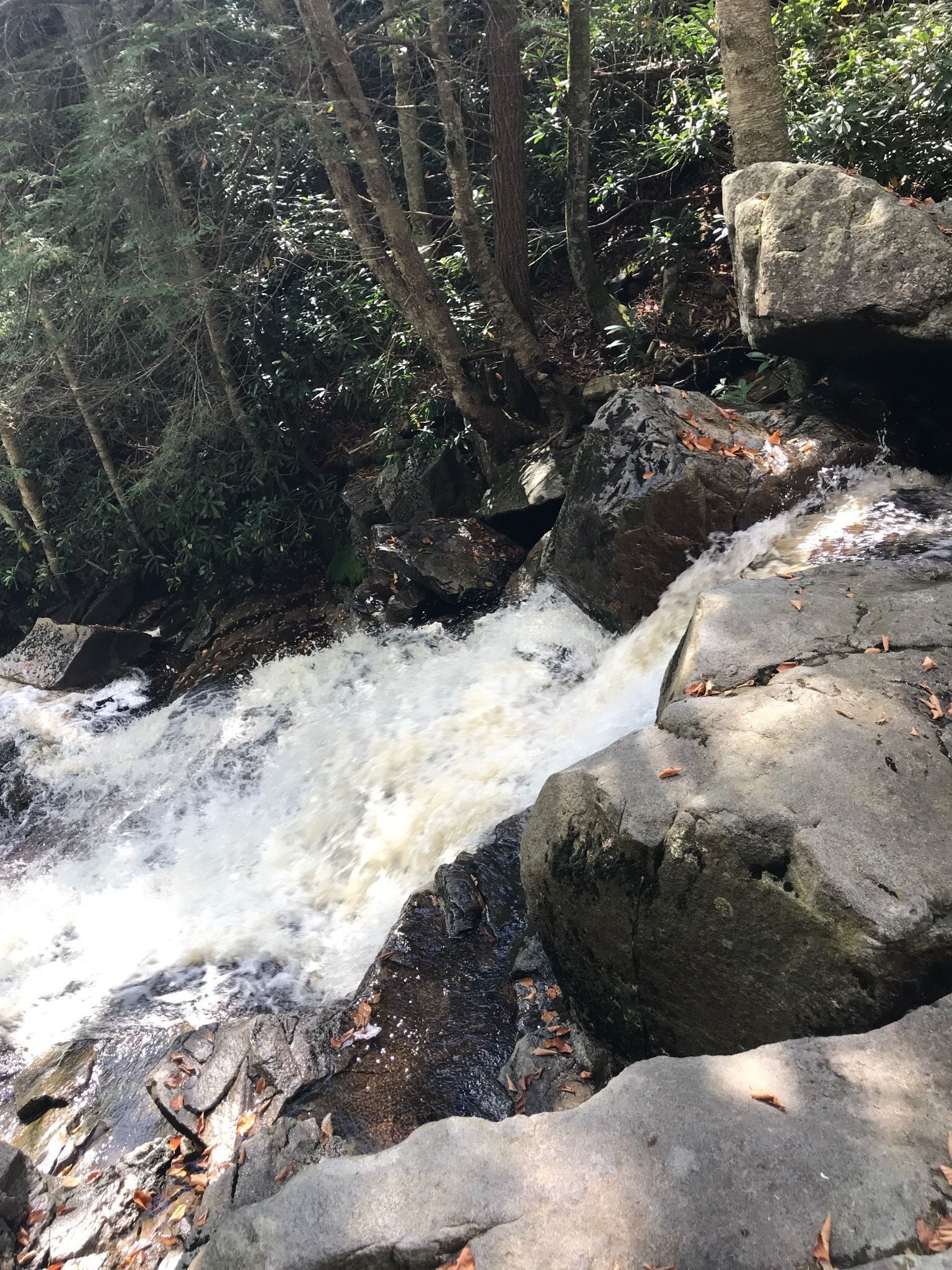
When we arrive at Red Creek, it has turned into a raging river, twice as wide, who knows how deep, large boulders sending waves of foaming water into churning whirlpools.  Three guys stand soaking wet, on the other side yelling at us.  We can’t hear them over the roar.  They yell again as we venture onto a boulder at the water’s edge.  “Don’t try to walk across.  You’ll get swept down stream.  We barely made it.”

Dolly Sods Stream

My husband wants to get across if we can.  He has power cord, a very strong thin rope only 1/8 inch in diameter and a carabiner, a steel D-shaped coupling link used in rock climbing.  He ties a rock to one end of the power cord and throws it across to the guys on the opposite bank.  They catch it on the third try.  Then they throw it back to us.  We construct a pulley, using the carbiner tied in the middle to ferry our backpacks across.  It works.

Now to ferry a person.  I go first.  This time I can’t take off my clothes, not with three guys standing there.  I’ll have to be wet the last two miles.   I keep my boots on too.  No telling what’s under the water.  I hope the guys are strong enough to pull me across fast because there is a terrifying rapid in the middle of the creek where the latte colored water churns and rises and swirls like a hungry thing.  It has slung each backpack out like a pea in a slingshot ready to shoot it down stream. I am shaking as I wade into the water and grab onto the cord.  I get to the middle. The current sucks my feet off the creek bottom, pulls them down stream and I am suddenly on my stomach, my legs strung out like the tail on a kite.  I hang on as the cord stretches and stretches. All I can see is me being swept away like a twig or a leaf bouncing from rock to rock, unable to grasp anything that can stop me. I can hear my husband yelling, “Pull. Pull.”  And they do.  Just as I think I can’t hold on, the cord relaxes and my feet feel the river bottom.  I have made it.

Jo, our dog is next.  My husband ties her up with a makeshift harness of webbing straps and clips her onto the carabiner.  He’ll go across with her, holding onto the dog with one hand so her head won’t go under and holding onto the power cord pulley with the other.  The guys begin to pull.   Jo’s head is above the water. They hit the mid-stream rapid.  The cord stretches out and out and snaps.  My husband and Jo go flying downstream bobbing and turning under water.  I scream, “Hold onto the dog.  Hold onto the dog.”  I know if he lets go she’ll be swept away and be gone.  My husband grabs onto a rock, pulls himself and Jo into shallow water and they are out of danger.  But they’re on the wrong side.   I’m shaking as we re-throw the cord and tie it back together.  We try again.  I can hardly bear to watch.  They hit the bad spot; the guys pull faster. The cord holds.  They are across.  Shivering, we hug, and laugh and kiss each other.  We’ve done it.

After we get back to the car, change, eat, and have a beer, we are feeling quite triumphant.  We’ve had an adventure, a real wilderness adventure.  It was scary and challenging and daring.  And we had made it.  We feel like pioneers who have survived a flood, modern day adventurers who’ve made the summit.  We can’t wait to tell our friends and our families.  I talk about it for weeks.

Freedom, Space, and Women Out of Doors

Freedom, Space, and Women Out of Doors

Outside I can see in a way I can’t indoors.  Outside I’m brought back to another rhythm, primordial and familiar.  Wind rustling across acres of dry corn stalks grounds and rejuvenates me. When children and work bear down too hard, I yearn for the freedom of space and the possibility of adventure.  I yearn for the freedom to breathe fresh air.  My breath moving in and out, my chest rising up and down purges the stress and clutter I’ve collected indoors.  I yearn for freedom from piles of laundry, noisy children, ringing phones, and unmade beds.  Outside those things don’t exist.  Looking out over miles of rolling hills gives me the illusion of escape.  Escape from routine, escape from the mother, writer, teacher, homemaker part of me.  I become what I think of as myself.  All the others fall away. The only voice I hear is my own and if I’m lucky, the honks of snow geese flying overhead.

Last Tuesday I walked my three-mile loop in southeast Pennsylvania. Up Hickory Road, down Kefauver Road to Cross Mill where I stop and stand by the mill stream in cold weather and sit in the cooling water when it’s hot.  It’s halfway.  Peaceful weeping willows sway on the ripples; minnows scatter when I step off of the bank.  I listen to the water’s gurgles and chuckles as it flows towards the village of Crossroads.  I walk around the restored mill, painted milky red.  The dimples in the original glass panes act as a prism reflecting mauve light. It’s nice bored teenagers didn’t break all of them years ago before this place became a tiny park.  A framed sign stating opening dates, demonstrations and times is attached to the wall beside the front door.  Cross Mill, donated by its last owner Harry E. Cross, ran continuously from 1826 until the 1980’s.   An undiscovered treasure of a place, it is on both the National and Pennsylvania Registers of Historic Places.  And although it is one of the York County Parks, it is lovingly operated and meticulously tended by a local volunteer group called, Friends of Cross Mill.

I walk on — up the steep hill to Pheasant Hill Farm where they breed pheasants and quail for hunting.  The two hundred acre farm rolls out along a wide ridge and down to shrubby hollows thick with deer.  People come here to hunt and shoot these birds, bred solely for this purpose.  One wonders the sport of releasing birds born in captivity, hand fed, and then let go in the nearby fields of dry Amaranth only to be chased by dogs and shot.  The hunters do wait a bit after the birds are released. Then they use dogs to flush the disoriented birds into the air so they can be shot in flight.

Paullina Brandreth would be outraged.

Brandreth grew up in the late 1800’s where she spent much time on her family’s 24,000 acres in the Adirondack Mountains.  There she hunted pheasants, bear, and deer. From the age of nine she wrote hunting and fishing articles under the alias, Paul Brandreth and as an adult in the early twentieth century, she waged an editorial campaign for still-hunting when it wasn’t popular.  Still-hunters stalk their prey alone, waiting motionless in places where deer, or birds travel or rest.  They do not shoot their prey until they have a clear kill shot.  Brandreth decried hunting deer with dogs, or driving deer with groups of men toward the gunners.  She was successful.  Today still-hunting is the most popular way to hunt deer in many states.  However, on private hunting camps and farms where the animals are bred, the rules do not apply.  I wonder how much it costs to kill a semi-tame pheasant.

As I walk by the farm I hear the pop of a gun close by.  I marvel that people can march around fields and woods with rifles and shotguns slung over their shoulders or across their torsos posed to shoot if anything suddenly appears.  Bullets from a rifle can travel up to one mile. Shot from the shotguns these pheasant hunters are carrying can travel more than one hundred yards, and I’m only fifty yards away. The hunters look at me and keep walking, thankfully, in the opposite direction, their dogs sniffing along the ground searching with their noses for those terrified birds.  I think about freedom, the hunters’ freedom to hunt and to have an adventure.  I wonder who am I to dictate how they shoot those birds.   I’m not opposed to hunting per se, just the sort of hunting that resembles a trap shoot.

I don’t always walk on the road; many times I walk in the woods or in the fields.  My decision is often based on whether it is hunting season or not.  I don’t like getting shot at. Hunting season begins here in November and ends in early March.  Then I waken to gun shots most Saturday mornings.  I resent the inability to walk up through the woods behind my house and down the other side to the stream during those months. When hunters are about, I may be mistaken for a deer.

And since I’m a woman, my sense of freedom has to do also with my ability to feel secure from harm by men.  In the city or suburbs I’m aware of those around me, those that might do me harm.  In the city I may become their prey.  At least in the country when it’s not hunting season and I’m bushwhacking in the woods or across fields this is not a concern.  The possibility, the reality of freedom exists there. And that nagging awareness of possible danger, which all women experience whenever they’re outside, vanishes.  I’m free and completely safe.  I’ve spent entire afternoons lying, relaxed and unafraid, on an ensolite pad in the middle of the woods reading a book and snoozing.   I’ve always felt safer off the trail in the woods than anywhere else outside.

I suppose Gretel Ehrlich, who wrote The Solace of Open Spaces, felt safe from men, at any rate, when she was a shepherd in Wyoming. Being thirty miles away in any direction from another human being would provide that security at least.  But then she had other concerns.  No phone, no contact with anyone for two weeks at a time.  That is a sort of freedom and a sort of confinement. Freedom to roam wide open spaces, setting one’s own pace and thinking what one will and the confinement of being isolated and unable to leave. Ehrlich loved the wide openness of Wyoming writing, “Space has a spiritual equivalent and can heal what is divided and burdensome in us.”  Yet she felt the duality of such freedom: “There’s too much of everything here. I can’t pace myself to it.”   She spent her days outside looking over one hundred mile views and hoping she’d find the next water hole for her thousand sheep and the small trailer filled with food and water for herself.  She was afraid she wouldn’t find them.  But she or the sheep always did.

Space represents freedom and adventure, but also danger and its sister fear.  When we’re outside there’s no shelter from predators imagined or real.  Alone outside we recognize our vulnerability, but we also recognize our willingness, our trenchant desire to be where the action is.  We want to attend the show, see what’s going to happen next. We know we’re vulnerable to the physical elements of weather, people and animals.   But we also know we’ll be present to hear wind playing music on 100 acres of dried corn stalks, to see trout lilies’ and spring beauties’ first blooms, to break ice thin as sheets of rice paper edging a stream with our boot. That is what draws me — this yin and yang of my recognized vulnerability and my willingness to be vulnerable at the same time.  It’s a trade off.  If I want to be outside then I have to take some chances.  Will I be cold, hot? Will I chance upon a fox trotting by pretending he doesn’t see me?  Will I see a hawk snagging a rodent, or will there be men with guns? We go outside to be surprised.

Last week I decided to take a different route when I came to Pheasant Hill      Farm.  I walked up Rock Jim Road to a place where I couldn’t be seen from the farmhouse, barns, and pen.  Then I struck out across their fields, aiming for the woods and stream behind my house – a short cut of sorts. I was trespassing, but I didn’t care.  I wanted something new, something daring. I got down to the stream and realized that finding a place to cross wasn’t going to be easy.  The water was deep and rushing after rain the previous day.  I walked up and down the bank thinking how foolish I was not to have considered this possibility.  My feet were going to get wet; the water everywhere was over a foot deep.  I found an old log light enough to push into a shallow section of the stream.  It only went half way.  I crossed on the log, stepped off and sloshed across.  Suddenly as I stepped onto the bank, a gunshot pop popped up the steep hill to my left.   How foolish of me – all for a change and a thrill.  I walked quickly to the right staying low along the stream bank aiming for the open fields adjacent to the woods.  That field I knew was posted and safe, even though it took me completely off course and made my original short cut a long cut. As I squished in my boots up through the breaks in the dry corn I felt exhilarated.  I had had an adventure of sorts, albeit a very small one.  I reached McCleary Road; home was around the corner.  The neighbor with the green Ford truck waved as he drove by.  I was back in civilization, feeling as though I’d just come back from a stint in the wilderness.