
ADIRONDACK MOUNTAIN STREAM
Amelia M. Murray, the maid of honor to Queen Victoria, camped in the Adirondack Mountains in 1855 with the Governor of New York, Horatio Seymour, his niece, and three guides. While on
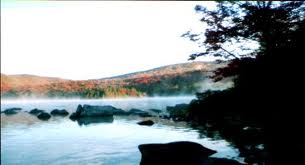
Adirondack Autumn Landscape Where Amelia Murray Hiked
her five-day trip, she learned how to sleep on a hemlock bed, to bathe in Saranac Lake, and to hike sixteen miles in one day through a dense forest filled with “gigantic timber felled by storms…deep bogs and slippery rocks.” She did all this while wearing a corset, which greatly restricted her breathing capacity, and very unsensible shoes.
Although she was a refined English lady, she carried her fair share — “a basket and a bundle.” Throughout her diary account of the trip, she makes light of the dirt, rain, thunder, damp bedding and clothes. She brags about her “London portable soup” which she had brought from England a year earlier and claimed was still in “good preservation” although one should “add lemons and a good store of sugar, brown and white” before eating it. Amazing. Her account is enthusiastic, joyous, and chatty.
She was a woman of privilege, an English lady. Yet she was able to escape “polite society” long enough to have an adventure out of doors in the company of the genteel (the Governor) and not so genteel (the guides). Although she writes after the trip that it took her “three days at Utica …to recruit and repose” herself, she had had a fine time and welcomed the chance to do it all again.
What is this need, this trenchant desire we have to be in the “wilderness”, to connect with the natural world? Why would an elegant and refined lady of the 1800s who had probably never ventured much further than a stroll down an English country lane seek the untamed woods of New York State? She sought adventure, yes, but more than that, I think. She sought to discover a part of her that had not been tested, had lain dormant. She wanted to test her fearlessness, her courage, her adaptability. Normally, tests of fearlessness and courage are associated with men as men’s goals. Men are supposed to like adventuring; they want to be tested in nature. Isn’t that what the armed forces ads used to say, “Come see the world. Come adventuring with us.”? But women need to be tested too. Even girls of thirteen seek adventure.
Last Sunday, my daughter Campbell announced she wanted to go fishing with me down by Cross Mill in Cross Mill stream about one and half miles away. I thought she was kidding. Even

Campbell, age 12, my outdoor girl.
though it was sunny and warm for February, 55 degrees, there were still patches of snow about, and I knew the water would be icy cold. She persisted. After packing an old red school backpack with a water bottle, water shoes, a towel, and a fishing rod, she pronounced herself ready to ride her bike down to the stream. I couldn’t convince her to walk, arguing unsuccessfully that the roads are narrow and winding and in some places cars fly by at forty miles an hour. Ultimately, I agreed to her riding the bike as long as she stayed with me. I wanted to walk. We spent three hours walking and riding to and from the stream and playing in the water. We waded in the frigid creek, our feet aching and numb. We skipped rocks, looked for crayfish. I snoozed in the sun on the brown picnic tabletop in between commenting to Campbell about her solo rock skipping contest. On the way home, we spotted a male pheasant a few feet away, scurrying through the bushes by the side of the road.
Why had Campbell wanted to go? Did my daughter latch onto the idea of riding off with fishing rod, towel and water bottle because she needed to get away, needed to be out of doors? Or did she want to go adventuring in order to test her mettle by riding her bike to a place she hadn’t fished before and wading in frigid February water? I doubt she could answer these questions or would even want to. She’s thirteen. She just wanted to go.
She just wanted to go like Opal Whiteley, a writer who grew up in Oregon in the early 1900’s.
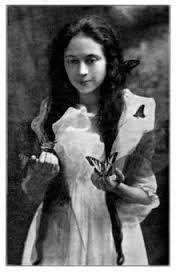
Opel Whiteley, Nature Writer
Whiteley wrote in her diary at about age seven, “I like to go in among the rushes where the blackbird s with red upon their wings do go. I like to touch fingertips with the rushes. I like to listen to the voices that whisper in the swamp. I do so like to feel the mud ooze up between my toes.” Campbell could identify with that. This desire to connect with nature and to seek sensory experiences in it is common to most of us. My daughter and Opal Whiteley aren’t the only young girls who’ve found adventure and joy in nature.
Hannah Hinchman, a contemporary writer and visual artist, created an enchanted world in the woods near her home when she was a teen. She spent whole days attired in a wood nymph dress dancing among tall oaks and pines, performing rituals she had “learned “ from the woodland fairies. She “wanted these adventures to form an unassailable world, composed only
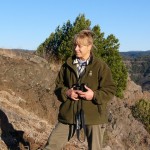
Hannah Hinchman, out door writer and artist.
of pure things.” As she grew older she abandoned her woodland fairies and her fantastical view of nature, yet nature continues to be her solace. “If I were about to pull the trigger and happened to hear a red-winged blackbird, I doubt that I could complete the act.”
Sometimes this desire to connect to nature becomes a pathological need, a self-medication for mental or physical illness or ordinary loneliness. When I was enduring and battling a brutal divorce, I used to run long and often on the Panther Branch trail in Maryland. The two mile trail curves through the woods around house-sized boulders, decaying deadfall, and foot high maiden hair ferns edging the stream and winding up to the top of a hill. I used my runs there as therapy, going over and over all the terrible lies and injustices. I recounted the same sad incidents and betrayals in my head; the dialogue never changed. “He said this; can you believe it? And then he did that on top of everything else. Doesn’t he even care about his children?”
As I ran, I ran, literally and figuratively, through this dialogue every time. I spoke sentences, paragraphs in my mind as if I were speaking to a therapist or friend. As I hit the chest high boulder with the red columbine I would begin my diatribe. I couldn’t stop it; it rolled on and on of its own free will. After the divorce was final, I still began this ugly conversation whenever I got to the red columbine boulder. I did it unintentionally, unconsciously, until I consciously put an end to it.
Sadly, after I’d resolved my divorce and the ugly voices, I no longer wanted to go to the place. The Panther Branch trail, which had been my solace, my comfort, my dumping ground became my nemesis, a reminder of bitterness, hurt and anger. I felt as if I’d deposited every vengeful thought and desire in its rocks and branches and they were all there waiting for me. I didn’t go back for years and then only occasionally.
For me, the Panther Branch became a place that was lovely on the surface but underneath was seething with unpleasantness.
Why do we attach meaning to place? Does it make it more real, make it more our own? I heard a psychologist say that artists are often depressed because they try to find meaning in every single thing, and when they can’t find it, they become despondent. Most of us don’t go that far, yet most of us do attribute some meaning to place.
Places are the tangible stage sets for our happiest and saddest moments, celebrations, rituals and events. Hospital bedsides, altars, and babies’ rooms are the backdrops for life’s most poignant moments. Some cultures construct places to house these significant events – churches, burial mounds and grounds, concert halls, and court rooms. Others, like Native Americans, believe some natural outside places hold deep significance; these places contain spirits or powers that other places do not. They are hallowed or evil, full of the universe’s energy or places of death.
Place enriches or diminishes what happens within it. Sipping tea in front of a roaring fire is not the same as drinking tea at the local Seven Eleven store. Place can change our mood, alter our interactions with one another in positive or negative ways. Having a conversation in a basketball court or in a room full of whining children is not the same as having a conversation beside a woodland stream or in a quiet, candle lit room. “Place subtends and enfolds us, lying perpetually under and around us. Place…is the bedrock of our being-in-the-world,” writes Edward S. Casey, author of Getting Back Into Place.
I just came back from spending two days in New York City. I love New York. I love its
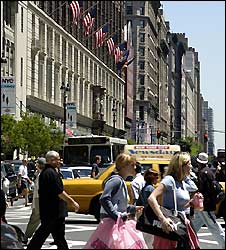
Manhattan Street Scene
overabundance. It’s so full of everything human, overflowing with everything people make. Art, buildings, fashion, food, noise, dirt. People are everywhere. On foot, in cars, on bicycles — talking, driving, and honking. Walking around the city is like walking a human obstacle course; you are blasted with people, color, and noise — snippets of intimate conversations, a man on a space age motorized walker rolling along the sidewalk, pigeons under foot, shop window after shop window stuffed with every conceivable and inconceivable object. Food markets, their cases over laden with hundreds of cheeses, ten types of proscuitto, twenty pates, truffles, black or white, sauced or canned, marinated or plain. The stimulation becomes overwhelming; the noise eventually becomes too noisy and then it’s time to go home.
After 48 hours of being high on the over-stimulation, I crashed and felt like Amelia M. Murray. I needed three days at home in the woods in rural Pennsylvania “to recruit” myself. Just like Murray, I wanted an adventure, a taste of the unfamiliar. And when it was over, I wanted to repose — in my own place.
 Seeking The Wild