hiking

Snippets — Renewing in the ADK

Two Hornbeck's on the shore of Lake Champlain

Two Hornbeck’s on the shore of Lake Champlain

I usually write essays, drafted and tinkered with over many weeks — sentences and words agonized over and then agonized over once again.

Now after 5 weeks in the ADK, I want to write only snippets. Too much has happened in these past weeks.  I could write a bulleted report of my doings but that would not only be boring but would only scratch the surface of my experience, would leave out the most important part — how I came to be more of who I am, not restored after the terror of the past three plus years, but  renewed.

Over these weeks, I have discovered through moving my body and mind and soul through experiences as diverse as restorative yoga, paddling rivers, hiking mountains, grading students’ essays, chatting with friends, attending concerts and theater, shopping, eating, and visiting with family and friends that I am different from when I left Stewartstown, PA.  I am my old self and my new self.  The anxiety, pain, and fear that was my daily and hourly experience has vanished, and I am in a foreign land, one in which I want to stay, permanently. If I had to sum up my new place, it would be with one word — perspective.  My perspective has shifted, shifted to a place that I plan on staying for quite awhile. It feels so  good to be here, seeing and feeling from this place that current or future conditions can’t shake so ferociously.


Black Spots

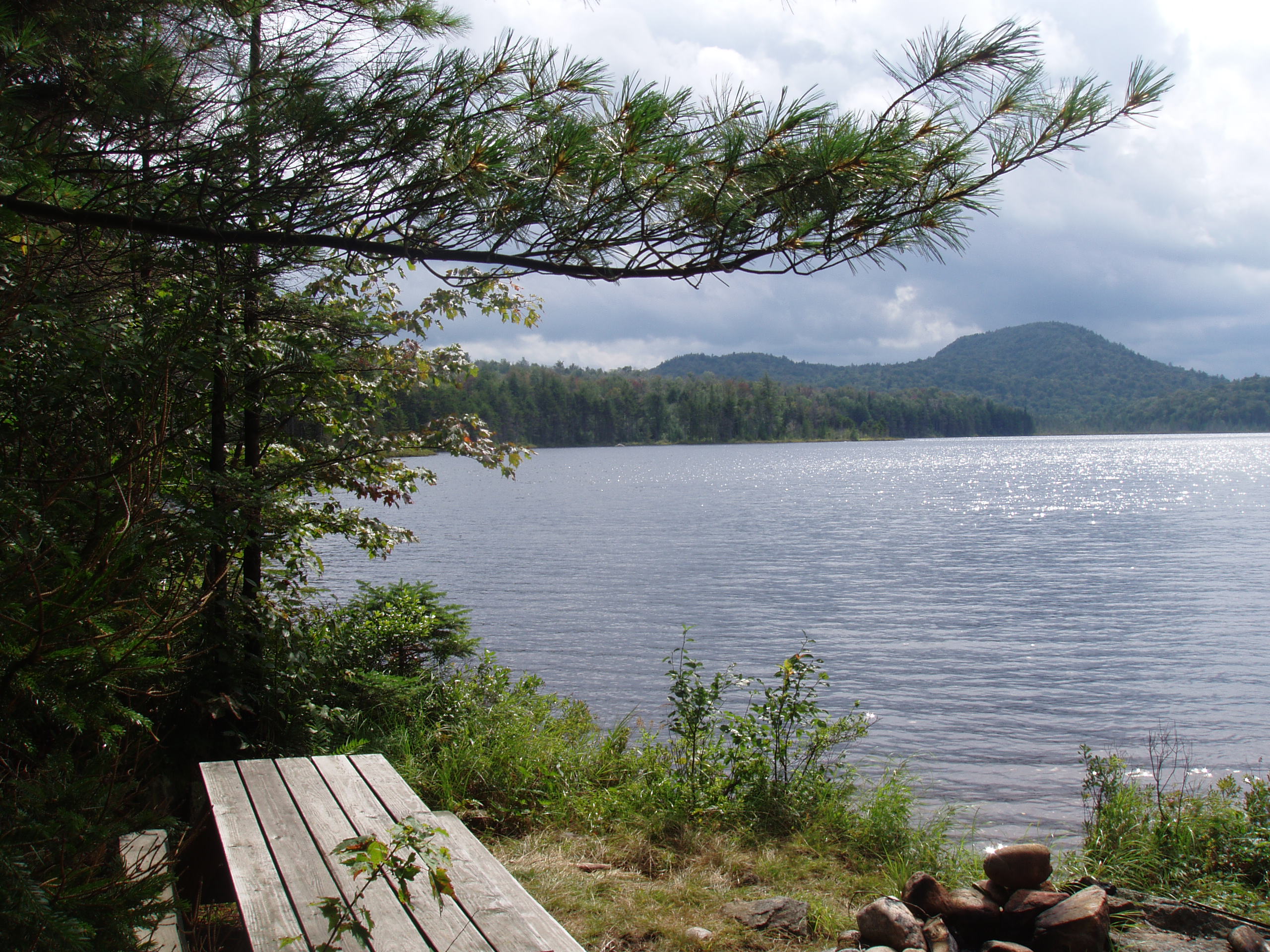
THAYER LAKE, THE BRANDRETH PROPERTY

THAYER LAKE, THE BRANDRETH PROPERTY

PREFACE — My essay, Black Spots, tells the story of my adventure at a 15,000 acre camp in the Adirondack Mountains in New York.  My partner, Kevin and I, camped, paddled, and fished in the middle of the wilderness for a couple of days with permission of the Nature Conservancy who had just purchased a portion of this family’s original tract.

                                                           BLACK  SPOTS
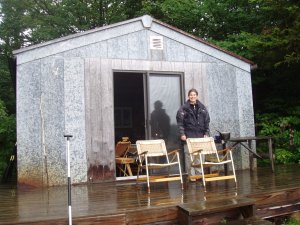
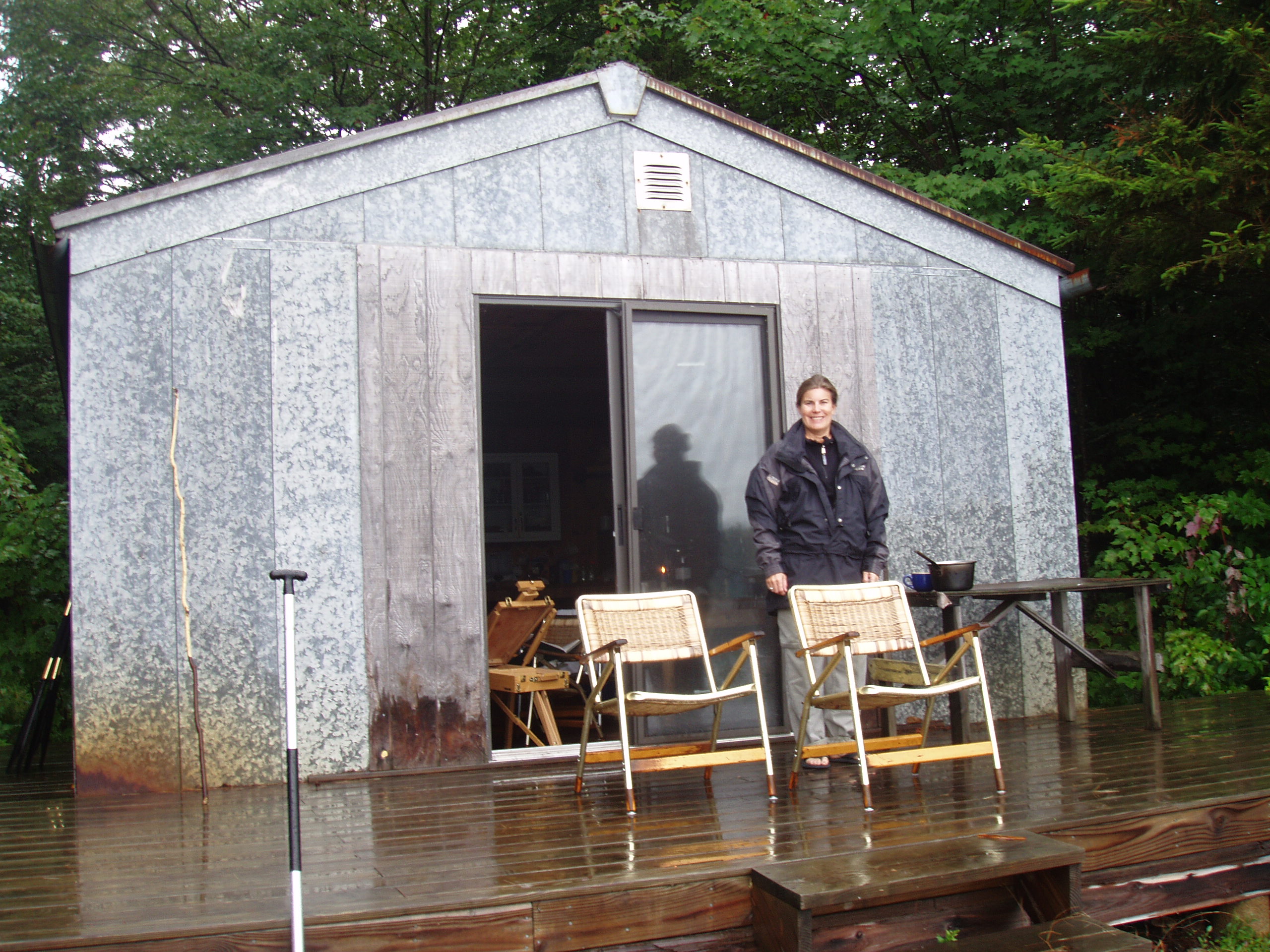
KATIE IN FRONT OF OUR QUONSET HUT

KATIE IN FRONT OF OUR QUONSET HUT

Late last August I went to the Brandreth family tract in the Adirondack Mountains of New York.  The same Brandreth as Paullina Brandreth, an early twentieth century hunting and fishing writer who wrote under the pseudonym of Paul Brandreth.  I had read her book, Trails of Enchantment, and couldn’t believe my luck when Kevin, a friend and landscape painter, invited me to spend a week there in a Quonset hut type cabin  on Thayer Lake, one of several ponds on the property.  The Nature Conservancy had recently purchased the 15,000 acre  property and they were eager to show it off.  I was to write about and Kevin was to paint the reclaimed property that had been in the same family for over one hundred years.

As we drove on the twisting private dirt road fifteen miles into the cabin, we surprised two bears who were feeding on the blackberries that were growing on the verge between the road and the woods.  When they heard our truck, they ran as fast as they could down the road, leaped into the heavy brush, and disappeared.  All we saw were two large round bear bottoms dashing away ahead of us.  People hunt bear here. The woods, thick with alders, are perfect bear habitat and difficult to see or walk through. In fact, you can’t see more than a few feet into the woods on either side of the road.

We stopped at a couple of ponds along the way, one whose water was so clear it was hard to believe that it was dead, a victim of acid rain.  Acid rain works like bleach does on fabric.  It irradiates everything: all color, design, and life. But just as the fabric looks spotless, so does the water.  Spotless and lifeless.

We passed Shingle Shanty Pond where Paullina Brandreth had had a lean-to they used for
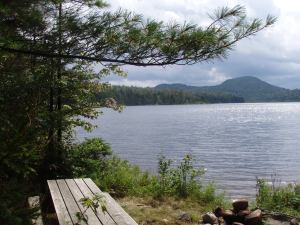
SHINGLE SHANTY POND

SHINGLE SHANTY POND

hunting expeditions.  When you own, hunt, and fish on over 24,000 acres its nice to have shelter here and there.  I planned on kayaking its 100 acres, searching around the perimeter in hopes of finding the remnants of her camp.  Two hours after we had begun bumping and winding  up and down over the hilly woods, we arrived at Thayer Lake and our Quonset cabin.  We had expected a dilapidated, primitive structure filled with mice and spiders.  To our delight we would be living, sleeping, and cooking in a steel twenty by fifteen foot building with a pine table and matching chairs, aluminum cots with thin mattresses, two folding deck chairs, and a deck overlooking the one mile long lake.  We also had a clean, new privy 25 yards away and a barbecue pit style fireplace just off the deck, feet from the water. We had arrived in paradise.

As if it had been choreographed by a Wild Kingdom producer, two loons, a male and female, swan up to within 30 yards of our place.  As they swam they called their tremolo, “hahahahahaha” back and forth to one another and to us, we hoped.  The pair stayed for fifteen minutes yodeling and diving, dipping their heads and watching — watching us. After unpacking the truck and making our beds, we carried the red camp canoe into the water and paddled out onto the lake.  We paddled to the middle, stopped, and just sat.  Silence.  We were in it, deep in the north woods, surrounded by 100,000 acres of wilderness.  The dirt track on which we had arrived was our only way out unless we wanted to hack our way through thousands of acres of dense brushy woods so thick with dead fall, alders, black flies and mosquitoes that we would need a machete and  several bottles of bug dope.

After paddling the shore line, we decided upon a likely location for catching some small mouth bass.  We were told the lake was full of them, and so we had visions of a dinner of  crisply grilled bass, baked potatoes, and  steamed string beans accompanied by a couple of glasses of shiraz.  Since we only had one fly rod,  I had planned on doing the paddling while Kevin, an expert fisherman, did the fishing and catching.  But after a couple of casts, Kevin insisted I try, saying it was easy and small mouth bass are  fun to catch.

I am a worm fisherwoman and proud of it.  Back home on the Gunpowder River in Maryland, I catch lots of rainbow trout and brown trout on my spinning reel baited with worms dug up on the river bank. A fly rod is baited with a fly and has a much longer line than a spinning reel and rod.  One must cast back and forth and then out, making the fly appear to the fish as if it is a real insect just waiting to be caught and eaten.  I tried it  after much cajoling, and incredibly, a bass attacked my bait.

My line went out, and my rod bent over U shaped towards the water’s surface.  I had a bass.  I actually had a bass! But as I reeled it in, Kevin announced that he’d forgotten the net so I’d “just have to tire it out” before bringing it along side the canoe.  I followed his patient directions as I broke my tension with loud high pitched “oooh’s”, imploring every other second, “What should I do now”?  Miraculously, the bass stayed on and tired.  Carefully, I hauled him up and over the gunwale and into the bottom of our canoe.

I was ecstatic. I couldn’t believe I’d done it and without a net.  I wanted to try  again.   I cast sloppily, but the bass didn’t mind; they jumped onto my bait at almost every cast.  Getting them tired and into the boat was harder.  As soon as they got close to the boat, they swam away from it as fast as they could.  I had to be ready to give them line, but not too much, or they would be able to jump up out of the water and get off of the hook.  Every one of them jumped, at least once.  And every time, I squealed like a child at an amusement park.  After I had caught six and kept four, we called it quits.  We couldn’t eat more than two a piece.

As we paddled to shore, the loons called from the other end of the lake.  This time their calls sounded primordial like a bevy of ghosts wailing loudly, plaintively.  Their “hoooo-lii” echoed ten times over the water, woods, and hills, sending shivers up our  backs and raising the hair on our arms.  .
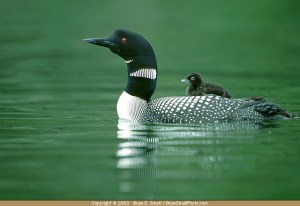
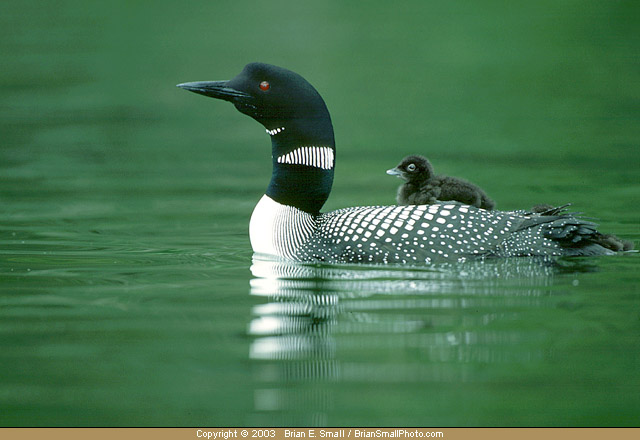
COMMON LOON WITH BABY

COMMON LOON WITH BABY

Common Loons are large birds, 32 inches long with a wing span of 46 inches.  They are described by the Audubon Society as “black-headed, with a heavy, dagger like black bill,  a white and black striped necklace, prominent white checkers on their back, and white underpants.” Their eyes are red.  They eat mostly fish, sometimes diving 240 feet  for them  and staying submerged for fifteen minutes.  Because they can stay submerged for so long, Eskimos and Native Americans thought them capable of magic.

Back at the shore in front of our cabin, we pulled the canoe out of the water and changed into fleeces and long pants.  It was chilly, about 55 degrees. I opened the shiraz as Kevin sharpened his knife.  We chatted back and forth about our day, how lucky we were to be here, such a nice cabin and no sign of mice.  We’d had bright sunshine and seventy degrees with only a slight breeze.  The water in Thayer Lake was still warm.  We could swim in it tomorrow.  The loons came floating back, looking us over quietly this time.  Kevin spread a wooden board on a flat rock and began to filet the bass.

As he cut, he explained that bass smell bad when you gut them, so he was just going to avoid that and simply filet their sides for the only meat we would eat anyway.  Why make a mess when you didn’t have to.  After cutting the filets from the first fish he stopped and looked at them closely.  “Katie, look at this.  The fish has parasites.”

I looked and sure enough hundreds of little black spots as small as the head of a straight pin dotted the meat.  “Why don’t you clean another one and see if it has any?”

Kevin did and the second one had them and so did the third and the fourth.  “I guess the whole lake is infested with them.”

I didn’t want to give up my image of wilderness camping, the image of fishing and eating our catch. “Maybe they’ll be alright if we cook them.  The parasites will die won’t they?”

“Katie we’re not eating these fish.” And we didn’t.  It’s funny how black spots in fish can change everything.

We thought we were in a pristine environment, fishing in immaculate water. Water we could
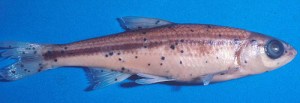
BLACK SPOT PARASITES ON FISH PERFECTLY NATURAL

BLACK SPOT PARASITES ON FISH PERFECTLY NATURAL

drink, water cleaner than we’d ever seen.  But now that notion was dashed.  Our small mouth bass had little black spots all through them.  We imagined the worst and blamed man, acid rain, and pollution. We made grilled chicken instead and sipped our wine wondering how this lake in the middle of no where could have  become contaminated with parasites.

Ironically, we were all wrong.  Humans didn’t cause the parasites. After our trip, we found out from a local Adirondack fisherman and the Michigan Department of Natural Resource’s web site that Black Spot is not man made.  Black spot is a  naturally occurring parasite that is commonly found in earthen bottomed lakes and ponds.  It has nothing to do with pollution. The parasites only infest fish with certain diets, not humans swimming in their waters. Even when a fish is heavily infested, he is no danger of dying or becoming sick.  These parasites are not harmful to humans and die when the fish is cooked.  So we could have eaten the fish, even though they looked pretty unappetizing with all those hundreds of tiny black parasites imbedded in their flesh.

Has our postmodern culture  conditioned us to believe that we are the cause of everything that seems harmful because we see the havoc we have caused in more populated places?  Well, we’re not always the cause of harm, and parasites are a natural  part of the natural world.
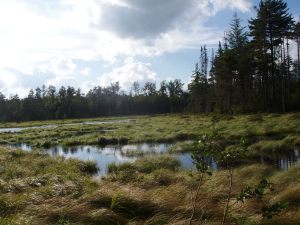
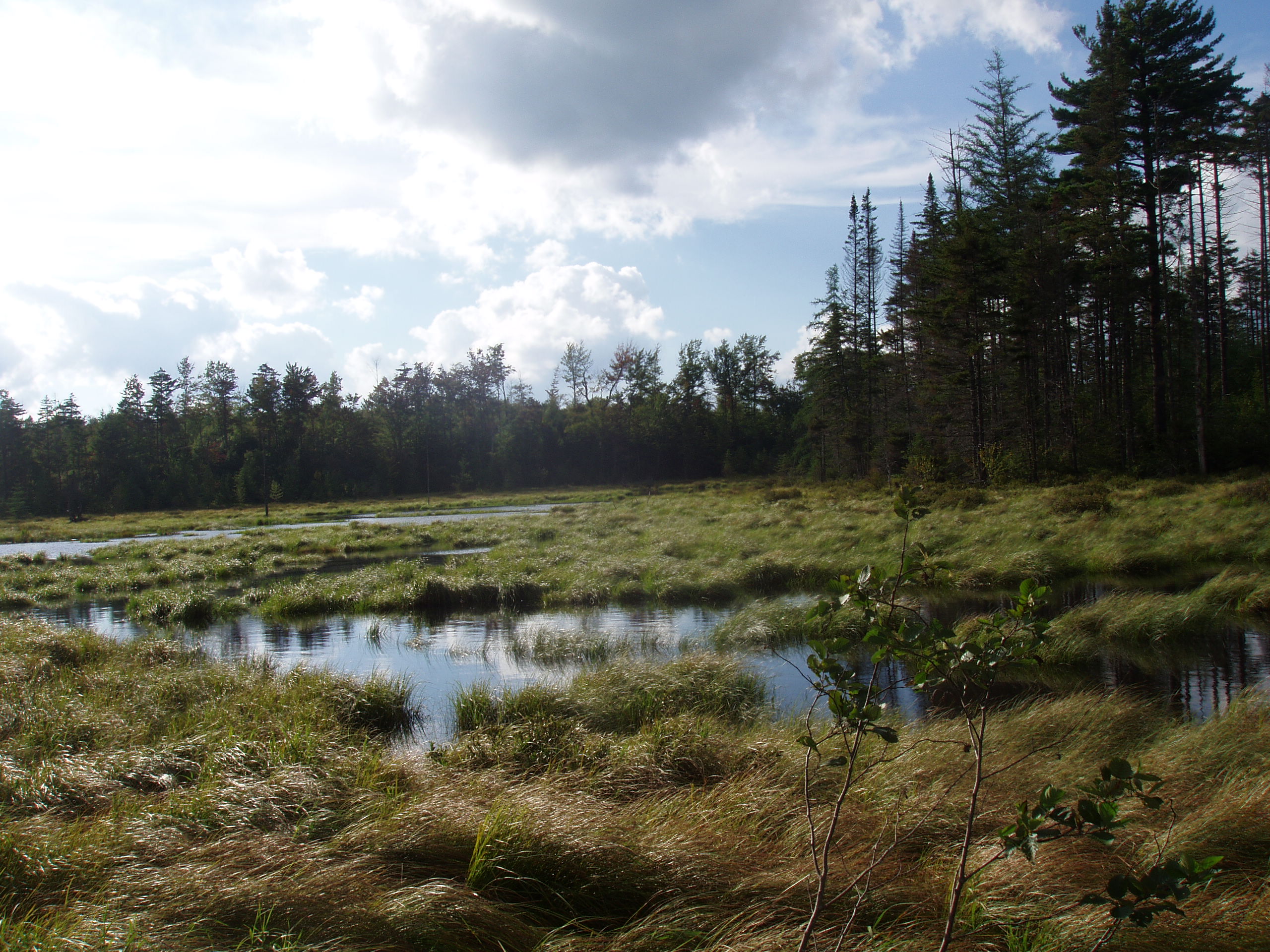
BRANDRETH PROPERTY

BRANDRETH PROPERTY

If being in the wilderness for a few days taught us anything about our place in the natural world, it taught us that we are a part of the whole.  We’re not the center or the biggest part or the most important part.  We’re just a part.  We don’t affect everything.  In the wilderness, we affect very little unless we bring along dynamite and heavy equipment.  Without any props, we fit right in — we aren’t too loud or too rough.  We eat and sleep and make love like everything else in the woods.  And that is what we’d come for after all– to fit in and to be a part of the wild with or without parasites.
Adventure Calls

dolly-sods-wilderness-area-west-virginia-mark-vandyke

Dolly Sods West Virginia


Adventure Calls

After I’ve been cooped up in my office for too long, I yearn for an adventure that doesn’t involve hosiery or cell phones.  I long for the rush of a wilderness adventure with all its real and imagined dangers.  One where I’m camping along the Yukon River in Alaska one hundred miles from anywhere, watching grizzly bears come down to scoop up twenty-five pound salmon with their paws.  Or one where I’m backpacking in the Appalachian Mountains and a black bear sniffs around my tent.  But I don’t want too much danger.  Not like the adventure two mountain bikers had in California when they encountered a mountain lion while mountain biking.

They were riding along a narrow brushy mountain trail, talking about life and the scenery when suddenly a mountain lion leaped out and swatted one of the women off of her bike.  The mountain lion chomped down on her head, dragging her into the brush as her friend grabbed hold of her legs and pulled, screaming at the predator.   Luckily another biker came along and heard the screams.  He ran into the brush, picked up his bike, and threw it at the mountain lion all the while yelling as loudly as he could.  It worked. The lion slunk away and the injured woman was flown to shock trauma.  Later that same day rangers found the remains of another man also taken by a mountain lion, perhaps the same one.  The fellow who saved the day told the National Public Radio correspondent that he’d never go mountain biking alone or in that part of the mountains again.  I wouldn’t either; that’s too much adventure for me.

I think we forget that there is danger in the wilderness, in the woods and in the mountains of this country.  We’ve developed so much of it into cities, towns, farms, and suburbs that we forget another world is out there. And it’s not tame.  I’ve been reading Annie Dillard’s, Living Like Weasels.  She tells a story about a naturalist whom a weasel bites on the hand:   “The man could in no way pry the tiny weasel off, and he had to walk half a mile to water, the weasel dangling from his palm, and soak him off like a stubborn label.”   What a terrifying picture I had in my head after reading that.  Or the story I read in Adirondack Life magazine about a group of college students who tried to ascend 46 Adirondack high peaks (over 4000 feet) during a nineteen day Christmas vacation.   They didn’t make it.  One of them fell on a steep slop and luckily only sprained an ankle.  Still it took all day to get him out with the others carrying his equipment through snow so deep they “found themselves walking on the tops of small trees.”  People die in the Adirondack Mountains in the winter.

I don’t want a wilderness adventure that intense.  I don’t want to be traumatized or injured.  I don’t want to come out damaged, psychically or physically.  I want a wilderness adventure that will reconnect me with nature, one where I will be astonished and amazed, exhilarated and perhaps a little bit frightened.  I want a wilderness adventure like the one I had backpacking in the Dolly Sods Wilderness Area.

It is Memorial Day weekend and my husband, our dog, Jo, and I go backpacking every Memorial weekend in Dolly Sods.  Dolly Sods, West Virginia is a special place because it looks exactly like the northern Canadian tundra although it is only five hours away from Baltimore, Maryland. Timbering and fire changed the entire ecology of the mountain’s ridge in the 1800’s.  Before that happened, Dolly Sods was covered with seven to nine feet of humus and a red spruce and hemlock forest where, according to the Dolly Sods web site, “the average tree was four feet in diameter.”  After the forest fires and timbering, the rich land became a thin rocky soiled moor covered with bogs, streams, and dwarfed, bent evergreens about six feet high and 100 years old.  In 1975 Congress designated it a wilderness area. Congress didn’t need to tell us it was a wilderness.  We already know.

We love going to Dolly Sods at the end of May because anything is possible.  Sometimes it’s warm and the wild azaleas are blooming, fragrant flame orange.  Sometimes we hike across glacier-like snowfields three acres wide and two feet deep.  We have to be prepared for snow or rain or mosquitoes and 75 degrees.

We arrive mid afternoon and hike down the Blackbird Knob Trail a couple of miles to Red Creek.  Red Creek is about twelve feet wide and in most places no more than six inches deep.  We camp by its banks, eat freeze-dried shrimp, and  homemade spaghetti and drink cabernet.    We are back in heaven.

Dolly Sods Brook Stream

Red Creek

The next day we hike five miles further along the trail through the forest and back out into open land.  I love the openness and the views especially after the cloister of the woods.  We camp again beside water, this time a small brook with steep 3 ½ foot clay banks

At about 5:00 AM I wake up.  I feel as if I’m floating, as if I’m sleeping on a waterbed.  And in a way I am.  It’s pouring, and the floor of our tent is sitting on an inch of water.  I awaken my husband.  About an hour later at first light, the rain becomes a drizzle. We gulp down some granola and water, pack up our camp and walk to the water’s edge.  The brook has risen to the top of both banks and it’s rushing, not with too much force but enough to knock us over.  We hike up stream and find a spot where the water looks calm but is four feet deep.  If we walk  across we’ll be soaked and the clothes in our packs are already damp.  We can’t afford to walk seven miles in wet clothing when the air is 50, maybe 55 degrees.  It’s  perfect hypothermia weather.

So we take off our clothes and boots and walk across naked with our packs on top of our heads like African women carrying their laundry.  The water is surprisingly warm. Jo swims across and then shakes on the opposite bank as we dry off, get back into our clothes and boots and hike on.  At the next stream, we do the same thing.  It begins to rain lightly as we got closer to Red Creek.  I am feeling quite macho, high on adrenaline, and into the whole wilderness experience.

When we arrive at Red Creek, it has turned into a raging river, twice as wide, who knows how deep, large boulders sending waves of foaming water into churning whirlpools.  Three guys stand soaking wet, on the other side yelling at us.  We can’t hear them over the roar.  They yell again as we venture onto a boulder at the water’s edge.  “Don’t try to walk across.  You’ll get swept down stream.  We barely made it.”

Dolly Sods Stream

My husband wants to get across if we can.  He has power cord, a very strong thin rope only 1/8 inch in diameter and a carabiner, a steel D-shaped coupling link used in rock climbing.  He ties a rock to one end of the power cord and throws it across to the guys on the opposite bank.  They catch it on the third try.  Then they throw it back to us.  We construct a pulley, using the carbiner tied in the middle to ferry our backpacks across.  It works.

Now to ferry a person.  I go first.  This time I can’t take off my clothes, not with three guys standing there.  I’ll have to be wet the last two miles.   I keep my boots on too.  No telling what’s under the water.  I hope the guys are strong enough to pull me across fast because there is a terrifying rapid in the middle of the creek where the latte colored water churns and rises and swirls like a hungry thing.  It has slung each backpack out like a pea in a slingshot ready to shoot it down stream. I am shaking as I wade into the water and grab onto the cord.  I get to the middle. The current sucks my feet off the creek bottom, pulls them down stream and I am suddenly on my stomach, my legs strung out like the tail on a kite.  I hang on as the cord stretches and stretches. All I can see is me being swept away like a twig or a leaf bouncing from rock to rock, unable to grasp anything that can stop me. I can hear my husband yelling, “Pull. Pull.”  And they do.  Just as I think I can’t hold on, the cord relaxes and my feet feel the river bottom.  I have made it.

Jo, our dog is next.  My husband ties her up with a makeshift harness of webbing straps and clips her onto the carabiner.  He’ll go across with her, holding onto the dog with one hand so her head won’t go under and holding onto the power cord pulley with the other.  The guys begin to pull.   Jo’s head is above the water. They hit the mid-stream rapid.  The cord stretches out and out and snaps.  My husband and Jo go flying downstream bobbing and turning under water.  I scream, “Hold onto the dog.  Hold onto the dog.”  I know if he lets go she’ll be swept away and be gone.  My husband grabs onto a rock, pulls himself and Jo into shallow water and they are out of danger.  But they’re on the wrong side.   I’m shaking as we re-throw the cord and tie it back together.  We try again.  I can hardly bear to watch.  They hit the bad spot; the guys pull faster. The cord holds.  They are across.  Shivering, we hug, and laugh and kiss each other.  We’ve done it.

After we get back to the car, change, eat, and have a beer, we are feeling quite triumphant.  We’ve had an adventure, a real wilderness adventure.  It was scary and challenging and daring.  And we had made it.  We feel like pioneers who have survived a flood, modern day adventurers who’ve made the summit.  We can’t wait to tell our friends and our families.  I talk about it for weeks.