Family

Packing Up

img_0545

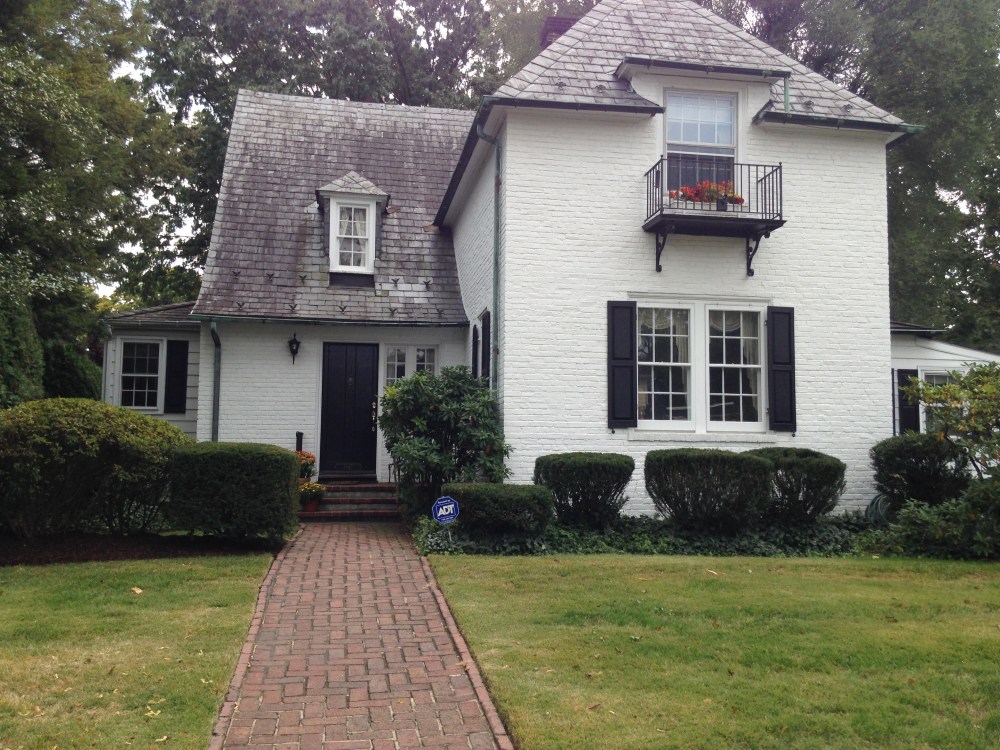
Paul Avenue

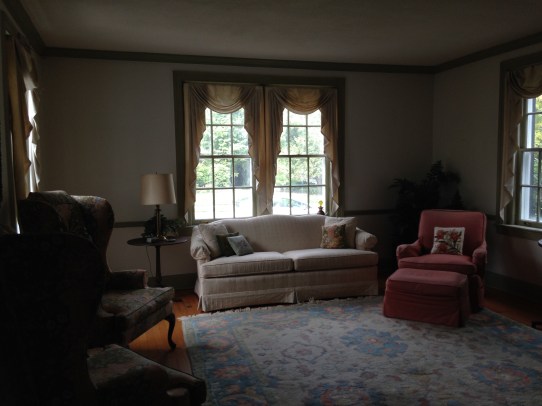
Everything was old and tired and worn. The chintz on the wingback armchairs was split and the green background in places had faded to near white. The small Art Deco vase that had sat forever on the Queen Ann table was chipped. The off white silky drapes hung limp; gray dust shadowed their folds. The house smelled old and empty and untended.

I sighed and thought how everything in my childhood home looked exactly as it had 35 years ago, only totally spent. It was surreal. It was strange. And, it was weird. It looked as if my parents had up and left one day leaving everything in its place, as if they would return in a short time. They didn’t.

My mom had died two years earlier. My dad was in their Florida condo and was too ill to help me. He said even if he was well, he just couldn’t bear to do it.

I was there to pack up.  I felt the hook in my chest, the tension headache coming on, so I breathed in deeply and exhaled slowly, just like I do when I’m practicing yoga. Packing up. Packing up, I kept thinking. How can I do this? It’s too much: too much to deal with emotionally and physically.

A 3,000 square foot house lived in for 60 years and packed, and I mean packed. Packed to the gills. Every drawer, closet, and room contained stuff. Every empty nook was filled. The basement rafters and crawl spaces were jammed full of old bent curtain rods, dirt covered Lionel Train boxes, paint cans, plastic covered fabric from the sofa slipcover back in 1963. You get the picture.

And then there was the emotional part. My mother had loved this house on Paul Avenue, poured herself into its appearance and decoration. This was her home. This was the last physical expression of whom she was that I would experience. And I was in charge of taking it apart.
img_0499

Our Living Room — Unchanged for 35 Years

Every object, painting, chest, table, piece of crystal or china had been chosen and placed by my mother’s eye and hand. She’d created the still lives on the tabletops, the bookshelves, and the mantel. As I walked from room to room, I remembered when we’d driven to Lahaska, Pa to look at the 19th century chest in the dining room. I remembered learning to dance the jitterbug with my dad in front of the 1950’s oil painting of the bridge covered woodland stream. Now two years after her death, the dried pomegranates she’d arranged in the silver bowl five years ago sat dust covered in the center of the dining room table. The dozens of family photos sat crowded together on the piano as usual. Memories leapt out of everything. Pictures, movies unreeled in my brain. I grew up here, was happy and sad here, argued and laughed here.

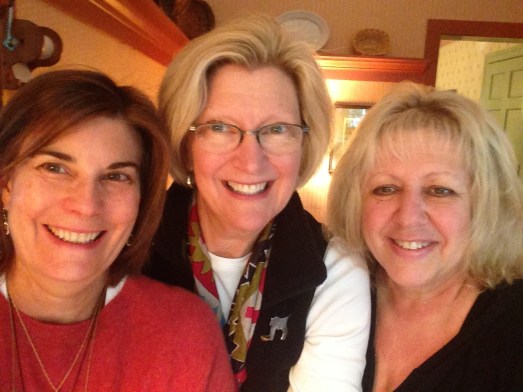
Fortunately for me, I wouldn’t have to pack up all alone. My two childhood friends, Cheryl and Fran, helped me a lot. We spent whole weekends together. My partner, Kevin, came several times helping me to make decisions about what to keep and what to toss. My twin 24-year-old daughters helped too. And through the relator, I had the help of the dismantling-sixty-years-of-stuff expert, Nancy. Taking apart my mother’s home took 10 weekends of cleaning out and packing up.
img_0610

Rosemont Mini-Skirt Mob

It was hard, really hard especially that first weekend. By the end, I’d hardened. I’d become an expert at throwing away without remorse. I threw away the three dozen framed photos on the piano. We all had these pictures in our own homes. I even threw away the hundreds of photos of long dead ancestors. No one had any idea who they were. Chipped crystal and china that my mother had loved so much she’d kept the damaged ones, I tossed without a pang. Dirty, faded crewel pillows I’d embroidered for my mom 40 years ago, into the Hefty bags they went.

We recycled what we could. Old towels and sheets went to the animal shelter. Dr. Clutter, a recycling company, picked up three truckloads of stuff.  Weekend by weekend, Paul Avenue changed from being somehow my mother and my mother’s home to a house. A pretty 1920’s painted brick house with a slate roof and the original cooper gutters. A very desirable house to old house lovers according to the dismantler, Nancy and the realtor, Barb. As my friends, daughters, and I cleaned out and packed up together, we reminisced. Rooms and objects brought up old stories, some we’d forgotten until then. Yes, the house was packed with a mountain of stuff, but it was packed even more with our memories.

On those packing-up weekends, I was a teenager once again, laughing with Cheryl and Fran about sleepovers, remembering the dinner parties my mother made for our group of six girlfriends. My twin daughters, Anna Lou and Campbell, and I talked about the weekends spent with my mom and dad at the pool or the golf course. We laughed about how Anna Lou had peeled the wallpaper off of the bedroom wall during her nap. (I’d thought my mom would be really upset; she wasn’t.) As we packed up the kitchen, Campbell reminded us of my mother baking blueberry pies and never being too busy or too tired to make French toast or sit at the kitchen counter and play a hand of gin.

I realized dismantling my mom’s house wasn’t getting rid of my mom or my dad or my life. I realized we were dismantling a place that was once beautiful and interesting and meaningful – and now it wasn’t. Just because it was gone didn’t mean it was gone in my imagination. I could be right back in our living room or kitchen or my childhood bedroom, anytime I chose.
img_0500

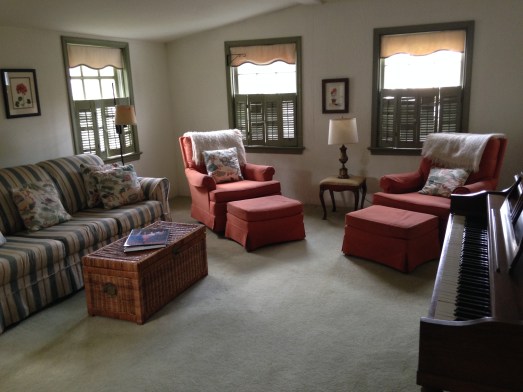
My Parent’s Den and Their Two Chairs

I realized too, that family traditions and rituals go on. We still have my mom’s blueberry pie and special muffins every time Campbell bakes them for us in my mom’s muffin and pie tins. I use my mom’s sterling forks, knives, and spoons in our home now. She’s with me at every meal. Anna Lou wears my mom’s gold scallop shell locket and remembers long heart-felt talks with her Nana about what’s important in life and how to see the world as a place of love and beauty and possibility.

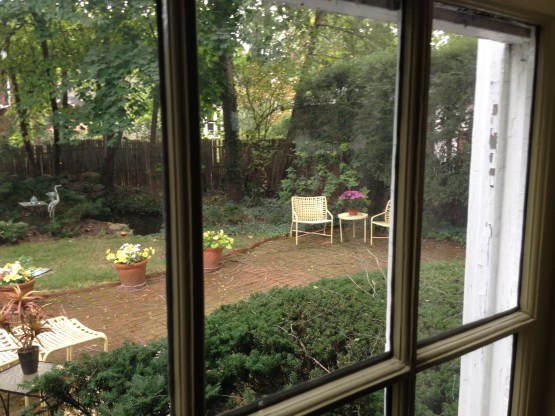
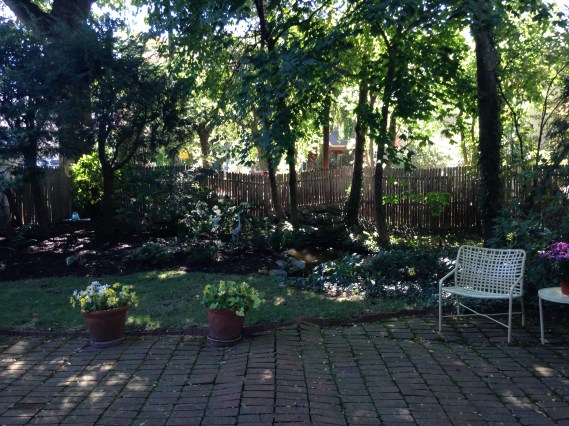
Paul Avenue sold on the first day it was on the market – we had five contracts, most over the asking price. A young woman bought it. She fell in love when she walked into the dining room and looked out its many windows to the sweet brick patio and original fishpond surrounded with hostas, rhododendrons, and hemlocks. The same view my mom had fallen in love with sixty years earlier. A circle.
img_0542

My Mother’s Favorite View

Now, many months later, I consider my stuff and begin clearing out. I’m reading Paris In Love, a memoir by romance novelist and English Lit professor, Eloisa James. She packed up and cleared out most of her stuff after she recovered from breast cancer. I’m also reading The Life-Changing Magic of Tidying Up by Marie Kondo.   I totally get why clearing out makes you feel lighter and freer. I totally get why some stuff is a burden and some stuff isn’t. It seems to me that stuff has a shelf life. When it’s expired, pack it up.
img_0568

The Fish Pond and Patio

Snippets — Renewing in the ADK

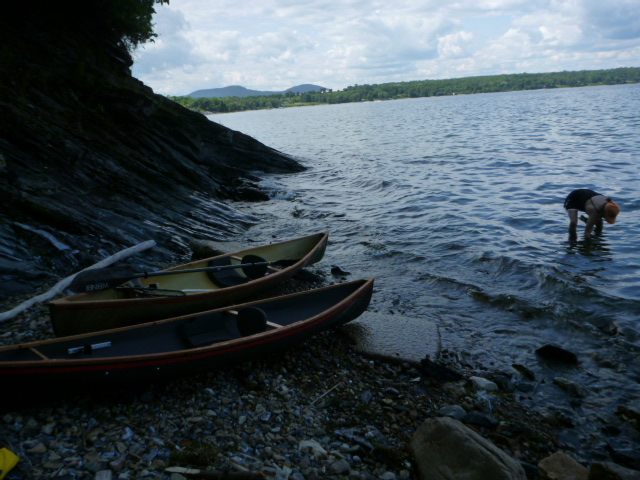
Two Hornbeck's on the shore of Lake Champlain

Two Hornbeck’s on the shore of Lake Champlain

I usually write essays, drafted and tinkered with over many weeks — sentences and words agonized over and then agonized over once again.

Now after 5 weeks in the ADK, I want to write only snippets. Too much has happened in these past weeks.  I could write a bulleted report of my doings but that would not only be boring but would only scratch the surface of my experience, would leave out the most important part — how I came to be more of who I am, not restored after the terror of the past three plus years, but  renewed.

Over these weeks, I have discovered through moving my body and mind and soul through experiences as diverse as restorative yoga, paddling rivers, hiking mountains, grading students’ essays, chatting with friends, attending concerts and theater, shopping, eating, and visiting with family and friends that I am different from when I left Stewartstown, PA.  I am my old self and my new self.  The anxiety, pain, and fear that was my daily and hourly experience has vanished, and I am in a foreign land, one in which I want to stay, permanently. If I had to sum up my new place, it would be with one word — perspective.  My perspective has shifted, shifted to a place that I plan on staying for quite awhile. It feels so  good to be here, seeing and feeling from this place that current or future conditions can’t shake so ferociously.


Into the Wilderness

ADIRONDACK  MOUNTAIN STREAM

ADIRONDACK MOUNTAIN STREAM

Amelia M. Murray, the maid of honor to Queen Victoria, camped in the Adirondack Mountains in 1855 with the Governor of New York, Horatio Seymour, his niece, and three guides.  While on

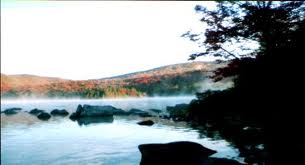
Adirondack Autumn Landscape Where Amelia Murray Hiked

Adirondack Autumn Landscape Where Amelia Murray Hiked

her five-day trip, she learned how to sleep on a hemlock bed, to bathe in Saranac Lake, and to hike sixteen miles in one day through a dense forest filled with “gigantic timber felled by storms…deep bogs and slippery rocks.”  She did all this while wearing a corset, which greatly restricted her breathing capacity, and very unsensible shoes.

Although she was a refined English lady, she carried her fair share — “a basket and a bundle.”  Throughout her diary account of the trip, she makes light of the dirt, rain, thunder, damp bedding and clothes.  She brags about her “London portable soup” which she had brought from England a year earlier and claimed was still in “good preservation” although one should “add lemons and a good store of sugar, brown and white” before eating it.  Amazing.  Her account is enthusiastic, joyous, and chatty.

She was a woman of privilege, an English lady.  Yet she was able to escape “polite society” long enough to have an adventure out of doors in the company of the genteel (the Governor) and not so genteel (the guides).  Although she writes after the trip that it took her “three days at Utica …to recruit and repose” herself, she had had a fine time and welcomed the chance to do it all again.

What is this need, this trenchant desire we have to be in the “wilderness”, to connect with the natural world?  Why would an elegant and refined lady of the 1800s who had probably never ventured much further than a stroll down an English country lane seek the untamed woods of New York State?  She sought adventure, yes, but more than that, I think.  She sought to discover a part of her that had not been tested, had lain dormant.  She wanted to test her fearlessness, her courage, her adaptability.  Normally, tests of fearlessness and courage are associated with men as men’s goals.  Men are supposed to like adventuring; they want to be tested in nature.  Isn’t that what the armed forces ads used to say, “Come see the world. Come adventuring with us.”?  But women need to be tested too. Even girls of thirteen seek adventure.

Last Sunday, my daughter Campbell announced she wanted to go fishing with me down by Cross Mill in Cross Mill stream about one and half miles away.  I thought she was kidding.  Even

Campbell, age 12, my outdoor girl.

Campbell, age 12, my outdoor girl.

though it was sunny and warm for February, 55 degrees, there were still patches of snow about, and I knew the water would be icy cold.  She persisted.   After packing an old red school backpack with a water bottle, water shoes, a towel, and a fishing rod, she pronounced herself ready to ride her bike down to the stream.  I couldn’t convince her to walk, arguing unsuccessfully that the roads are narrow and winding and in some places cars fly by at forty miles an hour. Ultimately, I agreed to her riding the bike as long as she stayed with me.  I wanted to walk.  We spent three hours walking and riding to and from the stream and playing in the water.  We waded in the frigid creek, our feet aching and numb.  We skipped rocks, looked for crayfish.  I snoozed in the sun on the brown picnic tabletop in between commenting to Campbell about her solo rock skipping contest.  On the way home, we spotted a male pheasant a few feet away, scurrying through the bushes by the side of the road.

Why had Campbell wanted to go? Did my daughter latch onto the idea of riding off with fishing rod, towel and water bottle because she needed to get away, needed to be out of doors?  Or did she want to go adventuring in order to test her mettle by  riding her bike to a place she hadn’t fished before and wading in frigid February water?  I doubt she could answer these questions or would even want to.  She’s thirteen.  She just wanted to go.

She just wanted to go like Opal Whiteley, a writer who grew up in Oregon in the early 1900’s.

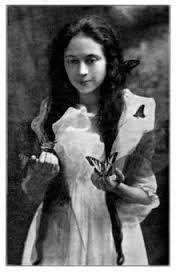
Opel Whiteley, Nature Writer

Opel Whiteley, Nature Writer

Whiteley wrote in her diary at about age seven, “I like to go in among the rushes where the blackbird s with red upon their wings do go.  I like to touch fingertips with the rushes.  I like to listen to the voices that whisper in the swamp.  I do so like to feel the mud ooze up between my toes.”  Campbell could identify with that.  This desire to connect with nature and to seek sensory experiences in it is common to most of us.   My daughter and Opal Whiteley aren’t the only young girls who’ve found adventure and joy in nature.

Hannah Hinchman, a contemporary writer and visual artist, created an enchanted world in the woods near her home when she was a teen.  She spent whole days attired in a wood nymph dress dancing among tall oaks and pines, performing rituals she had “learned “ from the woodland fairies.  She “wanted these adventures to form an unassailable world, composed only

Hannah Hinchman, out door writer and artist.

Hannah Hinchman, out door writer and artist.

of pure things.”  As she grew older she abandoned her woodland fairies and her fantastical view of nature, yet nature continues to be her solace.  “If I were about to pull the trigger and happened to hear a red-winged blackbird, I doubt that I could complete the act.”

Sometimes this desire to connect to nature becomes a pathological need, a self-medication for mental or physical illness or ordinary loneliness.  When I was enduring and battling a brutal divorce, I used to run long and often on the Panther Branch trail in Maryland.  The two mile trail curves through the woods around house-sized boulders, decaying deadfall, and foot high maiden hair ferns edging the stream and winding up to the top of a hill.  I used my runs there as therapy, going over and over all the terrible lies and injustices.  I recounted the same sad incidents and betrayals in my head; the dialogue never changed.  “He said this; can you believe it? And then he did that on top of everything else.  Doesn’t he even care about his children?”

As I ran, I ran, literally and figuratively, through this dialogue every time.  I spoke sentences, paragraphs in my mind as if I were speaking to a therapist or friend.  As I hit the chest high boulder with the red columbine I would begin my diatribe.  I couldn’t stop it; it rolled on and on of its own free will.  After the divorce was final, I still began this ugly conversation whenever I got to the red columbine boulder.  I did it unintentionally, unconsciously, until I consciously put an end to it.

Sadly, after I’d resolved my divorce and the ugly voices, I no longer wanted to go to the place.  The Panther Branch trail, which had been my solace, my comfort, my dumping ground became my nemesis, a reminder of bitterness, hurt and anger.  I felt as if I’d deposited every vengeful thought and desire in its rocks and branches and they were all there waiting for me.  I didn’t go back for years and then only occasionally.

For me, the Panther Branch became a place that was lovely on the surface but underneath was seething with unpleasantness.

Why do we attach meaning to place?  Does it make it more real, make it more our own?  I heard a psychologist say that artists are often depressed because they try to find meaning in every single thing, and when they can’t find it, they become despondent.  Most of us don’t go that far, yet most of us do attribute some meaning to place.

Places are the tangible stage sets for our happiest and saddest moments, celebrations, rituals and events. Hospital bedsides, altars, and babies’ rooms are the backdrops for life’s most poignant moments. Some cultures construct places to house these significant events – churches, burial mounds and grounds, concert halls, and court rooms. Others, like Native Americans, believe some natural outside places hold deep significance; these places contain spirits or powers that other places do not.  They are hallowed or evil, full of the universe’s energy or places of death.

Place enriches or diminishes what happens within it.  Sipping tea in front of a roaring fire is not the same as drinking tea at the local Seven Eleven store.  Place can change our mood, alter our interactions with one another in positive or negative ways.   Having a conversation in a basketball court or in a room full of whining children is not the same as having a conversation beside a woodland stream or in a quiet, candle lit room.  “Place subtends and enfolds us, lying perpetually under and around us.  Place…is the bedrock of our being-in-the-world,” writes Edward S. Casey, author of  Getting Back Into Place.

I just came back from spending two days in New York City.  I love New York.  I love its

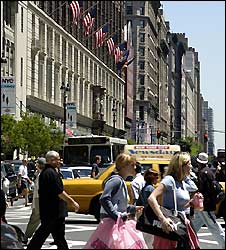
Manhattan Street Scene

Manhattan Street Scene

overabundance.  It’s so full of everything human, overflowing with everything people make. Art, buildings, fashion, food, noise, dirt.  People are everywhere.  On foot, in cars, on bicycles — talking, driving, and honking.  Walking around the city is like walking a human obstacle course; you are blasted with people, color, and noise — snippets of intimate conversations, a man on a space age motorized walker rolling along the sidewalk, pigeons under foot, shop window after shop window stuffed with every conceivable and inconceivable object.  Food markets, their cases over laden with hundreds of cheeses, ten types of proscuitto, twenty pates, truffles, black or white, sauced or canned, marinated or plain. The stimulation becomes overwhelming; the noise eventually becomes too noisy and then it’s time to go home.

After 48 hours of being high on the over-stimulation, I crashed and felt like Amelia M. Murray.  I needed three days at home in the woods in rural Pennsylvania “to recruit” myself.  Just like Murray, I wanted an adventure, a taste of the unfamiliar.  And when it was over, I wanted to repose — in my own place.