Author: chearn27

Evelyn Brendel Jennes 1964 – 2022

Evelyn Jennes Brendel – 1964 – 2023

Evelyn Jennes Brendel died on Wednesday night, March 22, 2023. She persevered for several years with great courage and great good humor through a diagnosis of metastatic breast cancer. No words can express what a gigantic hole her leaving has made in our hearts and lives. We miss her so very much.

Evie’s light shone like an image from the Webb telescope. She loved people. Her great curiosity and sense of adventure took her around the world to live, play, and to work. In the USA, she worked for Baxter and US Surgical where her marketng and people skills made her a top salesperson. Then off she went to Russia in the 1990’s, then on to Slovakia to work for Coca-Cola.

Finally, she settled down in the Netherlands with the love of her life and husband, Erik, and raised three lovely daughters, Everie, Elies, and Ella. There she made a wonderful life full of friends and learned how to speak excellent Dutch – with a very American accent, of course. She was involved in her new community and culture, celebrating Dutch holidays and customs with joy and eagerness.

Evie loved being a mother. She was affectionate and funny, and made sure her family gathered each evening for a proper sit-down dinner. The conversation was always lively and full of laughter – current school activities and dramas, politics, art, and local events. Evie shopped each week at the Haarlem market with Erik and/or some of their girls. She inherited her love of nutritious organic whole foods from her mother. Evie loved to try new foods and recipes, often passing them on to friends and family. She kept a list of each family members’ favorites, making them upon request or for special occasions.

Evie kept in regular touch with her friends and family in the USA for thirty years, visiting each summer for several weeks. In America, she visited her childhood friends in and around Bethlehem, Pennsylvania where she grew up. Evie also visited her Penn State University friends (she graduated with a BS in Business in 1986), and they all raised their children as one big brood. Their children are now adults, and they too keep in touch and visit with one another.

Evie, her husband, Erik and children always spent at least one week with her family in Avalon, New Jersey, a lifelong annual family vacation spot. There she visited and played beach paddle tennis with her parents (Mary and Bob – deceased), sister Katie, brother Robby, brother-in-law, Kevin and nieces Anna Lou and Campbell.

Evie was an international entrepreneur who worked on several start-ups in the US and Europe. Her ability to connect with people and organize marketing projects made her indispensable. Her colleagues around the world miss her.

The Jennes family loves to travel. And because Evie is a born organizer, the five E’s (as they call themselves) traveled far and wide. From France to Egypt to Southeast Asia. To Central America and the Alps. From Hollywood to Vermont to Maine and Utah, USA. Evie loved places with history and culture – even Hollywood culture. She planned trips that would teach them how others lived and worked. Trips that showed them the art and natural beauty of a particular place.

Evie’s positive perseverance and tenacity during the seven years she had breast cancer inspired everyone she encountered. Her study and knowledge of her disease, her approach to healing and her constant attitude of moving forward in joy and gratefulness was awesome to behold. She was a ‘never say die person’ who withstood much hardship and pain, yet never complained. If you asked her how she was – she always said ‘good’. She had so much life that she wanted to live and so much more time she wanted to spend with her family. When the end came, she was surrounded by her children, husband, and sister. Erik never left her side for the last three days she was alive. Evie died in her beloved husband’s arms.

Evie’s ability to connect with people and forge deep and lasting friendships was a lived example for her family. They, too, have her gift of caring and connectedness with others. Since Evie’s death, the now four E’s have been surrounded by their friends. Each day, friends come to their home with hugs, tears, food, cards, and flowers. Visiting for an hour or so, laughing and crying, sometimes walking on the beach together. Time to reminisce, reflect and mourn an amazing life that ended much too soon. Farewell sweet Evie.

My Sister, Evie

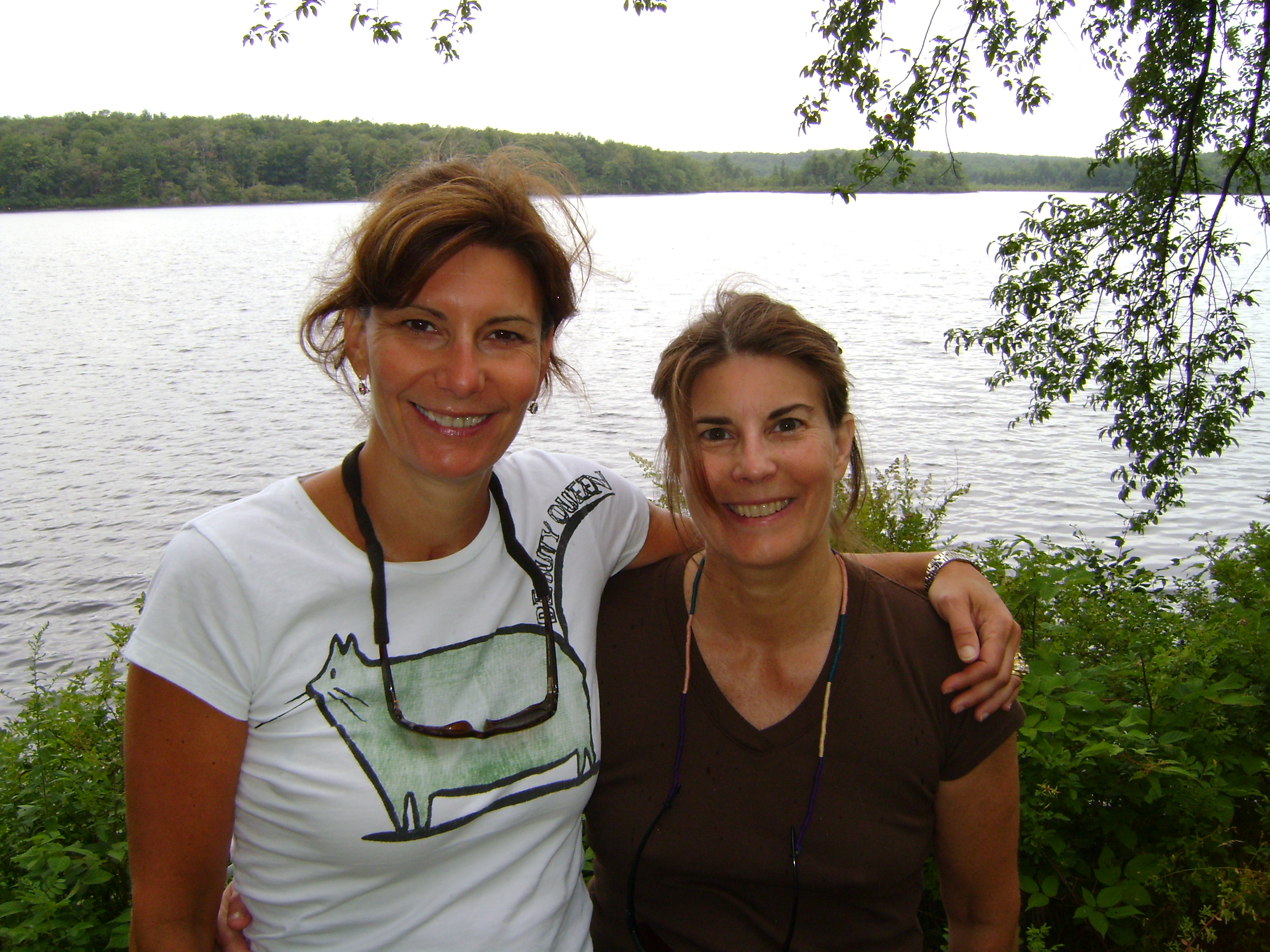
Evie and I at Big Bass Lake, PA Summer 2008

My name is Katie Hearn, and I’m Evie’s older sister. We were born 11 years apart, so she was like my first real-life baby.

Erik has spoken about Evie as a grown woman, wife, mother, entrepreneur, and world traveler. I’m going to talk about Evie as a child and a young adult.

As I mentioned, I thought of Evie as my baby. I took care of her, played with her and sometimes took her to the grocery store. One day, our mother asked me to pick up some groceries and would I take Evie along. I was 16, and she was 5.

Evie sat in the grocery cart’s child seat, which was right up front. As we went up and down the aisles, Evie and I chatted. Evie loved to go to the grocery store.

When we got to the check-out lines which were very crowded, she noticed candy bars on the shelf nearby and immediately asked for one. I said, no.  I would have gotten in trouble with my mom for that purchase. My mother was a 1960’s health food fanatic.

As I began putting the lettuce, tomatoes, string beans and carrots on the counter, Evie, said distinctly and loudly, “Mommy, can we get some milk? We never have milk. Please.”

I turned and scowled at her, saying, I’m not your mother.” And she retorted again more loudly, “Yes, you are, Mommy. You always say that. You are my mother.”

The check-out woman looked at me with total disgust; the other women in lines all around us were giving me looks of great disapproval. I could feel them thinking – ‘Another teenage mother who doesn’t know how to take care of her child.

And – even denies being her mother.’

I hustled out of the grocery as quickly as I could, taking Evie by the hand and scolding her as we walked across the parking lot to our car. When we arrived home a few minutes later, I stormed into the house, a furious, embarrassed teenager, calling “Mom, Mom, Evie called me mommy in the grocery store check-out line, and everyone stared and gave me dirty looks. And then when I said, I’m not your mother, she called out louder that I always say I’m not her mother when I really am. I’m never taking her to the store again!! Never! But I did — a few weeks later. And she didn’t call me Mommy, and I bought her a chocolate bar. We didn’t tell our mother.

As you all know, Evie is/was a beautiful strong, joyful person who loved life and people. She was funny, she was kind, generous, brave, and an amazing problem solver. She was also charming and resolute when faced with challenges.

When we were on a sisters-only trip to Tuscany and Umbria in the 1990’s, we got lost everywhere we tried to go in our rental car. We often stopped to ask for directions in our few horrific words of Italian. The person always smiled and answered in fast paced Italian using their arms and pointing this way or that. And we looked back at them with faces of complete comprehension. We were great actors. As we drove off, we’d turned to one another and asked, “Did you understand what they said?’’ Then we’d burst out laughing, saying at the same time, “NO, not one word.”

One day, we ended up at the entrance to a toll road, a row of toll booths straight ahead. Oh no, we knew this was very wrong. I was driving.

Evie, said, “Make a U turn.” I said, “But there’s a police officer in the middle. I can’t do that.”  “Sure, you can,” Evie said, “Just go.”

 So, I did. And immediately the policeman stopped us. He walked over to the car and told us quite forcefully in Italian that we may NOT turn around.  Evie leaned over me. I was afraid. In the US, you don’t confront the police.

Evie looked straight into the policeman’s face and said very assertively, ‘We must turn around. We must.”

 The policeman kept saying ‘No”, and many other words besides. And Evie leaning across me kept saying over and over, “We must turn around!”

 After 4 or 5 back and forths, the policeman suddenly changed his tone, smiled and waved us on to make the U turn. I was shocked. This would never happen at home. Evie looked at me and said, “You can’t give up. If you keep saying it long enough, they give in.”

So here we are today, celebrating dear Evie’s glorious life. She was my baby, my friend, my confidante, my sister, my model of courage and perseverance, and my partner in laughter. She has flown, and we are here saying, we will miss you sorely.

How Do You Mourn Your Ex-Husband?

My ex-husband, Skip, the father of our twin daughters died on October 5, 2022. He suffered a stroke on September 3, 2022. He was 87 years old. It was completely unexpected. He’d just retired 2 and a half months earlier from a 65 year real estate career. Our daughters and his three older children were at his bedside every day until he passed.  It was very hard to say goodbye.

No one plans to get divorced when they get married. I’m certain Skip and I both believed this was it – another chance at married happiness. We planned a life that included children, a farm, horses, and dogs. We both loved the outdoors and gardening. We were both in the commercial real estate business. He was 18 years older, and I believed wiser and smarter about life. I was full of youthful energy and the joy of possibility. We were happy, good friends and spouses until we weren’t. It was a hard, contentious three year break-up.

That was 24 years ago. Through our post marriage, we raised our twin daughters together, usually sitting side by side at every school activity and sporting event. It was hard and easy. Hard because we were no longer anything like friends and easy because we both adored our children. During those elementary through high school years, we sometimes saw each other 5 days a week. After they went off to college, not so much.

When one daughter became critically and chronically ill at 20, we were both there together or tag teaming one another at the many hospital stays, surgeries, and recouperations. Strangely, we rarely disagreed about children’s issues. It’s sad we couldn’t use those skills when we were still married and ran into disagreements.

So now, 25 days after Skip’s death, I am mourning. Mourning the full-stop end. The full-stop end of our knowing each other, of forgiving each other, of coming to a more caring communion. A “double loss”, that’s what the experts call losing your ex to death. Double because you lost each other when your marriage ended and now once again when one of you dies.

Any conscious or unconscious hope/wish for a different, happier outcome is now officially over. Any hope for a deeper more considered and welcoming relationship is gone forever. Strangely, all the happiness, good family times and laughter you shared are suddenly remembered as if it were yesterday. The scenes fresh and real and oh so sad. You muse: Why couldn’t we have done better?

And yet, my life moved on many years ago. Moved on to a wonderful, loving 20 year relationship and marriage. Moved onto a 23 year career in higher education. Moved on to the Adirondack mountains, hiking, paddling, fishing, writing, teaching, and cooking. So why was I mourning a person I rarely thought about unless he was mentioned by one of our daughters?

At first, I thought my heart sick feeling was only for the terrible loss my 31 year old daughters were suffering. They are bereft and will mourn for a long time as all children of good parents do.  But it wasn’t only for them I was heart sick. I realized I am heart sick for myself, too.

I mourn the happiness I knew with Skip. I mourn the end of our parent to parent relationship. I feel sad he isn’t here as my back-up, another parent to console and counsel our daughters. Another parent who is as excited as I am when Anna Lou or Campbell has a happy adventure or success.

My heart aches for my children. Losing a parent is hard. A deep sense of security is suddenly and irrevocably taken away. One of their two rocks is suddenly gone…forever. Our children will never be able to pick up the phone and call or stop by for a weekly visit. Go on a walk. Watch a game together. The finality.

And yet, our coming together at Skip’s funeral and family reception created a space for loving, caring and mourning together as a family. Anna Lou, Campbell and Susie, Campbell’s partner were supported and loved by their three older siblings and their spouses. My husband, Kevin, and I were welcomed to all the family gatherings. Love and care were everywhere.

I am so grateful for everyone in the Hearn family. Along with the sadness and finality of death, life and love go on and on and on.        

Back To The Forest?

Back To The Forest?

I bet the inmate in upstate New York had no idea what was outside his prison walls when he decided to escape into the Adirondack wilderness last summer.  He probably thought the Adirondacks was like a really big Central Park.  He probably thought it was the perfect break.  Fleeing into the Adirondack Mountain wilderness near the Canadian border had to mean certain success and freedom.

I was in the Adirondacks on the day the inmate broke out of the Ray Brook Correctional Facility in Ray Brook, New York.  My car was stopped three times at one of the many roadblocks. My trunk was checked, and I was questioned.  The locals at the grocery store laughed about the break because when prisoners escape up there, they usually turn themselves in after a couple of nights in the woods.  It was no different with this guy. After only one day of being out, he was found walking down the street in Saranac Lake. The Adirondack woods was no place for him.

Other inmates have run away in the past and have turned themselves in after being lost, wet, hungry, and eaten alive by bugs. They said they had no idea it was so much better in prison than “out there.”  Instead of a tame Central Park type woods, they found a dense, sometimes impenetrable place filled with bears, bogs, and millions of mosquitoes, gnats and black flies — the wilderness.

In primeval times when we were hunters and gatherers, the concept of  “wilderness” didn’t exist. Nature was nothing to be afraid of ; it was where we lived.  It was home.  We were wholly connected to the natural world. That’s all there was and for us it was a “Garden of Eden.”  As agriculture evolved and we became homesteaders and farmers instead of hunters and gatherers, we thought of ourselves as separate from the natural world and the concept of wilderness was born.

Wilderness became the other, a place to be feared and conquered. Wilderness means in Old English, a place of wild deer.  Satan inhabited the forest. Druids practiced their “pagan” rites and witches lived there. By the Middle Ages wilderness meant a place where hermits, insane people, and savages lived.  It was a place uncivilized, and therefore to be avoided and feared.

Wilderness became something we needed to control and dominate, and we did this through cultivation, which we esteemed more highly than our old way of living.  Land became something to be owned by a group or an individual.   Cutting down forests, plowing, planting and taming the land became our vocation.

Dominating the natural world instead of being a part of it was promoted and valued as our human right by both politicians and priests. Priests quoted from the bible the passage stating that man shall have dominion over the entire world. God created the natural world for man’s use and pleasure.   Politicians supported that idea, seeing how it could work to their political advantage. Europeans believed it was Christianity’s duty to convert the “pagans” to Christ and thus we rationalized stealing the Native Americans’ land in North America, colonizing Africa, South America, and the Middle and Far East. We wanted to rule over men as well as nature.

This monumental change in our perception of our relationship with nature put us out of our “Garden of Eden” and into a power struggle for dominance over nature.  Ever since, we have struggled with the dichotomy of our need to be reconnected with nature and our need to dominate it.  Yet, we still yearn for nature and consequently protect and preserve it. And this is why we write about and concern ourselves with conservation, ecology, and pollution.  We have a strong desire to save wild places and preserve virgin forests, because we need to know there exists the real possibility of reconnection with nature. Wild places are an extension of ourselves.  We’ve not traveled as far as we think from our primeval days when we lived in nature and not merely beside it.

In the nineteenth century many people wanted to “get back to nature”.  They wanted to reconnect with wild places, calling them “sublime.”  The Romantic poets wrote about nature’s wonder, beauty, and ability to take one’s mind into the spiritual realm. Wordsworth wrote To a Butterfly, I Wandered Lonely as a Cloud, The Sparrows Nest, and To the Cuckoo — all poems about the love and the beauty inherent in nature– nature created by God and therefore inherently good. Nature became idealized as something transformative – being in nature became a new type of spiritual experience. Where previously man’s spiritual experiences had been limited to church and prayer, now they were outdoors in nature, God’s world.   The idea of living and sleeping close to nature never minding the bugs, dirt, and the inconveniences became a fad, particularly of the comfortable classes. Getting away from the modern, fast paced Victorian life style and its conveniences such as indoor plumbing, comfortable furniture, and insulated, warm houses became a way of seeing life and the world differently. Paulina Brandreth, a nineteenth and twentieth century writer and hunter writes, “One of the chief beauties about hunting or fishing rests in the fact that both create within the individual an enthusiasm that is tonic to mind and body alike.”

People who lived outdoors in shacks and makeshift tents because they had no other choice were called poor. But people who chose (the operative word) to spend their summers living in tents and lean-tos were called campers. Mildred P. Stokes Hooker (1881-1970) and her family were among those first campers.  Hooker’s book, Camp Chronicles about spending seventy summers at her family’s camp on the Upper St. Regis Lake, New York, gives an intimate look at what camping was like at the turn of the last century.

During the first several years her family, including infants and toddlers, lived in tents.  Balsam branches covered in quilts were their beds and the lake was their bathtub.   They had to take along all their food supplies for the summer or buy them from local farmers.  Hooker’s upper class mother took forty chickens to kill for their meals and Hooker’s father rented cows for milk from a farmer. Her father kept the cows on a nearby island so they couldn’t escape.

They were not the only ones camping 120 years ago.  Other families, primarily from New York and wealthy, spent their summers in similar accommodations until their Great Camps were built.   It was common for the men in these camping families to hire guides who would take them out hunting and fishing for game they would use to feed themselves and their families. Sometimes groups of men with guides would spend a week or two off in the woods and mountains killing as many deer, bear, and other game they could. Days were spent feasting on roasted venison haunches and scores of grilled and baked trout, partridge, pheasant and sadly the now extinct American Passenger Pigeon. Game and fish were so abundant that they were considered in unlimited supply and a guide’s reputation grew from the number of game he killed. According to Paul Schneider in his book The Adirondacks, one of the Adirondack’s greatest guides, Alvah Dunning, killed eight moose in five days and during one winter he and three others killed 100 moose. It was not uncommon to catch fifty to sixty trout on fly rods in a couple of hours. Another guide, named Elijah Simonds, was believed to have killed more than 2,000 deer, 3,000 foxes, 150 bears, 12 wolves and 7 panthers during his guiding career.

Slowly these nineteenth century campers built simple or elaborate cabins and icehouses. Some camps had servant’s quarters and stables. Some civilized their wilderness environment a lot and some not too much.  Either way the whole idea was to experience the “freedom” of living out of doors in the great north woods –to experience a different culture than the staid upper class Victorian culture they normally lived.

The idea of combining and relating culture with nature was not a new one.  Muir, Emerson, Thoreau and Hawthorne wrote about it.  Winslow Homer, Albert Bierstadt, and Frederick Church painted it — man’s effect upon wilderness, man’s perception of nature. Whenever a human being goes into nature, he brings culture along.   Even a stroll through the woods changes those woods, leaving footprints and human scent where before there were neither.  Thoreau believed that nature and humans had a sympathetic relationship–one where nature responds to us as we respond to nature.  He writes, “Shall I not have intelligence with the earth?  Am I not partly leaves and vegetable mould myself?”   Or Emerson who wrote, “ Nature is so pervaded with human life that there is something of humanity in all, and in every particular.”

That is what those early campers were after, a sympathetic relationship with nature.  While they wanted some creature comforts, i.e. ice and wooden dwellings instead of canvas ones, they didn’t want to destroy the very essence they were after in living in the wilderness for the summer.   They wanted to experience and understand nature and their undeniable connection to it.  They believed as Paul Gruchow, author of The Necessity of Empty Places, believes, “We will not come to any deep understanding of our place in nature except as we delve into its basic documents, and these documents are our wild places.”

We need to keep in touch with the wildness within us, the animal side of our nature.  That is one reason why we have preserved wild places all over the world.  Places where we know wildness exists, places we have not tamed and developed into skyscrapers, roadways, and farm fields.  Knowing wild places exist buoys us when we are in places uncomfortably manmade, like shopping malls and parking lots.  This need for connection and communion with the natural world fuels a camping, fishing, hunting, and boating industry worldwide. In the United States alone, millions of us spend millions of dollars a year on tents, boats, fishing equipment and guns. We have an innate need and desire to be in nature whether it is an ocean, lake, desert, wood or mountain.  The visit makes whatever is lacking or ailing in us whole and well.  We are restored, freed.

For those wealthy Victorian campers connecting with nature meant freedom from some of the social strictures of upper class society.  Hooker’s mother wrote in her diary,  “I do like the freedom of this place in the way of dress.  Even calls are made in flannel suits and gentlemen wear knickerbockers and coarse stockings.”   Dressing for dinner was banned at some camps while at others women “bedecked in diamonds and men in ‘boiled’shirts paddled their canoes to the Vanderbilt’s for dinner.”  For some, too much social freedom while in the wilderness was too much wildness.

For Martha Reben, wildness and wilderness were her salvation.  Reben was a tuberculosis patient at a sanatorium in Saranac Lake, New York. Her father had sent her there from their home in New York City when she was diagnosed at age sixteen.  Her mother had died of the disease ten years earlier.  Reben had endured three dangerous and painful operations over her three-year stay and still was no better.  She was dying.  One day as she was reading the local newspaper, she chanced upon an ad looking for a TB sufferer who would like to try an experimental “treatment” in the Adirondack woods.  This “treatment” was to spend a summer in the woods camping beside a pond and being taken care of by an Adirondack guide named Fred Rice.  She answered the ad and after some convincing of Mr. Rice and her father, she was accepted as Rice’s first experimental patient for the summer of 1931.  It worked.  By the end of that summer Reben was remarkably better.

For the next ten years, Reben spent spring, summer, and fall camping along the banks of Weller Pond.   Although she eventually was cured of TB, she never completely recovered her strength because of the lung damage she had incurred from the disease and the operations.  Still in her book, The Healing Woods, she writes that she wouldn’t have lived another year without her summers spent camping on Weller Pond.   There she learned how to live out of doors, to use a compass, to fish and to write on an old typewriter.  She wrote about what she saw at Weller Pond much as Thoreau wrote about Walden Pond.   She made pets of raccoons and birds.  She slept at the edge of the pond with the water literally lapping at the legs of her bed.  She learned the constellations and how to read the wind and sky for weather clues. When she had to leave in November before the pond froze, she cried.  While many people would find the realities of life beside a wilderness pond more reality than they would like to experience, Reben found there the reality of a new life.

Some of us try to get into a wilderness forest and some of us try to get out. It all depends on our perspective. As for me, the next time I hike along Heart Lake with the chipmunks scolding my passing and me preoccupied with my thoughts and suddenly an osprey swoops down six feet away to retrieve her prey, I’ll be as startled as the escaped Adirondack inmate, but I’ll also be amazed. And if a Great Blue Heron and I surprise each other along the banks of the Rocky Falls Brook, he’ll squawk and I’ll scream and after the shock wears off, we’ll both thrill at the meeting.

adirondack mountains adirondacks adventure Animals Appalachian Mountains backpacking Commentary death Environment Family forest hiking Home Humor hunting Inspiration Kids Life Lifestyle Literature Love mothering mountains Musings nature Opinion outdoors Personal Philosophy Places Random Thoughts Reflections Relationships Romance rural Spiritual Spirituality Teaching writing Thoughts Travel Women women and nature woods Writers Writing
Shingle Shanty Pond

When I conceived of the idea of paddling the perimeter of Shingle Shanty Pond, my purpose was to search for and hopefully find Paullina Brandreth’s lean-tos. Brandreth used these lean-tos for many hunting trips in the early twentieth century on her family’s 24,000 acre property in the Adirondack mountains of New York.   They were constructed of logs felled on the spot and erected facing each other about ten feet apart. That way a fireplace could be erected between them, heating both lean-tos. She writes, “Over the fire a high roof of poles covered with heavy tar paper keeps out the rain, and makes cooking agreeable in all kinds of weather. On very sharp nights we stretched a sheet of canvas across the opening…and with this arrangement we were well protected from wind and cold.” The Brandreths used pack horses and camp employees including a manager and guide to get their equipment to camp.

I was camping on the Brandreth property in hopes of exploring, absorbing, and writing. I wanted to live (if only for a few days) in the same environment that had so influenced a woman hunter of the late nineteenth and early twentieth centuries. I wanted to find an intersection of our experiences in the same place, and I wanted to write about them. A woman hunter of her era was a rarity, yet by writing under a pseudonym she was able to publish 31 articles in Field and Stream and Forest and Stream magazines, as well as three books on hunting, fishing, conservation, and camping in the wild. She was an anomaly because as Rob Wegner, the author of the new foreword to Brandreth’s book, Trails of Enchantment, writes, “Of the more than 2000 books written on the subject of deer and deer hunting…, only five are written by women.   It is one of the best books ever written on the subject…”

Many women camped and even hunted in Brandreth’s time, but none lived in camp as one of the men; most tried to maintain their ladylike manners and behaviors even in the middle of the wilderness. Brandreth was not pressured by these social mores’ because she kept her public identity a secret thereby preserving her anonymity to all but family, close friends, and acquaintances with whom she hunted.

Paullina Brandreth’s book, Trails of Enchantment, introduced me to a female writer writing about hunting. She got me excited about visiting Shingle Shanty Pond. I could retrace her steps, stand on the same ground, paddle the same water, and perhaps even sit inside the same lean-tos she and her friends and family had used. Our Nature Conservancy representative, Todd, who had brought us into the Brandreth’s, had stopped here on the way into our cabin. He had pointed down the length of the pond to a point and had said he thought a lean-to was there. He’d never seen it himself, but one of the Brandreth’s had indicated that it was down there tucked up back in the woods high above the water. I couldn’t wait to find it.

The day was sunny, a few tiny widely scattered clouds and about 72 degrees. I had a sandwich, an apple, and water. I was dressed to get wet since one usually does in a kayak. The wind barely whispered across the water, and so I paddled straight out into the middle of the pond. When you are paddling across a flat body of water, it’s hard to judge distance, and as I paddled I kept looking back to see how far I’d come from shore. The light wind was at my back, and I made good progress, paddling to the middle in about 20 minutes. Out in the middle of a lake or a pond, it’s a good idea not to think too much about exactly where you are – sitting level with deep water in a six foot plastic cigar shaped boat many pool lengths from land. The water is tannin black from the pines and spruces lining the banks. You can’t see the bottom. The bottom that is thick sucking mud. The bottom that swallows your foot and half of your calf when you stand on it. The bottom out in the middle of Shingle Shanty Pond that might be twenty, thirty, forty feet deep and is hundreds of yards from the shore. I was anxious.

I had a life vest in the boat, but I wasn’t wearing it. On shore the idea of stowing the hot cumbersome thing in the bow seemed a reasonable decision. Out in the middle of the pond, it seemed insane. What had I been thinking? Was I completely crazy? I could drown if the boat tipped. I breathed in then out. I looked around. I was sitting in perfectly calm water, the tiniest of wavelets lapping against the side of my boat. The boat couldn’t possibly tip unless I leaned way out and tipped the boat myself. The wind hadn’t changed its velocity. What was I worried about? I kept paddling and focused on my destination, the point about fifteen to twenty minutes away.

I turned around again to check on my progress and to see what my friend, Kevin was up to. I could see him getting into his kayak. I hoped he would head out towards me.   I paddled a few more strokes, then turned to see if Kevin was following me. He wasn’t. He was headed towards the opposite shore line. I yelled. He didn’t hear me. I waved. He didn’t see me. Now he was poking around the irregular shoreline looking, I supposed, for the lean-to. I thought, “Why is he over there? The lean-to is over here.” But then maybe he wasn’t looking for the lean-to. I was doing that. Maybe he was looking for something else, a different discovery.

I gave up trying to make contact and concentrated on my own adventure. As I neared the point, I found an opening between a hemlock and a large fallen tree trunk sticking out perpendicular to the bank. A dock. Now I would have something to hold onto and possibly climb onto. I tentatively put my leg over the side of the boat and on to the bottom. I sank but only to my ankle. Good. After hauling the boat up onto the steep bank, I looked for an opening or a trail that might lead to where a camp might be. I found a sort of trail up to where the ground leveled off onto a rolling rather open (by Adirondack standards) plateau. I could walk without climbing over or around lots of deadfall. The sun shone through the leaves and needles, dancing shadows on boulders, moss, and logs.

I listened. Was that rustling to my right the wind through the white pines or was it an animal? A squirrel, a chipmunk? Small animals sound very big when you’re alone in the woods on the other side of the pond from your friend. It was a chipmunk, thank goodness. The only thing I really didn’t want to see was a bear. Even a timid, scared bear would scare me. A fox, a lynx, a weasel, a marten, even a coyote would thrill me, but not a bear. I’d read and heard too many stories about bears and bear attacks.

Bears normally avoid people and run before you see them. But if you surprise a female with cubs or worse come between a female with cubs, she may attack or at least charge. Bears that are old, sick or starving may also view you as prey, especially if they have become familiar with humans. When bears attack they threaten first by standing on their hind legs and sniffing to see what you are. Then they may stomp one foot, growl, hiss, pant, make jaw-popping noises or charge within a few meters and stop. According to the Northwest Territories Wildlife and Fisheries web site, you should never run from a bear. If threatened you have three options: shoot to kill if you have a firearm, play dead only if it is a grizzly bear, or fight back if attacked by a black bear.

About 4600 black bears live in New York. If one is threatened according to the Northwest Territories web site you should “act aggressively. Defend yourself with whatever means are available. You want to appear dominant and frighten the bear. Jump up and down and shout. Wave your arms. It may help to raise your jacket or pack to make you look bigger.” I didn’t have a jacket or a pack.

According to Lynn L. Rogers, PhD of the Wildlife Research Institute, my chances of being attacked by a black bear were slim. She says that the biggest misconception about black bears is “that they are likely to attack people in defense of cubs”, which I had just read was true on three other web sites.  According to her, “they are highly unlikely to do this.” She goes on to say that she and other black bear researchers often capture screaming cubs in the presence of bluff-charging mothers with no attacks and that black bear mothers have not been known to kill anyone in defense of cubs. I find that hard to believe since she also states that almost three dozen people in North America have been killed by black bears in the past one hundred years. Rogers says that my chances of being killed by a domestic dog, bees, or lightning are vastly greater. Being murdered is 90,000 times more likely. I still don’t feel safe: a bluffing, charging bear is just as scary as a serious, attacking bear.

After searching around the area and trying to get up my courage to go more than one hundred yards into the tangle of brush and deadfall, I gave up. My bare legs were scratched and bruised. My adventurous spirit was lagging. I walked back to my boat, climbed in, and paddled out into bright sunshine. Kevin was waving to me from the opposite shore. Perhaps he had found something. Perhaps I had been looking in the wrong place.

I paddled across to Kevin and relayed my mini adventure without either a lean-to discovery or a bear sighting. We paddled side by side around the corner of a cove and decided to pull ashore and take a look. The bank was steep here too but then the forest opened up for a good acre and we could see that this peninsula would be an ideal spot for a hunting camp.   We walked up to the top where the ground leveled out all around us. We looked to the left and right and decided first to check out the left side nearest the point. It seemed the most likely. Deep lime green moss covered everything and was a carpet for every imaginable size of stick, stone, log, and boulder. The widely scattered pines cast a shadowy, dusky light. The moss sponged underfoot, as we walked over and around.

You can’t walk in any sort of straight line in the Adirondack woods because most of the Adirondacks has been lumbered at least a few times and this woods was no exception. The lumberjacks leave behind branches and parts of tree that aren’t worth hauling out. As the woods grows back, brush and saplings grow in between all of the lumberjack’s litter. Walking through this landscape is a lot like walking through a huge game of pick up sticks, climbing over, under, and around all of the overlapping tangle of downed trees and branches, brush and new growth.

By contrast, a virgin forest is wide open and its floor is free of debris. It’s easy to walk through, but you’re bound to slow down and look up. And when you do, you’ll feel as if you’re in holy place, a gothic cathedral, quiet and reverent. Old woods have a spirit new ones don’t have for ancient woods have been around for several hundred years. They’ve seen a lot. As you walk around their five foot diameter trunks, you notice these woods smell different than younger woods. Old pine needles and mossy dampness. You breathe in their serenity and immortality and feel you’re on hallowed ground.

Since we arrived here a few hundred years ago, we’ve cut down almost every tree from the Atlantic Ocean to the plains in the Midwest. Still virgin forests do exist, and they are mightily protected in all the states that possess them. They are what this land used to look like everywhere. It must have been quite a sight for those early settlers, awe inspiring and frightening at the same time. What an undertaking to cut those giants down to make way for houses and hayfields.

This young forest at Shingle Shanty Pond is like most of America’s woods, young and messy. When we reached the peninsula point, we didn’t find any sign of a manmade structure so we backtracked looking on the east and then the west shores . Each time we thought we saw a dark lean-to-like hump in the distance and climbed over, under and around to get to it, we were wrong. Only a lump of dead fall. There had to be something of the Brandreth’s here. Something left behind. We knew they had used this pond as a primary hunting and fishing camp. Where was it? Nothing to the east, west, north or south.

Maybe we could come back another time and search some other likely places along the shore. As we paddled back side by side, we breathed and smiled and looked up at the breezy puffs of cloud and saw a raven fly overhead. He cawed once and then disappeared over the ridge. Back at the picnic table, we took out towels and biodegradable soap and went for a bath, scrubbing and rinsing away the dirt and disappointment in the tea colored water. As we stood on the sandy bottom, we laughed about our overconfidence at finding the place on our first try. Setting out with one goal and finding something else is usually the way of it.

I wonder why we human beings cling to our heart’s and mind’s desire with such tenacity and then when it isn’t fulfilled, we’re so disappointed and dissatisfied with what we receive or experience instead? It’s a mystery because what we usually get instead is better than what we had imagined we wanted. Yes, it is different, perhaps not as exciting, but it’s good just the same. We didn’t discover Paulina Brandreth’s lean-to, but we could look again tomorrow or another year. Instead, we discovered the giddy excitement and anticipation of discovery, the adrenalin rush of a possible bear sighting, the echo of a single raven’s caw as he flew overhead, mossy, dark, sometimes scary forests, and sunshine sparkling off of tea colored wavelets.


adirondack mountains adirondacks adventure Animals Appalachian Mountains backpacking Commentary death Environment Family forest hiking Home Humor hunting Inspiration Kids Life Lifestyle Literature Love mothering mountains Musings nature Opinion outdoors Personal Philosophy Places Random Thoughts Reflections Relationships Romance rural Spiritual Spirituality Teaching writing Thoughts Travel Women women and nature woods Writers Writing
Sledding

Drafted winter, 2002. Completed 2021.

“ Stop! Stop! Stop!”, I yelled and then screamed as I watched my two children careen away down the ice covered snow. If they heard me they couldn’t stop. I knew their sleds would roar against the ice as they flew away. Their sleds were those molded plastic flat-bottomed sort you get at the True Value hardware store for $10 a piece. These were turquoise with yellow pull ropes at the front end.

Ten minutes earlier, we’d walked to the top of McCleary Road and had looked out over the hundred acre hill covered with 2 and a half feet of snow and 2 inches of ice on top of that.   In the summer, the hillside is planted in corn and sometimes beans. It is steep about 45° to 55° and goes down about a quarter of a mile to a stream bordered by thick woods full of sticker bushes and brambles. It is a long hill, a good hill for walking or sledding or skiing on most days but not today.

On this late afternoon with the last bit of sun shimmering off the ice, we’d come to sled in the setting sun. But now I could see this was a bad idea. The top two inches of ice had melted and with every other step into the field, we’d plunged down to our thighs or worse. I looked at  my twin eleven year old daughters, “ I think we should come back tomorrow.”

“No. No. We want to go,” they both protested.

Finally I said, “All right, but only sled over here where it isn’t so steep. Then you’ll be able to stop by jamming your heels through the ice into the snow.”

They said okay. Then they looked at each other in silent communion, turned and threw down their sleds, flopped their rear ends down on them, and with a push of their hands jettisoned down the entire quarter mile hill. I was furious. Then I was frightened.

I continued to yell for a few more seconds, amazed with disbelief at their joint defiance. They became smaller and smaller; the red and blue and pink and white patterned ski jackets became a blur. My heart pounded. How will they ever get back up the hill? You could take one or two steps on top of the crust then ‘boom’ you broke through up to your hip.  I knew from backpacking in the snow that this was quickly exhausting especially uphill.

Campbell was bigger and fitter and an athlete who loved to play outside. Anna Lou, however, was small for her age and not an outdoor girl. I realized I couldn’t go after them  crashing through the crust every other step; I needed snowshoes and polls.

We’d walked two blocks from our home, so I turned and walked down the snow packed road as quickly as I could trying to calm myself. I found my snowshoes and polls in the mud room, threw them in the back of our black Explorer and drove around the corner to the field. I could see them trudging and then falling up the hill pulling their sleds sometimes behind them and sometimes pushing them ahead and flopping down on their stomachs to rest a bit.

Ann Lou was 50 yards from the top; Campbell was about 25 yards ahead of her pulling her legs free every other step, but looking strong as she moved steadily closer to me. Anna Lou looked exhausted. She was crawling on all fours her long blonde hair streaming out from her fleece hat covering most of her face. She had the rope of the sled in one hand and this was getting tangled up in her legs as she crawled. As she got a bit closer I could hear her crying and then yelling with frustration. She alternated her crying and yelling with some whines and whimpers.

My anger was beginning to melt as I moved across the snow in my snowshoes and polls sinking in a few inches but able to move fairly quickly. I reached Campbell first. She said she was okay. I went on  to Anna Lou who upon seeing me put her head down on the snow and began crying long hard sobs. I told her to get up on the sled which she lay on gratefully, and I picked up the yellow rope and began pulling.

Campbell and Anna Lou said very little as we put their sleds in the back of the truck, and they climbed in tired, wet and cold. We drove home in silence. When we walked into the mud room a few minutes later they each said, “I’m sorry, Mom.” I said I hoped they’d  learned something about snow and ice and hills and listening to mothers. They nodded solemnly.

We went back to that hill a few days later when the temperature was 10° and the ice crust was so hard we could walk on top and never crashed through.  We rode our sleds down the entire length a few times until finally settling on an icy stretch two thirds of the way down that was the fastest. This meant more rides and less trudging. We laughed and sleighed until it was almost dark.

Later after hot showers, we sipped hot chocolate with mini marshmallows at the dining room table recounting our wild rides in the cold. We’d made what had been a hair-raising experience a few days earlier into a joyful family adventure.

Years later, we’ve told his family story many times. A story of children being children, a story of calamity and adventure. A part of our family history that makes each of us feel together even when we’re apart.

Finding My Place

Written shortly after moving up north to the Adirondacks during Covid, 2020

Finding my place. That’s what I’ve been dong these past 4 months. Since moving to our home in the Adirondack Mountains because of Covid, I’ve been pinching myself most mornings when I look out our bedroom window at the 100 plus year old white pine. I like to think the farmers who built our small white clapboard house over 100 years ago planted it as a symbol of their good fortune. The Champlain Valley was prime farm and iron ore mining country at the turn of the last century.

Now it’s home to vacationers, second homeowners, and year round residents. Some of the year round residents have been here for generations or like us, they discovered this amazing landscape over the past 30 years, fell in love and stayed.

We’ve owned our little home since 2007 and have longed to move up here full-time. This year of the Covid has made that possible. This terrible pandemic forced most of us, who could, to work remotely. As college professors we were teaching online last spring and figured we’d be teaching remotely through the fall and possibly winter. We thought, why not move to our Adirondack home for the duration. We made arrangements for our months away, packed up a lot of stuff and were off. It was intense.

Now that the dust has settled, I’m figuring out how I want to live up here in the north woods. We’re far away from interstate commutes, crowded streets and cities. I haven’t worn ‘work’ clothes except for my zoom teaching stints. And then, it’s jeans below and silk blouse/jacket above. 

I walk in the woods most days and gaze at the high peaks from a hill behind our house.  Chickadees come up close – one almost hit me in the head the other day as I was walking on the trail behind our house. Then it perched within an arm’s length, unafraid and chirping. Amazing.

Now, we get our ‘groceries’ at our new CSA, Essex Farm. Each Saturday, I take my bags and put on my mask to ‘shop’ at the farm. We have separate time slots because of the Covid which means I don’t have to rush or worry about distancing. There is a large pavilion with tables full of produce and staples like pastry flour, bread flour, corn meal, rolled oats plus two refrigerator trucks/containers of more produce, eggs, chicken, milk, yogurt, cream. It’s a full diet CSA.

I’m picking up and then googling strange veggies like Kohlrabi, celeriac, Daikon radishes, Delicata and Kabocha squash. I’ve taken something called Schmaltz (chicken fat) from the freezer. Who would think six months ago, I’d be simmering lamb bones for hours to make a delicious stock for lamb stew and later chicken stew. Now I have time to cook! And I love it!

Cooking was not my favorite activity for the many years I worked fulltime and raised my twin daughters. It was a job, not a pleasure.  Now when I wake up at my 4:00 AM worry time, I think about what I’ll cook. Hmm. How about a pork shoulder roast with farm sauerkraut, apples and mashed tiny white and red potatoes. How about a combination of chopped leeks, red onion, garlic, shallots, and broccoli in white wine over pasta? How about mashed Delicata squash or roasted and halved squash filled with ground lamb and spices Indian style. The roasted chickens are to die for and with buttered and parsley new potatoes, steamed kale or carrots or brussel sprouts or cauliflower, ahhh. You get the idea. The possibilities are endless.

Because I have all this food in our frig and freezer, I don’t have to run to the store for missing ingredients. I use what I have and make actual grocery store runs to TJ’s in Vermont every two months. When I’m stuck, I use Google, and I use my imagination. It’s so much fun. I look forward to 4:00 or 4:30 each afternoon when I put on my butterfly apron and begin to chop and cook. For now my place is in the kitchen, practicing my culinary skills and listening to our white pine rustle in the evening wind.

Covid Chronicle: Musings on Living with Covid

I’ve collected these snippets over the past year. Sometimes writing in my journal, sometimes my phone. Whatever was handy. 

*March, April, May 2020. Don’t touch anything. Wash your hands 10 times a day. Wear gloves/don’t wear gloves. Wear a mask. Wear only an N95 mask. Don’t touch your groceries for 48 hours. Stay 6 feet apart. Strip and Wash your clothes ASAP. Take a shower as soon as you get home. Never, ever touch anyone. Don’t touch your face.

*March, April, May 2020. One of our daughters is in Brooklyn. FaceTiming everyday. We are glued together over air space. She is so frightened. Frightened to leave her apartment. Frightened to go outside for a walk or a quick trip to the small grocer a block away. She is glued to the screen, reciting the latest human stats. Deaths from Covid, number of ICU beds with Covid patients, refrigerated tractor trailers filled with bodies, the wide empty streets, the loneliness, the uncertainty about how you can contract Covid. The daily news briefing from the mayor and then governor. 

*March, April, May 2020. Another daughter in Hawaii. So terribly frightened. Doesn’t know whether or not she should fly home to the east coast. So many dangers. Should she risk the gauntlet of two flights, three airports, taxis? What if she makes us sick? What if she gets sick? So far from home. Life threatening Danger in what was a special trip to paradise. Hell.

*March, April, May 2020. Still another daughter here in Maryland. Now working from her apartment. Mostly safe. Thank god. She has autoimmune problems and almost died nine years back in every parent’s worst nightmare – a very sick child. We know she is careful. We can see her in our backyard patio, six feet away, masks, no hugs. A heartache but not heartbreak. Thank god.

*September, 2021. I’m slowly absorbing the fact that I’m living here in upstate New York for Covid – in this place I wrote about from Pennsylvania. Beauty is everywhere, part of every day. Amazing. You can feel it and see it in all of the people who live here. When you’re walking on the road the guys in the pick up trucks slow down, move over and wave instead of speeding up and getting as close as they can like they did in Pennsylvania.

*Fall and Spring Semesters, 2020, 2021. A hard Zoom class. Many students missing. Some emailing me about Covid sick selves, mothers, aunts, and siblings. Everyone looks exhausted. Everyone has had enough. Enough of everything: school, family, work and life. We all need months of restorative care on a tropical island. Floating in blue water and snorkeling with the 1000 yellow, orange, and turquoise fish.

*February, 2021. “Is it true? Is it kind? Does it need to be said”?  Priya Parker quote heard on interview podcast with Brene Brown. My daughter sent me Parker’s book, The Art of Gathering. I thought, how strange we are listening and reading about gathering when we are all in our own silos or pods. Still. Maybe that’s the point. Reflecting on gathering when we can’t and therefore have a different perspective, one we’ll perhaps never have again. 

*March, 2021. Two thousand Canada geese (my guesstimate) fly overhead. It’s spring. It’s March. In upstate New York, these are the real deal migrating Canada geese flying from the USA to Canada, not the domesticated and then released Canada Geese of Maryland, Pennsylvania and other states.  Did you know that the Canada geese you see in Maryland stay all year long, flying from one local body of water to another, were domesticated in the 1700’s? Their descendants escaped and grew into large flocks that stick around all year long. Canada goose for dinner anyone?

*March, 2021. Song of Rapa Nui, the film. Watched it and was filled with hope. If a person can make such a beautiful life filled with music, grace, hope and love with the support and care of many, Can’t we? Can we open our minds and arms and act to help those in need, to help those who are different, to help those who have less. What has happened to all of the pledges and ideas of real social change and equality since the spring 2020 demonstrations?

*March 8, 2021, 2:00 PM. The pileated woodpecker on the Sumac bushes in early March. Eight inches of snow on the ground. None on my sun baked picnic table perch overlooking Wadhams and the mountains. 25 degrees. I lie motionless for 10 minutes as he perches on one branch after another gathering and eating sumac seeds. A late winter feast. Six feet away. I study his magnificent red pyramidal crown. His silken black feathers. His near miss fall when he reached out too far. I swear he glanced over to see if I’d noticed. I didn’t flinch or breath. A miracle.

*Fall and Spring Semesters, 2020, 2021. My students’ family members are dying. Three so far. After twenty years of teaching, I’ve had students with every trauma you can imagine. But, that’s usually one student with one big trauma every couple years or so. A mother who died in Nepal before her son could fly there. A father who died in three short weeks at Johns Hopkins Hospital as his daughter sat vigil.  Surreal. Numb. Unbelievable. I go outside to ground myself. The woods are my solace.

*March 2, 2021. That’s what I came for – black-green pines against this incredible Meissen blue sky. Nowhere else has this. This combination of trees against sky fills me up so much that I could cry. How lucky am I to be here, mostly safe and sound and surrounded by beauty.

*March 25, 2021. Another challenging Zoom class day. Many students not there again. Someone’s dad checks me out as he walks by his son’s computer.  My student is embarrassed. He apologizes. His dad just wanted to see what I looked like. After class, I need a walk. I grab my sneakers and step out onto our porch. Unbelievable serendipity. Coming round the corner are three of my friends who are taking a pre dinner stroll.  That’s what they call it. A stroll. It’s warm, 70 degrees. I join and vent my Covid teaching frustration. Ahhh. I’m outside, home with friends, trees and the lake. I’m good.

*April 12, 2021. 9:00 PM. When you take away the stars, you take away everything. Crisp, clear, no moon April  night. The Milky Way. Once you’ve seen it, you can imagine anything. No wonder, we’re in such bad shape. Most of us never see the ‘unadulterated’ night sky. The ‘heavens’ as they were once called. Now I see why.

*May, 2021. First dinner at a restaurant in months. Girls’ night out. Amazing. Outside on Chez Lin’s porch overlooking the lake. Chilly. No mixed drinks. We don’t care. Delicious scallops.  Smiling and laughing. Lightness. Home at 10.  Almost hit a deer but didn’t.

Later, nightgown and a small Basil Hayden on our rental house porch while down the hill on the lake live music plays, people laugh and sing. Floating up, filling the small neighborhood. The Westport Restaurant closed for 18 months. Opening night. Lovely. I lean back on the rocker and listen into the dark. A treat on top of a treat.

*Saturday, May 15, 2021, 11:10. Life goes on with or without us. The osprey hatchling cries and cries for more and more food. They have no idea about our Covid madness. Now I have an idea about their lives on the edge. Horseshoe Pond, May, 2021.

*May, 2021. “Frogs are our heartbeat at night”, I write in my journal in mid May. First night hearing peeper and tree frogs. The darkness pulse with their sound – the pulse of us all – together and apart.  Listening. Connected.

Home Tending

Home Tending. Some people like to tend their gardens, some to mow their lawns. Others like to make curtains and paper their walls. I like to arrange things upon our tables, shelves, and chests. Upon the dining room buffet, I place smooth, sculpted rocks from Lake Michigan, calico patterned damask and white, a bumpy tortoise seashell lined in satin ribbon pink, and an urn shaped crystal vase jammed with wild flowers that I cut down the road. I place these and other objects on tables, mantles, and shelves, usually in groups of three. Three is good, two never enough, four cluttered. I think of them as still lives, ever changing still lives.   I arrange and rearrange.

When I grow tired of the monochromatic theme I had to have after Christmas’s colors – white pillar candles, white pottery, and white stones arranged carefully on the walnut chest – I change them. I turn on Bach or Chopin, sometimes even light candles or a fire and then I walk around our living rooms placing things, changing things. Arranging things reconnects me with my home, my idea of what home is – a place both stimulating and restful.

I take antique pewter bowls out of the wardrobe and sit them on the bookshelf. I stand a charcoal-colored terra cotta burial urn, marked with grasses of the African plains, on the Irish pine chest in front of the window. I lay velvet lime bracket fungi inside an ornate Victorian platter whose painted flowers match it. Sitting on the dining table the duff-smelling fungi will remind me of the Gunpowder woods and my hike there in early spring. I rearrange objects on the mantel — lean a carmine Native American basket against the wall behind an azure Emus egg, a mottled brown and white conch shell and a Waterford crystal decanter. It works.

The Politics of Place

IMG_0090

I just came back from visiting my parents in Southwest Florida where it was eighty degrees in March with a constant cool breeze. My parents live in a golf club community where homes vary from condos to mansions, costing from $175,000 to $5,000,000. not including maintenance fees,  golf privileges and club membership dues. The 2000 acre enclave, called Fiddlesticks, is surrounded by six foot high chain link fencing topped with barbed wire. This is thickly covered with taller shiny leaved Euonymus bushes that were just coming into fragrant white-flowered bloom. So as I cycled or walked or drove around the inside perimeter road, the only thing I saw on my visit was the lush foliage waving in the breeze. Just outside the fencing, a construction company is building a canal into which water will be drained from adjacent land that will become the newest to-be-built golf community. It’s easier to build on dry ground.

IMG_0040

Fiddlesticks Home

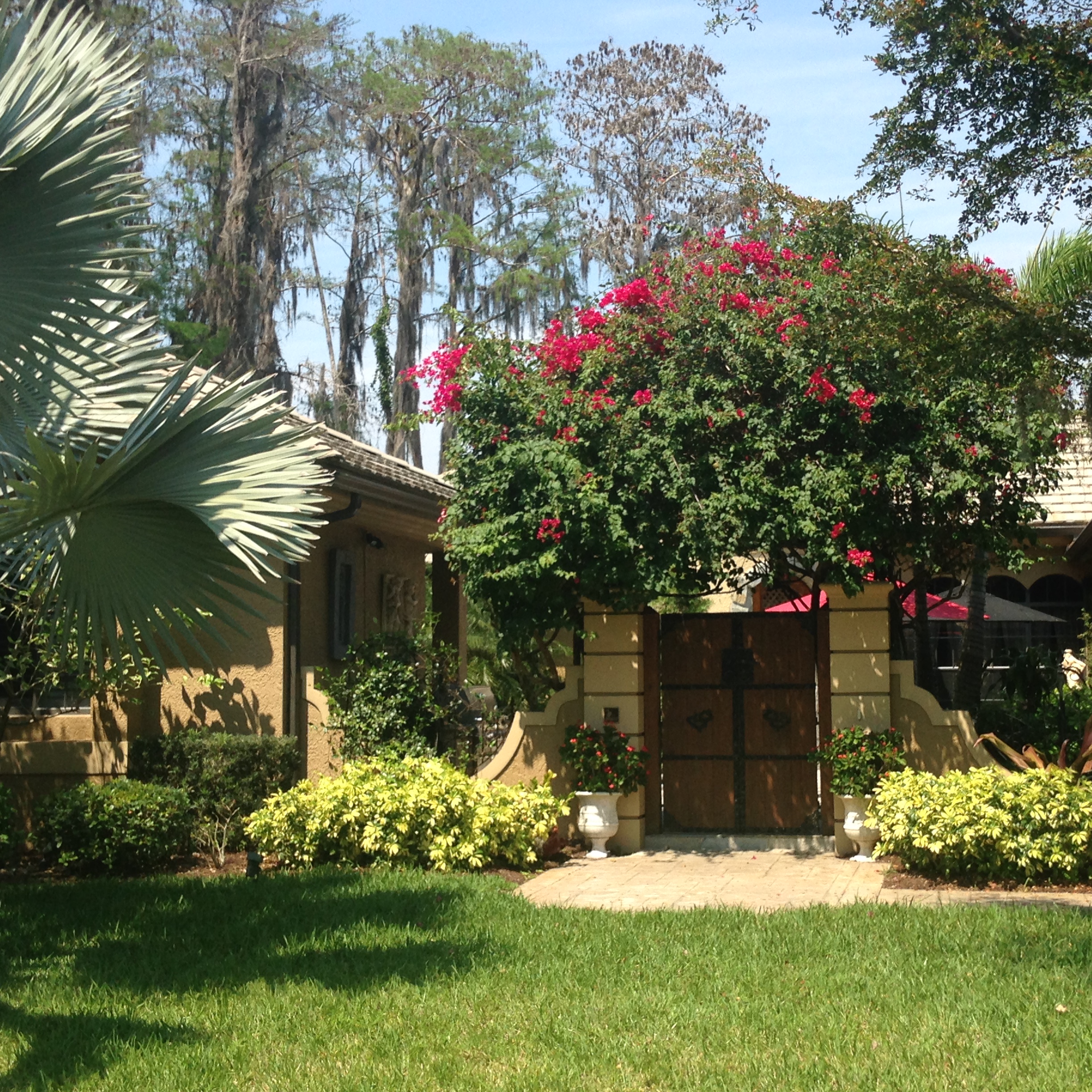
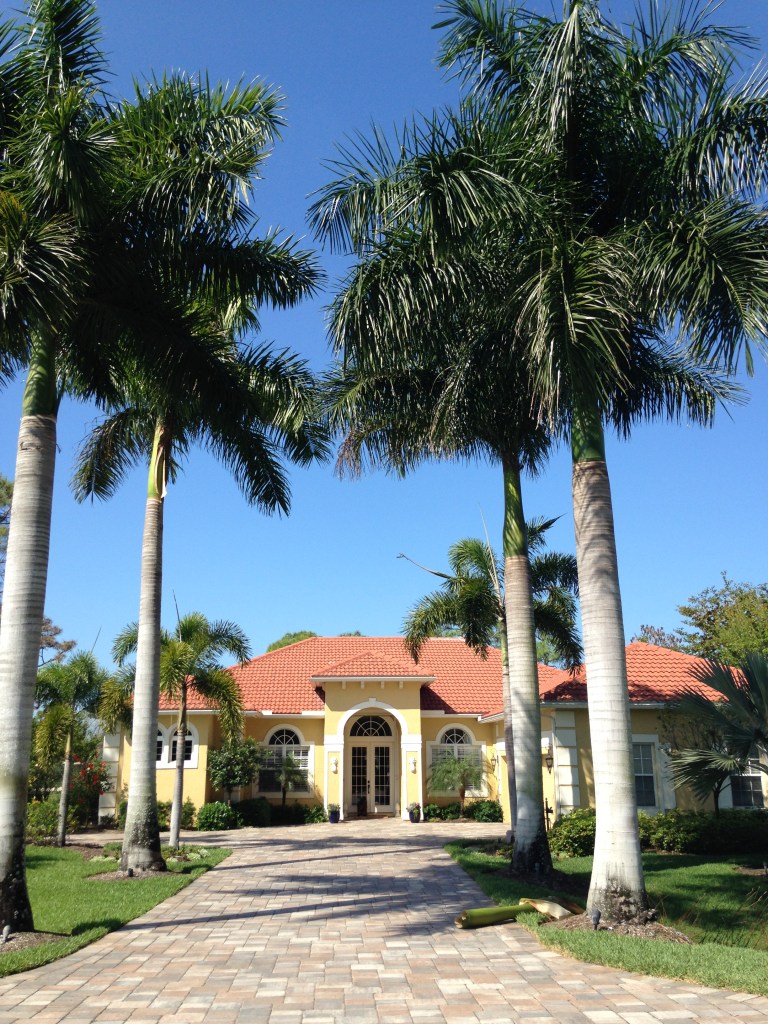
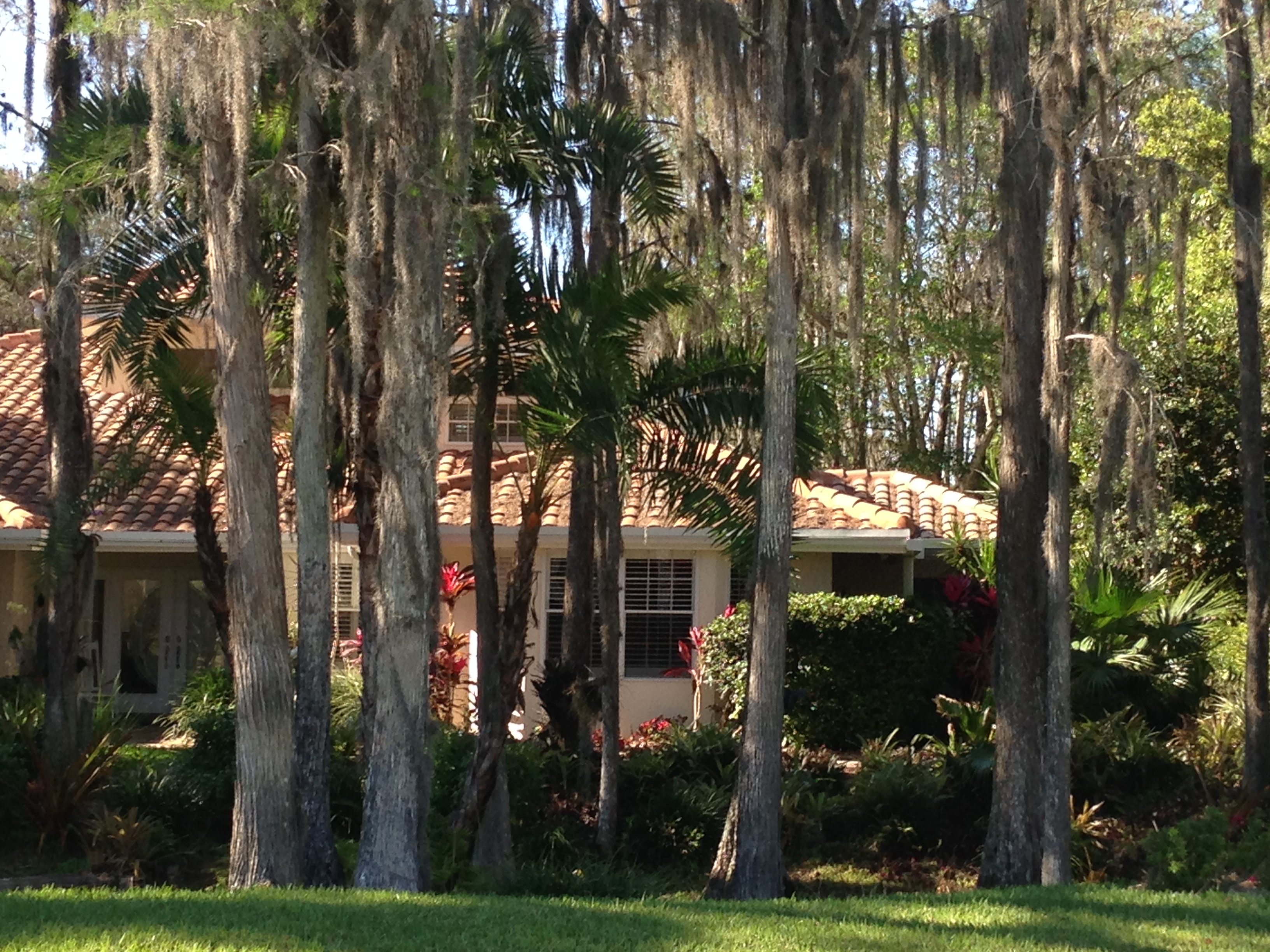
The Fiddlesticks property is stunningly beautiful. Many species of palms — royal, chamel, and saw palmetto live here along with cypress trees draped with hanging moss. Bougainvillea climbs up trees and around doorways and walls. Sometimes it stands alone, a ten-foot bower of dark pink. Dense plantings of begonia, alyssum, Tradescantia ‘Purple Queen’, hibiscus, impatiens, and petunias line roadways, swirl around houses, surround trees, congregate at corners, and form islands. Color, scent, and texture are everywhere. Lawns are edged, manicured, and irrigated with underground sprinklers fed by recycled wastewater from the community. As I rode my bike each morning in and out of the different ”villages” and around the golf courses, I couldn’t help thinking, how lovely. This gated and guarded community is only one of many in the area. How nice it would be if most of us could live in such a place. But most of us don’t.

IMG_0052

Fiddlesticks Home

One mile outside the gates of Fiddlesticks is the “real world.” Eight lanes of traffic sprawling on and on bordered by one unattractive shopping center after another. There are no trees or flowers, not a scrap of nature anywhere. This vast suburban sprawl goes on for miles in every direction. One marvels at the ability of so many stores to stay in business. One marvels that we perceive we need so many things. Tucked amid and behind the commercialism are the small tract houses and trailer parks of the not so-well-to-do. In their neighborhoods a scraggly palm leans here and there; sometimes a pot of orange geraniums or pink impatiens sits on a porch or stoop.

9022d6f8-dde8-4838-99e4-88e62739a7b0

FL Trailer Park

I’ve never seen a more vivid picture of how wealth equates to plenty of comfortable, beautiful space and lack of wealth equals lack of space, beauty, and comfort.   Those who have, have the best places. Those who have not, have the worst ones. I guess it’s the American way–exaggerated in this particular locale to the point of   unpalatable absurdity. In a culture that equates success with money and money with a nice place to live, our newer cities are bound to look this way. What happened to open space and parks?

Unfortunately, many American city parks and even some suburban ones have degenerated to meeting places for criminal activity and dumping grounds for old furniture and tires. They are unsafe, scary places. These planned green places originally were built as space for us to reconnect with nature and recharge our inner and outer selves. Why have they failed? Are the many trees and bushes to blame because they are good hiding places for muggers and rapists? Or is it that we don’t have enough police and security people patrolling should trouble arise? Perhaps it is because we don’t use then enough because they are dangerous, and they are dangerous because we don’t use them enough — a vicious cycle.

Jane Jacobs, who wrote The Death and Life of Great American Cities, believes that in order for public spaces to be dynamic, safe and people- filled, they must intersect. She says in an interview in 2001,” In a real city or a real town, the lively heart always has two or more well-used pedestrian thoroughfares that meet. In traditional towns, often it’s a triangular piece of land. Sometimes it’s made into a park.” This kind of park is not pushed off to the outskirts of a town or city; it is an integral part of it. And that makes it both user friendly and safe.

In Southwest Florida, a few county and state parks sit along the Gulf of Mexico where those who can afford the five-dollar parking fee may swim and sun themselves. However, another park, the Six Mile Cypress Slough Preserve is free and volunteer guides will take you on a ninety-minute walk through a preserved cypress slough (a moving swamp) filled with birds (some endangered), plants, and animals that wouldn’t be in the area otherwise.   The park closes at dusk and large steel gates make sure no one can enter to make mischief or to hunt for alligators. Again the problem of open space attracting troublesome behavior.

Perhaps these predators in our parks are trying to tame the wilderness, exerting control over our natural world. Or are they dominating that of which they are afraid?   Perhaps their psychoses require an outlet, and dark, brushy spaces are a conducive environment for heinous acts. Or maybe drug addiction prompts them to prey on victims in the easiest places, those empty and unpatrolled.   Whatever the provocation, parks evoke a wilderness in an urban environment that harkens back to when primitive man began to “tame” it.

Thousands of years ago man tamed the wilderness, cutting down the trees and cultivating the earth. This huge leap in the way we lived removed us from one place and put us into another. We separated ourselves from the natural world, took ourselves out of it psychically and physically. Even though we still prayed to gods and goddesses, made sacrifices to ensure good crops and prosperity, we “created” our own food, rather than “searching it out” in the wilderness.

When the Romans arrived in the Netherlands around 150 B.C., they found a people that they described as blue skinned because of the cold, swampy conditions of their environment. At that time, the Netherlands was a series of terps (manmade mud hills) amid swamps and lakes. It was cold, damp, dreary and rainy. The “Nederlanders” ( below the land), as they are still called, and their land were quickly passed over by the conquering Romans. Who would want to live in such a place?   Yet through incredible ingenuity and imagination, the Nederlanders developed their bit of land into a thriving place by manipulating too much water into a maze of dikes, waterways, and locks. By the twentieth century, they had increased the size of their country’s landmass by twenty-five percent. And by inventing and using windmills they were able to grind grain, process lumber, operate the locks and eventually produce electricity.

One might argue from this example that landing in the better place does not always ensure having the better life. It is human imagination together with a positive attitude and cooperative spirit that can create a productive and comfortable living space out of a swamp.

Take the Yucatan village, Nueva Vida (New Life) as a modern example of what man can do if so motivated. This village was begun as an experiment at the edge of the Calakmul Reserve as an attempt to save what was left of the wilderness reserve. For centuries, the natives had slashed and burned the dense forests in order to grow rows of corn. Every three years they moved on to a new place because the poor soil was used up. Nuevo Vida has changed that cycle by not cutting down all the trees and not growing corn. Instead, these ancestors of the Mayans live in the forest, clearing only a small area of land. They grow crops, plants, and trees that thrive in this environment — lime and papaya trees, bunched plantings of cilantro, lettuce, and chaya (a high protein leaf crop). The cooperative of thirty-six families works together composting, cultivating, building cisterns and high peaked houses, and gathering medicinal herbs from the forest. Recently they began beekeeping. Where once they subsisted, they now thrive – in the same place but with a different understanding.

Finding a new and different understanding of how to live has prompted humankind to create utopian societies particularly in the nineteenth and twentieth centuries. Some of these “utopias” were inspired by religion, others were inspired by political ideas, and still others by aesthetics. Some such as, the Branch Dividians in Waco, Texas or the People’s Temple in Guiana began innocently and ended in tragedy. Others resembled tidy perfectly neat towns like Columbia, Maryland which was the first entirely planned city built in the late 1960s and early 1970s by James Rouse. Everything in Columbia was pre-planned and approved from street signs to house colors and construction materials to commercial areas and landscaping. Critics called it “Milton Bradley Town” after the maker of the board games Candyland and Chutes and Ladders.

Utopian societies created from religious ideals such as the Shakers have vanished, but the Amish culture still survives and thrives. The Amish believe in living a simple, plain life close to God and the earth. This belief informs their idea of living a kind of heavenly existence on earth. Although some of the Amish have adopted the use of modern conveniences such as cars, computers and telephones, they have picked and chosen which things and how much they will be incorporated into their lives. They may use electricity at their work places but not always in their homes. One thinks of the Amish as a group both unwilling to change and uncertain of change. This is not true. More and more Amish are going into business. In 1990 in Lancaster County, Pennsylvania the Amish owned 1000 businesses. Now they own 2000 businesses. Unlike “regular” American businesses whose failure rate is 50%, the Amish have a 5% failure rate. And this is while doing business on their own terms within the values and beliefs of their religion, culture and life style.

The Amish who work at and own the Amish market near my home in southern Pennsylvania use telephones and computers at their market, but many don’t at home. They still dress in plain black clothes with no buttons or zippers and only bath on Saturday evenings. Most Amish live on family farms where they grow their own food and keep dairy cows and pigs. Extended families living together is the norm. Theirs is a tight knit community where they know and help one another with child tending, harvesting, and building.   This dependence on each other fosters their unique lifestyle and helps them to grow and prosper. Although they have become merchants by opening Amish markets that cater to consumer-minded Americans, they retain their core values and beliefs in the non-material. It’s an interesting contradiction.

For example, my sister recently attempted to buy some outdoor wooden furniture from the Amish market owners. Initially, they were delighted to sell several pieces to her until they learned that the furniture had to be shipped to Holland where my sister lives. As Matt, the Amish owner, explained to my sister, they had no idea how to do this nor did they wish to do it. My sister couldn’t understand this thinking. Being a businesswoman herself, she thought she was expanding their market. Her friends in Holland would want to buy Amish furniture too once they saw my sister’s. When she explained this to Matt, he said he didn’t want to expand his market. He said it would be too stressful to ship furniture to Holland. He didn’t care about the money. What was he going to buy with the extra income? What did he need? He was contented with what he already had.

I wonder if Matt would say the same thing if he wasn’t Amish and lived in a trailer park next to a Saks Fifth Avenue in southwest Florida? Out side of his Amish community Matt would quickly become a member of the ‘have nots.’ Inside the Amish community, he is has all that he needs. He feels he is prosperous. I wonder if mainstream American culture is capable of forming communities where people work together like the Amish or the Mexicans in Nueva Vida to create a fairer, less destructive, more beautiful, more prosperous place? I wonder if we, as individuals, have the courage to work and to do business within the limits of our values and beliefs? How many of us have the courage to say, “no”?   I wonder if we are capable of imagining a society where no bad places exist?