mothering

Packing Up

img_0545

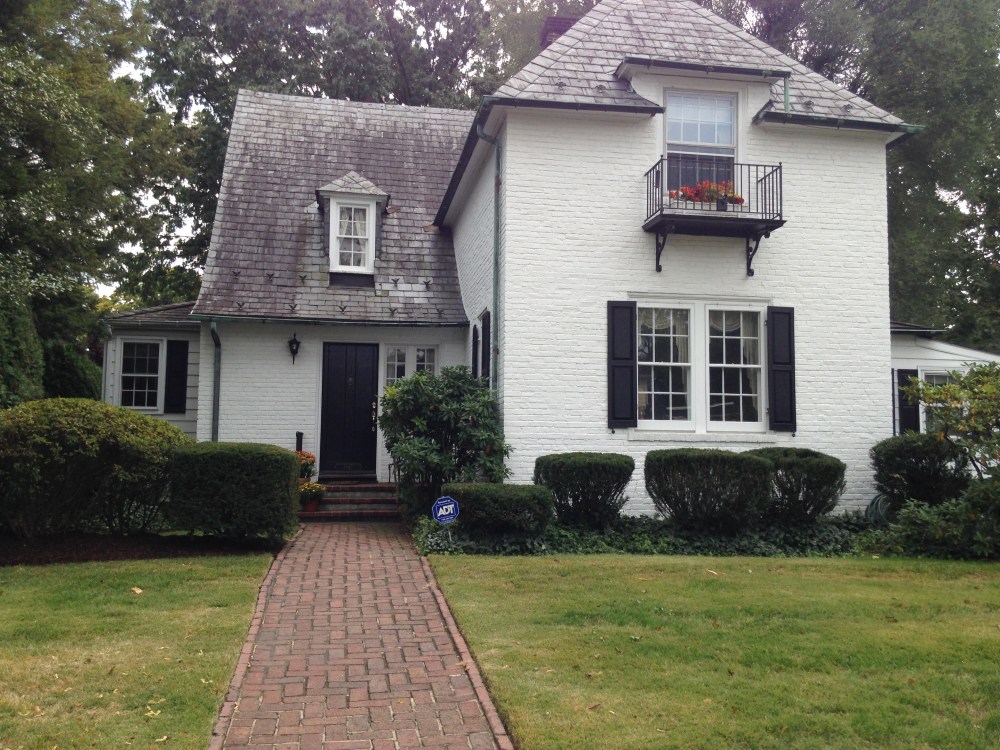
Paul Avenue

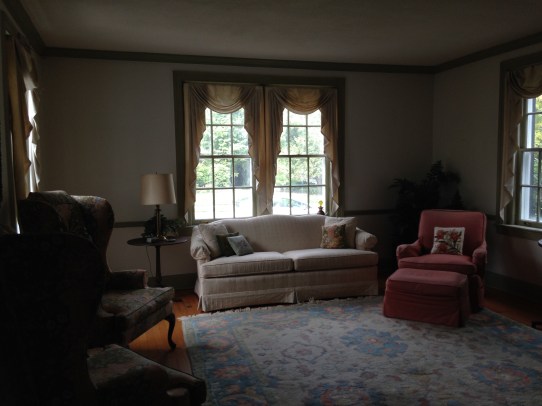
Everything was old and tired and worn. The chintz on the wingback armchairs was split and the green background in places had faded to near white. The small Art Deco vase that had sat forever on the Queen Ann table was chipped. The off white silky drapes hung limp; gray dust shadowed their folds. The house smelled old and empty and untended.

I sighed and thought how everything in my childhood home looked exactly as it had 35 years ago, only totally spent. It was surreal. It was strange. And, it was weird. It looked as if my parents had up and left one day leaving everything in its place, as if they would return in a short time. They didn’t.

My mom had died two years earlier. My dad was in their Florida condo and was too ill to help me. He said even if he was well, he just couldn’t bear to do it.

I was there to pack up.  I felt the hook in my chest, the tension headache coming on, so I breathed in deeply and exhaled slowly, just like I do when I’m practicing yoga. Packing up. Packing up, I kept thinking. How can I do this? It’s too much: too much to deal with emotionally and physically.

A 3,000 square foot house lived in for 60 years and packed, and I mean packed. Packed to the gills. Every drawer, closet, and room contained stuff. Every empty nook was filled. The basement rafters and crawl spaces were jammed full of old bent curtain rods, dirt covered Lionel Train boxes, paint cans, plastic covered fabric from the sofa slipcover back in 1963. You get the picture.

And then there was the emotional part. My mother had loved this house on Paul Avenue, poured herself into its appearance and decoration. This was her home. This was the last physical expression of whom she was that I would experience. And I was in charge of taking it apart.
img_0499

Our Living Room — Unchanged for 35 Years

Every object, painting, chest, table, piece of crystal or china had been chosen and placed by my mother’s eye and hand. She’d created the still lives on the tabletops, the bookshelves, and the mantel. As I walked from room to room, I remembered when we’d driven to Lahaska, Pa to look at the 19th century chest in the dining room. I remembered learning to dance the jitterbug with my dad in front of the 1950’s oil painting of the bridge covered woodland stream. Now two years after her death, the dried pomegranates she’d arranged in the silver bowl five years ago sat dust covered in the center of the dining room table. The dozens of family photos sat crowded together on the piano as usual. Memories leapt out of everything. Pictures, movies unreeled in my brain. I grew up here, was happy and sad here, argued and laughed here.

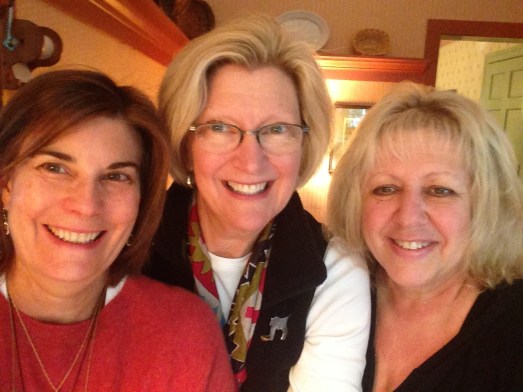
Fortunately for me, I wouldn’t have to pack up all alone. My two childhood friends, Cheryl and Fran, helped me a lot. We spent whole weekends together. My partner, Kevin, came several times helping me to make decisions about what to keep and what to toss. My twin 24-year-old daughters helped too. And through the relator, I had the help of the dismantling-sixty-years-of-stuff expert, Nancy. Taking apart my mother’s home took 10 weekends of cleaning out and packing up.
img_0610

Rosemont Mini-Skirt Mob

It was hard, really hard especially that first weekend. By the end, I’d hardened. I’d become an expert at throwing away without remorse. I threw away the three dozen framed photos on the piano. We all had these pictures in our own homes. I even threw away the hundreds of photos of long dead ancestors. No one had any idea who they were. Chipped crystal and china that my mother had loved so much she’d kept the damaged ones, I tossed without a pang. Dirty, faded crewel pillows I’d embroidered for my mom 40 years ago, into the Hefty bags they went.

We recycled what we could. Old towels and sheets went to the animal shelter. Dr. Clutter, a recycling company, picked up three truckloads of stuff.  Weekend by weekend, Paul Avenue changed from being somehow my mother and my mother’s home to a house. A pretty 1920’s painted brick house with a slate roof and the original cooper gutters. A very desirable house to old house lovers according to the dismantler, Nancy and the realtor, Barb. As my friends, daughters, and I cleaned out and packed up together, we reminisced. Rooms and objects brought up old stories, some we’d forgotten until then. Yes, the house was packed with a mountain of stuff, but it was packed even more with our memories.

On those packing-up weekends, I was a teenager once again, laughing with Cheryl and Fran about sleepovers, remembering the dinner parties my mother made for our group of six girlfriends. My twin daughters, Anna Lou and Campbell, and I talked about the weekends spent with my mom and dad at the pool or the golf course. We laughed about how Anna Lou had peeled the wallpaper off of the bedroom wall during her nap. (I’d thought my mom would be really upset; she wasn’t.) As we packed up the kitchen, Campbell reminded us of my mother baking blueberry pies and never being too busy or too tired to make French toast or sit at the kitchen counter and play a hand of gin.

I realized dismantling my mom’s house wasn’t getting rid of my mom or my dad or my life. I realized we were dismantling a place that was once beautiful and interesting and meaningful – and now it wasn’t. Just because it was gone didn’t mean it was gone in my imagination. I could be right back in our living room or kitchen or my childhood bedroom, anytime I chose.
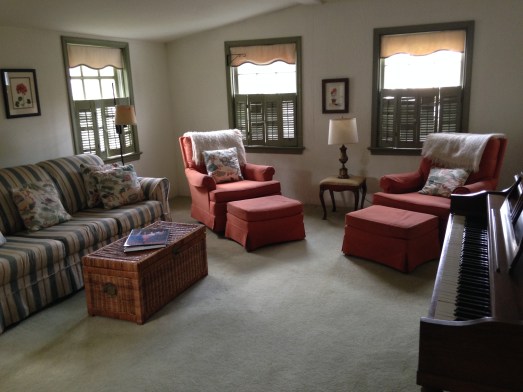
img_0500

My Parent’s Den and Their Two Chairs

I realized too, that family traditions and rituals go on. We still have my mom’s blueberry pie and special muffins every time Campbell bakes them for us in my mom’s muffin and pie tins. I use my mom’s sterling forks, knives, and spoons in our home now. She’s with me at every meal. Anna Lou wears my mom’s gold scallop shell locket and remembers long heart-felt talks with her Nana about what’s important in life and how to see the world as a place of love and beauty and possibility.

Paul Avenue sold on the first day it was on the market – we had five contracts, most over the asking price. A young woman bought it. She fell in love when she walked into the dining room and looked out its many windows to the sweet brick patio and original fishpond surrounded with hostas, rhododendrons, and hemlocks. The same view my mom had fallen in love with sixty years earlier. A circle.
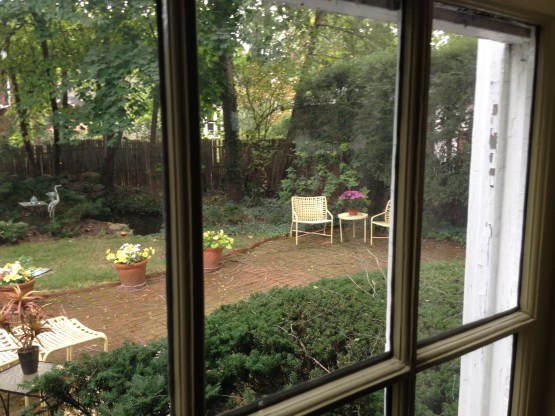
img_0542

My Mother’s Favorite View

Now, many months later, I consider my stuff and begin clearing out. I’m reading Paris In Love, a memoir by romance novelist and English Lit professor, Eloisa James. She packed up and cleared out most of her stuff after she recovered from breast cancer. I’m also reading The Life-Changing Magic of Tidying Up by Marie Kondo.   I totally get why clearing out makes you feel lighter and freer. I totally get why some stuff is a burden and some stuff isn’t. It seems to me that stuff has a shelf life. When it’s expired, pack it up.
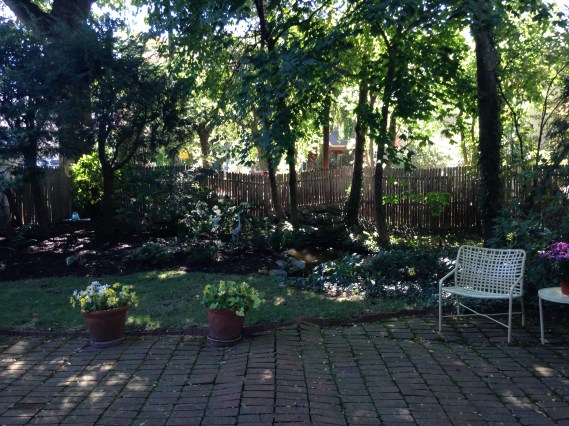
img_0568

The Fish Pond and Patio

Snippets — Renewing in the ADK

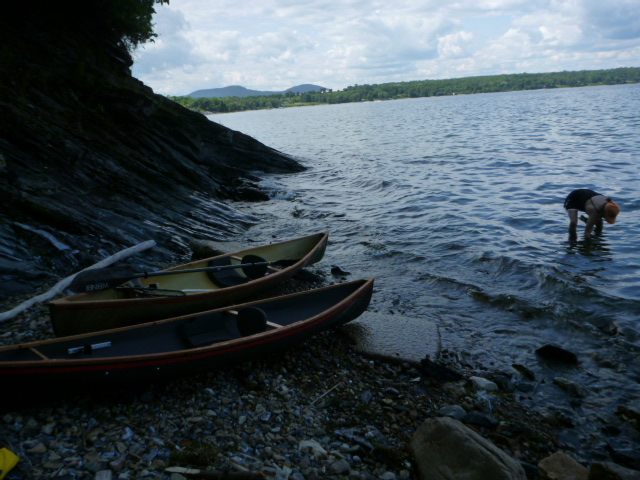
Two Hornbeck's on the shore of Lake Champlain

Two Hornbeck’s on the shore of Lake Champlain

I usually write essays, drafted and tinkered with over many weeks — sentences and words agonized over and then agonized over once again.

Now after 5 weeks in the ADK, I want to write only snippets. Too much has happened in these past weeks.  I could write a bulleted report of my doings but that would not only be boring but would only scratch the surface of my experience, would leave out the most important part — how I came to be more of who I am, not restored after the terror of the past three plus years, but  renewed.

Over these weeks, I have discovered through moving my body and mind and soul through experiences as diverse as restorative yoga, paddling rivers, hiking mountains, grading students’ essays, chatting with friends, attending concerts and theater, shopping, eating, and visiting with family and friends that I am different from when I left Stewartstown, PA.  I am my old self and my new self.  The anxiety, pain, and fear that was my daily and hourly experience has vanished, and I am in a foreign land, one in which I want to stay, permanently. If I had to sum up my new place, it would be with one word — perspective.  My perspective has shifted, shifted to a place that I plan on staying for quite awhile. It feels so  good to be here, seeing and feeling from this place that current or future conditions can’t shake so ferociously.


Freedom, Space, and Women Out of Doors

Freedom, Space, and Women Out of Doors

Outside I can see in a way I can’t indoors.  Outside I’m brought back to another rhythm, primordial and familiar.  Wind rustling across acres of dry corn stalks grounds and rejuvenates me. When children and work bear down too hard, I yearn for the freedom of space and the possibility of adventure.  I yearn for the freedom to breathe fresh air.  My breath moving in and out, my chest rising up and down purges the stress and clutter I’ve collected indoors.  I yearn for freedom from piles of laundry, noisy children, ringing phones, and unmade beds.  Outside those things don’t exist.  Looking out over miles of rolling hills gives me the illusion of escape.  Escape from routine, escape from the mother, writer, teacher, homemaker part of me.  I become what I think of as myself.  All the others fall away. The only voice I hear is my own and if I’m lucky, the honks of snow geese flying overhead.

Last Tuesday I walked my three-mile loop in southeast Pennsylvania. Up Hickory Road, down Kefauver Road to Cross Mill where I stop and stand by the mill stream in cold weather and sit in the cooling water when it’s hot.  It’s halfway.  Peaceful weeping willows sway on the ripples; minnows scatter when I step off of the bank.  I listen to the water’s gurgles and chuckles as it flows towards the village of Crossroads.  I walk around the restored mill, painted milky red.  The dimples in the original glass panes act as a prism reflecting mauve light. It’s nice bored teenagers didn’t break all of them years ago before this place became a tiny park.  A framed sign stating opening dates, demonstrations and times is attached to the wall beside the front door.  Cross Mill, donated by its last owner Harry E. Cross, ran continuously from 1826 until the 1980’s.   An undiscovered treasure of a place, it is on both the National and Pennsylvania Registers of Historic Places.  And although it is one of the York County Parks, it is lovingly operated and meticulously tended by a local volunteer group called, Friends of Cross Mill.

I walk on — up the steep hill to Pheasant Hill Farm where they breed pheasants and quail for hunting.  The two hundred acre farm rolls out along a wide ridge and down to shrubby hollows thick with deer.  People come here to hunt and shoot these birds, bred solely for this purpose.  One wonders the sport of releasing birds born in captivity, hand fed, and then let go in the nearby fields of dry Amaranth only to be chased by dogs and shot.  The hunters do wait a bit after the birds are released. Then they use dogs to flush the disoriented birds into the air so they can be shot in flight.

Paullina Brandreth would be outraged.

Brandreth grew up in the late 1800’s where she spent much time on her family’s 24,000 acres in the Adirondack Mountains.  There she hunted pheasants, bear, and deer. From the age of nine she wrote hunting and fishing articles under the alias, Paul Brandreth and as an adult in the early twentieth century, she waged an editorial campaign for still-hunting when it wasn’t popular.  Still-hunters stalk their prey alone, waiting motionless in places where deer, or birds travel or rest.  They do not shoot their prey until they have a clear kill shot.  Brandreth decried hunting deer with dogs, or driving deer with groups of men toward the gunners.  She was successful.  Today still-hunting is the most popular way to hunt deer in many states.  However, on private hunting camps and farms where the animals are bred, the rules do not apply.  I wonder how much it costs to kill a semi-tame pheasant.

As I walk by the farm I hear the pop of a gun close by.  I marvel that people can march around fields and woods with rifles and shotguns slung over their shoulders or across their torsos posed to shoot if anything suddenly appears.  Bullets from a rifle can travel up to one mile. Shot from the shotguns these pheasant hunters are carrying can travel more than one hundred yards, and I’m only fifty yards away. The hunters look at me and keep walking, thankfully, in the opposite direction, their dogs sniffing along the ground searching with their noses for those terrified birds.  I think about freedom, the hunters’ freedom to hunt and to have an adventure.  I wonder who am I to dictate how they shoot those birds.   I’m not opposed to hunting per se, just the sort of hunting that resembles a trap shoot.

I don’t always walk on the road; many times I walk in the woods or in the fields.  My decision is often based on whether it is hunting season or not.  I don’t like getting shot at. Hunting season begins here in November and ends in early March.  Then I waken to gun shots most Saturday mornings.  I resent the inability to walk up through the woods behind my house and down the other side to the stream during those months. When hunters are about, I may be mistaken for a deer.

And since I’m a woman, my sense of freedom has to do also with my ability to feel secure from harm by men.  In the city or suburbs I’m aware of those around me, those that might do me harm.  In the city I may become their prey.  At least in the country when it’s not hunting season and I’m bushwhacking in the woods or across fields this is not a concern.  The possibility, the reality of freedom exists there. And that nagging awareness of possible danger, which all women experience whenever they’re outside, vanishes.  I’m free and completely safe.  I’ve spent entire afternoons lying, relaxed and unafraid, on an ensolite pad in the middle of the woods reading a book and snoozing.   I’ve always felt safer off the trail in the woods than anywhere else outside.

I suppose Gretel Ehrlich, who wrote The Solace of Open Spaces, felt safe from men, at any rate, when she was a shepherd in Wyoming. Being thirty miles away in any direction from another human being would provide that security at least.  But then she had other concerns.  No phone, no contact with anyone for two weeks at a time.  That is a sort of freedom and a sort of confinement. Freedom to roam wide open spaces, setting one’s own pace and thinking what one will and the confinement of being isolated and unable to leave. Ehrlich loved the wide openness of Wyoming writing, “Space has a spiritual equivalent and can heal what is divided and burdensome in us.”  Yet she felt the duality of such freedom: “There’s too much of everything here. I can’t pace myself to it.”   She spent her days outside looking over one hundred mile views and hoping she’d find the next water hole for her thousand sheep and the small trailer filled with food and water for herself.  She was afraid she wouldn’t find them.  But she or the sheep always did.

Space represents freedom and adventure, but also danger and its sister fear.  When we’re outside there’s no shelter from predators imagined or real.  Alone outside we recognize our vulnerability, but we also recognize our willingness, our trenchant desire to be where the action is.  We want to attend the show, see what’s going to happen next. We know we’re vulnerable to the physical elements of weather, people and animals.   But we also know we’ll be present to hear wind playing music on 100 acres of dried corn stalks, to see trout lilies’ and spring beauties’ first blooms, to break ice thin as sheets of rice paper edging a stream with our boot. That is what draws me — this yin and yang of my recognized vulnerability and my willingness to be vulnerable at the same time.  It’s a trade off.  If I want to be outside then I have to take some chances.  Will I be cold, hot? Will I chance upon a fox trotting by pretending he doesn’t see me?  Will I see a hawk snagging a rodent, or will there be men with guns? We go outside to be surprised.

Last week I decided to take a different route when I came to Pheasant Hill      Farm.  I walked up Rock Jim Road to a place where I couldn’t be seen from the farmhouse, barns, and pen.  Then I struck out across their fields, aiming for the woods and stream behind my house – a short cut of sorts. I was trespassing, but I didn’t care.  I wanted something new, something daring. I got down to the stream and realized that finding a place to cross wasn’t going to be easy.  The water was deep and rushing after rain the previous day.  I walked up and down the bank thinking how foolish I was not to have considered this possibility.  My feet were going to get wet; the water everywhere was over a foot deep.  I found an old log light enough to push into a shallow section of the stream.  It only went half way.  I crossed on the log, stepped off and sloshed across.  Suddenly as I stepped onto the bank, a gunshot pop popped up the steep hill to my left.   How foolish of me – all for a change and a thrill.  I walked quickly to the right staying low along the stream bank aiming for the open fields adjacent to the woods.  That field I knew was posted and safe, even though it took me completely off course and made my original short cut a long cut. As I squished in my boots up through the breaks in the dry corn I felt exhilarated.  I had had an adventure of sorts, albeit a very small one.  I reached McCleary Road; home was around the corner.  The neighbor with the green Ford truck waved as he drove by.  I was back in civilization, feeling as though I’d just come back from a stint in the wilderness.