Appalachian Mountains

Adventure Calls

dolly-sods-wilderness-area-west-virginia-mark-vandyke

Dolly Sods West Virginia


Adventure Calls

After I’ve been cooped up in my office for too long, I yearn for an adventure that doesn’t involve hosiery or cell phones.  I long for the rush of a wilderness adventure with all its real and imagined dangers.  One where I’m camping along the Yukon River in Alaska one hundred miles from anywhere, watching grizzly bears come down to scoop up twenty-five pound salmon with their paws.  Or one where I’m backpacking in the Appalachian Mountains and a black bear sniffs around my tent.  But I don’t want too much danger.  Not like the adventure two mountain bikers had in California when they encountered a mountain lion while mountain biking.

They were riding along a narrow brushy mountain trail, talking about life and the scenery when suddenly a mountain lion leaped out and swatted one of the women off of her bike.  The mountain lion chomped down on her head, dragging her into the brush as her friend grabbed hold of her legs and pulled, screaming at the predator.   Luckily another biker came along and heard the screams.  He ran into the brush, picked up his bike, and threw it at the mountain lion all the while yelling as loudly as he could.  It worked. The lion slunk away and the injured woman was flown to shock trauma.  Later that same day rangers found the remains of another man also taken by a mountain lion, perhaps the same one.  The fellow who saved the day told the National Public Radio correspondent that he’d never go mountain biking alone or in that part of the mountains again.  I wouldn’t either; that’s too much adventure for me.

I think we forget that there is danger in the wilderness, in the woods and in the mountains of this country.  We’ve developed so much of it into cities, towns, farms, and suburbs that we forget another world is out there. And it’s not tame.  I’ve been reading Annie Dillard’s, Living Like Weasels.  She tells a story about a naturalist whom a weasel bites on the hand:   “The man could in no way pry the tiny weasel off, and he had to walk half a mile to water, the weasel dangling from his palm, and soak him off like a stubborn label.”   What a terrifying picture I had in my head after reading that.  Or the story I read in Adirondack Life magazine about a group of college students who tried to ascend 46 Adirondack high peaks (over 4000 feet) during a nineteen day Christmas vacation.   They didn’t make it.  One of them fell on a steep slop and luckily only sprained an ankle.  Still it took all day to get him out with the others carrying his equipment through snow so deep they “found themselves walking on the tops of small trees.”  People die in the Adirondack Mountains in the winter.

I don’t want a wilderness adventure that intense.  I don’t want to be traumatized or injured.  I don’t want to come out damaged, psychically or physically.  I want a wilderness adventure that will reconnect me with nature, one where I will be astonished and amazed, exhilarated and perhaps a little bit frightened.  I want a wilderness adventure like the one I had backpacking in the Dolly Sods Wilderness Area.

It is Memorial Day weekend and my husband, our dog, Jo, and I go backpacking every Memorial weekend in Dolly Sods.  Dolly Sods, West Virginia is a special place because it looks exactly like the northern Canadian tundra although it is only five hours away from Baltimore, Maryland. Timbering and fire changed the entire ecology of the mountain’s ridge in the 1800’s.  Before that happened, Dolly Sods was covered with seven to nine feet of humus and a red spruce and hemlock forest where, according to the Dolly Sods web site, “the average tree was four feet in diameter.”  After the forest fires and timbering, the rich land became a thin rocky soiled moor covered with bogs, streams, and dwarfed, bent evergreens about six feet high and 100 years old.  In 1975 Congress designated it a wilderness area. Congress didn’t need to tell us it was a wilderness.  We already know.

We love going to Dolly Sods at the end of May because anything is possible.  Sometimes it’s warm and the wild azaleas are blooming, fragrant flame orange.  Sometimes we hike across glacier-like snowfields three acres wide and two feet deep.  We have to be prepared for snow or rain or mosquitoes and 75 degrees.

We arrive mid afternoon and hike down the Blackbird Knob Trail a couple of miles to Red Creek.  Red Creek is about twelve feet wide and in most places no more than six inches deep.  We camp by its banks, eat freeze-dried shrimp, and  homemade spaghetti and drink cabernet.    We are back in heaven.

Dolly Sods Brook Stream

Red Creek

The next day we hike five miles further along the trail through the forest and back out into open land.  I love the openness and the views especially after the cloister of the woods.  We camp again beside water, this time a small brook with steep 3 ½ foot clay banks

At about 5:00 AM I wake up.  I feel as if I’m floating, as if I’m sleeping on a waterbed.  And in a way I am.  It’s pouring, and the floor of our tent is sitting on an inch of water.  I awaken my husband.  About an hour later at first light, the rain becomes a drizzle. We gulp down some granola and water, pack up our camp and walk to the water’s edge.  The brook has risen to the top of both banks and it’s rushing, not with too much force but enough to knock us over.  We hike up stream and find a spot where the water looks calm but is four feet deep.  If we walk  across we’ll be soaked and the clothes in our packs are already damp.  We can’t afford to walk seven miles in wet clothing when the air is 50, maybe 55 degrees.  It’s  perfect hypothermia weather.

So we take off our clothes and boots and walk across naked with our packs on top of our heads like African women carrying their laundry.  The water is surprisingly warm. Jo swims across and then shakes on the opposite bank as we dry off, get back into our clothes and boots and hike on.  At the next stream, we do the same thing.  It begins to rain lightly as we got closer to Red Creek.  I am feeling quite macho, high on adrenaline, and into the whole wilderness experience.

When we arrive at Red Creek, it has turned into a raging river, twice as wide, who knows how deep, large boulders sending waves of foaming water into churning whirlpools.  Three guys stand soaking wet, on the other side yelling at us.  We can’t hear them over the roar.  They yell again as we venture onto a boulder at the water’s edge.  “Don’t try to walk across.  You’ll get swept down stream.  We barely made it.”
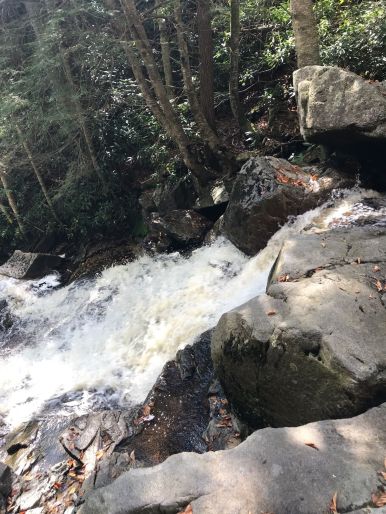
Dolly Sods Stream

My husband wants to get across if we can.  He has power cord, a very strong thin rope only 1/8 inch in diameter and a carabiner, a steel D-shaped coupling link used in rock climbing.  He ties a rock to one end of the power cord and throws it across to the guys on the opposite bank.  They catch it on the third try.  Then they throw it back to us.  We construct a pulley, using the carbiner tied in the middle to ferry our backpacks across.  It works.

Now to ferry a person.  I go first.  This time I can’t take off my clothes, not with three guys standing there.  I’ll have to be wet the last two miles.   I keep my boots on too.  No telling what’s under the water.  I hope the guys are strong enough to pull me across fast because there is a terrifying rapid in the middle of the creek where the latte colored water churns and rises and swirls like a hungry thing.  It has slung each backpack out like a pea in a slingshot ready to shoot it down stream. I am shaking as I wade into the water and grab onto the cord.  I get to the middle. The current sucks my feet off the creek bottom, pulls them down stream and I am suddenly on my stomach, my legs strung out like the tail on a kite.  I hang on as the cord stretches and stretches. All I can see is me being swept away like a twig or a leaf bouncing from rock to rock, unable to grasp anything that can stop me. I can hear my husband yelling, “Pull. Pull.”  And they do.  Just as I think I can’t hold on, the cord relaxes and my feet feel the river bottom.  I have made it.

Jo, our dog is next.  My husband ties her up with a makeshift harness of webbing straps and clips her onto the carabiner.  He’ll go across with her, holding onto the dog with one hand so her head won’t go under and holding onto the power cord pulley with the other.  The guys begin to pull.   Jo’s head is above the water. They hit the mid-stream rapid.  The cord stretches out and out and snaps.  My husband and Jo go flying downstream bobbing and turning under water.  I scream, “Hold onto the dog.  Hold onto the dog.”  I know if he lets go she’ll be swept away and be gone.  My husband grabs onto a rock, pulls himself and Jo into shallow water and they are out of danger.  But they’re on the wrong side.   I’m shaking as we re-throw the cord and tie it back together.  We try again.  I can hardly bear to watch.  They hit the bad spot; the guys pull faster. The cord holds.  They are across.  Shivering, we hug, and laugh and kiss each other.  We’ve done it.

After we get back to the car, change, eat, and have a beer, we are feeling quite triumphant.  We’ve had an adventure, a real wilderness adventure.  It was scary and challenging and daring.  And we had made it.  We feel like pioneers who have survived a flood, modern day adventurers who’ve made the summit.  We can’t wait to tell our friends and our families.  I talk about it for weeks.

Freedom, Space, and Women Out of Doors

Freedom, Space, and Women Out of Doors

Outside I can see in a way I can’t indoors.  Outside I’m brought back to another rhythm, primordial and familiar.  Wind rustling across acres of dry corn stalks grounds and rejuvenates me. When children and work bear down too hard, I yearn for the freedom of space and the possibility of adventure.  I yearn for the freedom to breathe fresh air.  My breath moving in and out, my chest rising up and down purges the stress and clutter I’ve collected indoors.  I yearn for freedom from piles of laundry, noisy children, ringing phones, and unmade beds.  Outside those things don’t exist.  Looking out over miles of rolling hills gives me the illusion of escape.  Escape from routine, escape from the mother, writer, teacher, homemaker part of me.  I become what I think of as myself.  All the others fall away. The only voice I hear is my own and if I’m lucky, the honks of snow geese flying overhead.

Last Tuesday I walked my three-mile loop in southeast Pennsylvania. Up Hickory Road, down Kefauver Road to Cross Mill where I stop and stand by the mill stream in cold weather and sit in the cooling water when it’s hot.  It’s halfway.  Peaceful weeping willows sway on the ripples; minnows scatter when I step off of the bank.  I listen to the water’s gurgles and chuckles as it flows towards the village of Crossroads.  I walk around the restored mill, painted milky red.  The dimples in the original glass panes act as a prism reflecting mauve light. It’s nice bored teenagers didn’t break all of them years ago before this place became a tiny park.  A framed sign stating opening dates, demonstrations and times is attached to the wall beside the front door.  Cross Mill, donated by its last owner Harry E. Cross, ran continuously from 1826 until the 1980’s.   An undiscovered treasure of a place, it is on both the National and Pennsylvania Registers of Historic Places.  And although it is one of the York County Parks, it is lovingly operated and meticulously tended by a local volunteer group called, Friends of Cross Mill.

I walk on — up the steep hill to Pheasant Hill Farm where they breed pheasants and quail for hunting.  The two hundred acre farm rolls out along a wide ridge and down to shrubby hollows thick with deer.  People come here to hunt and shoot these birds, bred solely for this purpose.  One wonders the sport of releasing birds born in captivity, hand fed, and then let go in the nearby fields of dry Amaranth only to be chased by dogs and shot.  The hunters do wait a bit after the birds are released. Then they use dogs to flush the disoriented birds into the air so they can be shot in flight.

Paullina Brandreth would be outraged.

Brandreth grew up in the late 1800’s where she spent much time on her family’s 24,000 acres in the Adirondack Mountains.  There she hunted pheasants, bear, and deer. From the age of nine she wrote hunting and fishing articles under the alias, Paul Brandreth and as an adult in the early twentieth century, she waged an editorial campaign for still-hunting when it wasn’t popular.  Still-hunters stalk their prey alone, waiting motionless in places where deer, or birds travel or rest.  They do not shoot their prey until they have a clear kill shot.  Brandreth decried hunting deer with dogs, or driving deer with groups of men toward the gunners.  She was successful.  Today still-hunting is the most popular way to hunt deer in many states.  However, on private hunting camps and farms where the animals are bred, the rules do not apply.  I wonder how much it costs to kill a semi-tame pheasant.

As I walk by the farm I hear the pop of a gun close by.  I marvel that people can march around fields and woods with rifles and shotguns slung over their shoulders or across their torsos posed to shoot if anything suddenly appears.  Bullets from a rifle can travel up to one mile. Shot from the shotguns these pheasant hunters are carrying can travel more than one hundred yards, and I’m only fifty yards away. The hunters look at me and keep walking, thankfully, in the opposite direction, their dogs sniffing along the ground searching with their noses for those terrified birds.  I think about freedom, the hunters’ freedom to hunt and to have an adventure.  I wonder who am I to dictate how they shoot those birds.   I’m not opposed to hunting per se, just the sort of hunting that resembles a trap shoot.

I don’t always walk on the road; many times I walk in the woods or in the fields.  My decision is often based on whether it is hunting season or not.  I don’t like getting shot at. Hunting season begins here in November and ends in early March.  Then I waken to gun shots most Saturday mornings.  I resent the inability to walk up through the woods behind my house and down the other side to the stream during those months. When hunters are about, I may be mistaken for a deer.

And since I’m a woman, my sense of freedom has to do also with my ability to feel secure from harm by men.  In the city or suburbs I’m aware of those around me, those that might do me harm.  In the city I may become their prey.  At least in the country when it’s not hunting season and I’m bushwhacking in the woods or across fields this is not a concern.  The possibility, the reality of freedom exists there. And that nagging awareness of possible danger, which all women experience whenever they’re outside, vanishes.  I’m free and completely safe.  I’ve spent entire afternoons lying, relaxed and unafraid, on an ensolite pad in the middle of the woods reading a book and snoozing.   I’ve always felt safer off the trail in the woods than anywhere else outside.

I suppose Gretel Ehrlich, who wrote The Solace of Open Spaces, felt safe from men, at any rate, when she was a shepherd in Wyoming. Being thirty miles away in any direction from another human being would provide that security at least.  But then she had other concerns.  No phone, no contact with anyone for two weeks at a time.  That is a sort of freedom and a sort of confinement. Freedom to roam wide open spaces, setting one’s own pace and thinking what one will and the confinement of being isolated and unable to leave. Ehrlich loved the wide openness of Wyoming writing, “Space has a spiritual equivalent and can heal what is divided and burdensome in us.”  Yet she felt the duality of such freedom: “There’s too much of everything here. I can’t pace myself to it.”   She spent her days outside looking over one hundred mile views and hoping she’d find the next water hole for her thousand sheep and the small trailer filled with food and water for herself.  She was afraid she wouldn’t find them.  But she or the sheep always did.

Space represents freedom and adventure, but also danger and its sister fear.  When we’re outside there’s no shelter from predators imagined or real.  Alone outside we recognize our vulnerability, but we also recognize our willingness, our trenchant desire to be where the action is.  We want to attend the show, see what’s going to happen next. We know we’re vulnerable to the physical elements of weather, people and animals.   But we also know we’ll be present to hear wind playing music on 100 acres of dried corn stalks, to see trout lilies’ and spring beauties’ first blooms, to break ice thin as sheets of rice paper edging a stream with our boot. That is what draws me — this yin and yang of my recognized vulnerability and my willingness to be vulnerable at the same time.  It’s a trade off.  If I want to be outside then I have to take some chances.  Will I be cold, hot? Will I chance upon a fox trotting by pretending he doesn’t see me?  Will I see a hawk snagging a rodent, or will there be men with guns? We go outside to be surprised.

Last week I decided to take a different route when I came to Pheasant Hill      Farm.  I walked up Rock Jim Road to a place where I couldn’t be seen from the farmhouse, barns, and pen.  Then I struck out across their fields, aiming for the woods and stream behind my house – a short cut of sorts. I was trespassing, but I didn’t care.  I wanted something new, something daring. I got down to the stream and realized that finding a place to cross wasn’t going to be easy.  The water was deep and rushing after rain the previous day.  I walked up and down the bank thinking how foolish I was not to have considered this possibility.  My feet were going to get wet; the water everywhere was over a foot deep.  I found an old log light enough to push into a shallow section of the stream.  It only went half way.  I crossed on the log, stepped off and sloshed across.  Suddenly as I stepped onto the bank, a gunshot pop popped up the steep hill to my left.   How foolish of me – all for a change and a thrill.  I walked quickly to the right staying low along the stream bank aiming for the open fields adjacent to the woods.  That field I knew was posted and safe, even though it took me completely off course and made my original short cut a long cut. As I squished in my boots up through the breaks in the dry corn I felt exhilarated.  I had had an adventure of sorts, albeit a very small one.  I reached McCleary Road; home was around the corner.  The neighbor with the green Ford truck waved as he drove by.  I was back in civilization, feeling as though I’d just come back from a stint in the wilderness.