The beauty of opposites
Imagine you have spent all day at the hospital sitting next to your 20 year old daughter as she struggles to heal. Imagine that she has been in this hospital for 6 weeks and counting. That she has had blood transfusions, CT scans, MRI’s, and blood tests galore, and still she bleeds internally. The doctors keep trying one treatment and then another. They bring in one more specialist, confer with doctors across the United States, all to no avail. Your daughter has lost 35 pounds she didn’t need to lose; she is 5’10” and weighed 128 pounds before all of this began. As you sit and watch her doze, you work on your laptop answering email from work, work you have no interest in attending to. Your daughter is slowly bleeding to death. And all you can do is be on full alert, learning about her condition, learning about anatomy and physiology and abdominal infections when your expertise runs to organizing teaching workshops and helping students learn to write. You sit and try to do your work and care for your child at the same time, something you have always done as a working mom. Only now you are trying to do both while filled with the kind of terror and anxiety that comes with every parent’s worst nightmare. Your child is critically ill. She is not getting better. She is getting worse.
I leave our home in the morning for my daily vigil at the hospital and go back home at nine PM after the doctors have come by for their daily check in. The doctors are kind and serious and always calm. Their calmness frightens me even more than their newest idea for healing my child.
At ten PM, I am home, numb and wired. My sweetheart and partner, Kevin, has made me mashed potatoes, roasted chicken, and green beans, one of my favorite comfort food meals. There is always plenty of red and white wine. He hugs me, arms wrapped softly around in blissful completeness and waits patiently for me to talk or get a glass of wine or take a shower. He doesn’t hover or ask too many questions. He is there, a quiet, calm, and nurturing anchor, my overnight mooring. My safe-spot for the night.
This was our life for most of two and half long years until today when we are once again doing something ‘normal’, something fun. Today we are light-headed and hearted with the reprieve of sickness and hospitals. Today we wear shorts and T-shirts and feel like children finally let out to play in the warm sunshine. And we are playing, playing in kayaks on the Gunpowder River in Maryland, a place that doesn’t look much different than it has for the past 20 years we’ve been paddling it. As I step into the 50° water wearing neoprene socks inside my water shoes I wonder why my feet always burn with cold before my calves, arms, or hands.
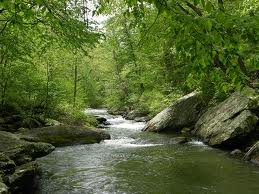
Gunpowder River, MD on a day in June, 2013
“Do you want spiders or ants?” asks Kevin smiling as he puts on his new REI khaki fisherman’s floppy hat. “Spiders”, I say with complete nonchalance. This is our first paddle of the season, and we’re lucky there aren’t worse in our kayaks after the long, damp winter our boats spent overturned on wooden horses on the edge of the woods in our backyard. Earlier we hosed them out but apparently, a few critters have survived our hose tsunami.
As we climb into our boats, the 94°air temperature sinks to 80° on the surface of the 50° Gunpowder River water. Sometimes the temperatures are so extreme between the air and the water that clouds float along the surface rising three or four feet so that it feels like you are paddling through chilly fog on another continent. But not today.
Today it’s perfect. Cold, clear water, bright blue sky, and hot sunshine beat on us in between the oaks, sycamores, and poplars that shadow the river. The pale pink fairy-cap shaped Mountain Laurel blossoms peep out of the jade velvet feather- shaped leaves as they climb up the steep hillside banks, covering them with sweet scent. Invisible Wood Thrush flute back and forth; a Louisiana Water Thrush flies across our path and lands a few feet alone and ahead of us, moving each time we come within the ‘too close’ zone. A Kingfisher scolds and darts in a straight line diagonally in front of us, as a score of colorfully dressed hikers wave and pick their way along the rocky trail running parallel to the riverbank. Their t-shirts and shorts sag with humidity. Patches of sweat circle their armpits and outline their spines as we sit coolly in our boats, dipping a leg overboard or cupping water onto our shoulders, neck, and chest whenever we wish to enjoy the shock and shiver of icy water running down our spines. Ahh. Instant hot to cold.
On this hot June day, we paddle together for a stretch and then apart just as we do in life, chatting about what we each see. It’s nice how we notice different things though we are paddling the same river at the same time in relative proximity. Now we are side-by-side steeped in the quiet that comes with knowing someone better than you know any other. Then a riffle or a shallow stretch appears with only one deep channel, so we part. Kevin asks, “Do you want to go first?” And I, just about every time, respond, “No, I do not want to go first.” Following instead of leading, I can maintain my semi-meditative state. That’s impossible when I’m the one having to pick the watery path through the rocks and riffles, the brushy overhangs and low branches. Sometimes entire trees stretch across the river jolting me into super consciousness. Today, I need my semi-meditative state for it has been a long time since we paddled anywhere together and two years since we paddled the Gunpowder.
My daughter’s illness stopped us in our tracks two and a half years ago. The 125 days in Baltimore hospitals, the middle of the night Emergency Rooms, sitting for hours on a tiny hard plastic chair in a corner of a tiny holding room, my daughter laying half asleep if the pain and fever weren’t too bad or curled in a fetal position if it was. Her father and I or Kevin and I waiting, waiting, waiting for the results of blood, urine, CAT scan and the inevitable admitting and then more waiting, waiting, waiting until there is a clean room (there never was, and so we waited a couple of hours more). Finally a room was ready and we settled my daughter there (the hospital had become so familiar it was a second-home kind of place to her now) and then driving the one hour back home, north to Stewartstown, or crashing several minutes away at my daughter’s apartment. Either place, I arrived wired, tired, and numb. Usually, I drank some wine or took an Ambien or both, and then crashed for five or six hours of a, hopefully, dead woman’s sleep. A sleep without nightmares was a good night indeed.
A sick child is no fun. It takes you by the throat and then the chest, chains you to the floor through an iron claw hooked deep, down inside your heart, and every time you move, it yanks down hard, its steely grip breathtaking and unyielding. And since you can’t surrender or leave town for the islands, you heave yourself up, and breathe knowing only one thing. You will do whatever it takes to save your daughter. Screw the iron claw and the mind-numbing fear. Each time it strikes, you will sit and breathe and gather yourself so that you can perform clearly and calmly. You will continue your dogged act of competence and serenity. You are the mother. You are the one your daughter will take her cue from. If you are steady and collected and proactive, then she will also be. You tell yourself over and over, “if she can take this, so can I.”. In this, there are no choices. We are moving onward, onward, onward. That’s all there is, head up, one foot in front of the other, trudging, trudging, trudging with a pasted smile on your face at least some of the time.
A daily trudge until today, when here I am in this relaxed, semi-meditative state floating on water with birds singing and green everywhere I look — the amazing and beautiful experience of opposites illustrated for me on this river. The sound of dipping paddles, laughing hikers, and silent fisherman is salve to the traumas of these past many months. I smear it all over my consciousness and breathe, smiling and happy. I think, “Be peaceful. Be calm. Let go.” These are my mantras of the past 24 months. I float quiet and far away from those frightened moments. I float quiet at last.
No matter how many times we paddle this river or even the same stretch of this river, it is new-found to me and I think, to Kevin as well. The scene changes: the woods, animals, birds, and people alter paddle to paddle, as does the light, weather and temperature. We have paddled and fished in winter with snow floating down around us, each of us coated in neoprene and wool, warm despite the frigid water. Once we surprised a Great Blue Heron as we rounded a bend, and he squawked and flapped awkwardly trying to move faster than his multi-jointed wings could lift him up and away. We both gasped at the same time, then shot each other a smile that said, “How lucky we are!” To be that close, to round a bend and run smack into energy and being and movement. It thrilled us for days.
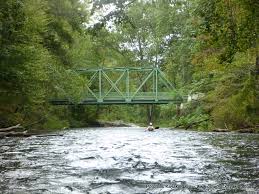
Masemore Road Bridge
Today, we laze along – both in no hurry. Usually, I am the slow one always stopping to look, to see, to get wet. My daughter and Kevin, often chide me for stopping so many times on a hike or a paddle – they complain they can never ‘just go’ when I’m along, saying, “You constantly stop. First, you’re too cold so you put on your jacket. Then you stop a bit later because your boot laces are too tight. Next you have to pee. Finally, when we think we’re on our way and that there will be no more stops, you say you need the green bandanna from your daypack so you can swat the black flies. Since we don’t want you to take off your backpack yet one more time, we spend several minutes rooting around trying to find this much needed bandana aka fly-swatter, as you stand there directing us on its location (which is always at the bottom). But that’s not the last of it. Incredibly, a quarter of a mile later, there’s yet another stop to take your jacket off and plunge it back inside your pack. You are now hot instead of the previous cold. We have come full circle, and finally, unbelievably, we hike on without further delays.”
Since they have embellished their account only minimally, what can I say except, “You’re right.” I’ve stopped defending myself. They don’t care that I want to be comfortable, neither too hot nor too cold. Nor do they understand what they would call my ‘strolling’ versus ‘hiking’. I wonder why we are in a hurry. Who cares how long it takes to get there? The there can be in upstate New York on the summit of Porter Mountain in the Adirondack high peaks, 6 miles and 4000 feet up or a 7 mile paddle on the Chubb, a meandering prehistoric-looking river close to Lake Placid. I don’t believe in rushing when out of doors; that’s what I have to do inside most days.
Even so, I do understand their point – who wants to begin an adventure and then stop unexpectedly a whole bunch of times before you’re halfway there? It wrecks the momentum and annihilates the crescendo of enthusiasm and excitement that builds as you move further along into the wilderness. We all have a hankering to move onward no matter where we are – advocating for medical expertise or walking in the woods.
Today, Kevin’s only comment to my voicing, “I’m going to pull over to this bank for a minute” is, “of course you are”. I know he is warmed by my unchanged pattern. Maybe our lives have seen drastic changes because of my daughter’s illness, but we are still essentially the same. This stopping along the way is an affirmation for each of us. We have once again reclaimed the peace of being together out of doors.
Six months ago, I couldn’t imagine as I sat in Johns Hopkins Hospital nursing my daughter’s devastated body that I would ever paddle or hike or float seamlessly from one peaceful moment to another. For days and months, I couldn’t imagine while witnessing my daughter’s concentration camp appearance that I could move onward lightly and effortlessly basking in the now. Yet, here I am. Dipping my paddle in and then out of the river as it moves along, the scene and my life changing moment to moment, day to day.
 Seeking The Wild