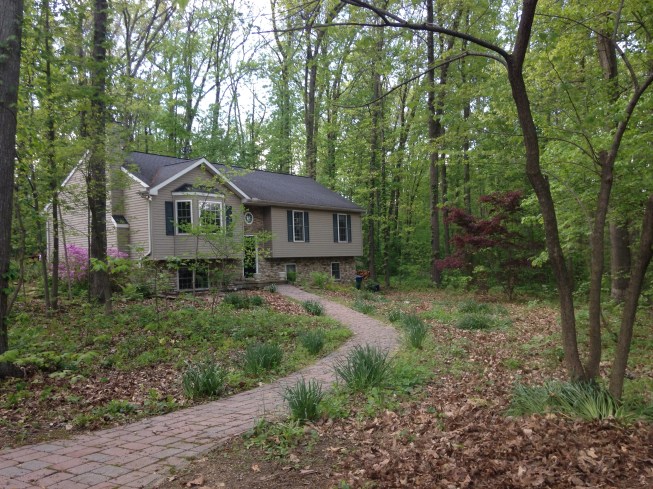
Early Spring – Post Cutting of Invasive Species, Pre-New Native Planting
For Christmas Kevin gave me an arborist – Sue Hunter. She came to our acre on Hickory road one cold and rainy early January morning to walk about and advise us on how to make our woodland more native, more diverse, more eco-friendly, more bird and bee friendly, and altogether more beautiful.
As we tagged Sweet Cherry trees, European Black alder, and Double-file Viburnum, invasive species from Europe and Asia, she complimented us on leaving our autumn leaves to rot in the woods and lying in open places our neighbors would have surely mowed. In our sunny leaf-covered spots, we had wild violets, bloodroot, and wood ferns that had begun to grow in wandering irregular patches. Kevin had spent many hours each spring and early summer pulling garlic mustard weed and the insidious Japanese Stiltgrass thus encouraging our native violets, bloodroot, trout lilies, and wood ferns to spread.
Sue has been in the nursery business for 35 years. She’s had three farms in Pennsylvania and Maryland where she raised native trees, shrubs, and plants. Seven years ago, Sue bought a farm right up the road from us, Heartwood Nursery. For the past five years, we’ve purchased our Christmas wreaths there. Beautiful wreathes made from the plants she grows. No two wreaths are alike; many are made from unusual hollies like the American yellow-berried holly. And since Sue is the president of the American Holly Association this figures.
Sue, Kevin, and I spent two and a half hours together, all of us cold and enthusiastic about what we could do in the next couple of winter months before planting in May. She told us to rip out and cut down all of the invasives, create brush piles tucked into our woods where they would make natural barriers between us and the sometimes noisy road and the sometimes nosey neighbors. She explained that birds love brush or stick piles and that we’d have more birds than we did now. We thought we had pretty many – at least two pairs of pileated woodpeckers, red-headed woodpeckers, wood thrushes, wrens, goldfinches, and all of the other usual suspects, robins, blue jays, wrens, titmice, and catbirds.
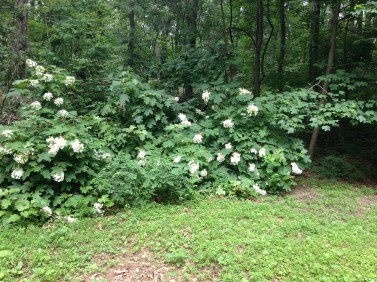
Original Native Oak Leaf Hydrangeas
After Sue’s visit I looked up invasive species. I wondered why they were called invasive and why were they bad. I found out invasive species can and do aggressively move into surrounding ecosystems eradicating habitat and food for native trees, plants, and animals. They are usually quite good at crowding out natives thereby destroying diversity and upsetting the balance.
For example, invasive trees are a problem because they can shade out forest understories and displace native vegetation. Native vegetation is important because it is beautifully adapted to a specific environmental niche. Natives have natural controls that keep them in balance. Invasives go ‘wild’ over-running the landscape and reeking havoc with that balance. Eventually, most birds move away to find a habitat that supports them. That is what had happened at our home-spot even though we’d never realized it until Sue.
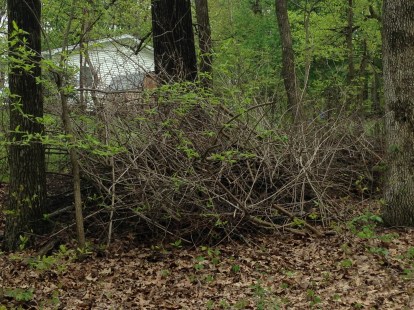
Brush Pile On South Side of House
On the Sunday after Sue’s visit the sky was clear and blue and cold, and I was itching to get started. I put on my corduroys, insulated underwear, and a fleece. I began with the two golden Hinoki False Cypress trees I’d misguidedly planted in the beds in front of our home ten years earlier. The Hinoki Cypress tree is not unattractive in a Japanese garden, but in a Pennsylvania woods, it looks ridiculous.. The cypresses were supposed to max out at six feet but had risen to fifteen, covering part of our living room bay windows. They looked beyond ridiculous. Not only were they too tall but I’d topped them a few years earlier when the windows were almost entirely covered with their branches. We had more light but with deformed flat–topped Hinoki Cypresses, not something one would choose as a landscape statement.
Once I began sawing down trees and bushes with a hand saw, I couldn’t stop myself. A handsaw is slow compared to a chain saw, but it’s quiet. I’m not strong enough to wield Kevin’s Stihl chain saw; though I ‘d love to experience the instant gratification. After sawing down the 6 inch diameter Hinoki Cypress trunks, I cut off their gold and green branches and carried them to one of the two brush piles I’d begun. It was so much fun to see the ugliness disappear and to build giant stick and brush piles. I felt like a child building forts in the woods, places to hide and pretend. I was creating bird habitat. I was a woman on a mission.
Physical work outdoors is one of my favorite things to do, and I’d quite forgotten through the years of my daughter’s illness and my mother’s death how energizing and cathartic it truly is. When I am digging, chopping, pulling, hammering, hauling, or sawing, I am nowhere else. I forget time, jobs, and worries. My mind forgets about itself. It stops planning lessons, tending children or students, making lists of all those things that never seem to be done. I am nowhere and everywhere. I am air, earth, water, breath. I am. I am not. How lovely.
Kevin, impressed with my progress, joined me several February and March Saturdays and Sundays. He can and does use his chain saw, wiping out a score of invasive species in a short afternoon. I dragged the branches into one of our now four stick piles. Two are over twelve feet high and twelve feet wide. They’ve begun to attract more winter birds, and as spring begins in March we enjoy the early robins, tufted titmice, and purple finches.
On another March Sunday, per Sue’s instructions, we dug up and moved seven mature
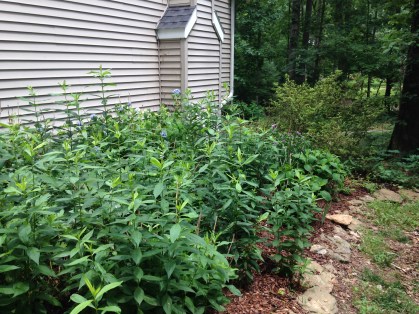
Newly Moved & Planted Hydrangeas
hydrangeas to a side of the house where they join four other mature ones. Wha-lah, we’ve created a massive planting of ‘endless summer’ blue hydrangeas 20 feet wide and three feet high. Sue believes in intensive planting. She says they have a visual impact that three measly bushes couldn’t have. She’s right. Even in late winter we can see the difference eleven leafless bushes can make.
As Kevin and I continued our deconstruction and dismantling, we noticed the neighbors slowing as they drove by. I’m sure they couldn’t imagine what we were up to. But since we’re professors, they figured it was probably something new and weird. Our neighbors, all of whom live in the same type of woodland environment as we do, endlessly rake and mow their ‘yards’. Since woodland soil is acid and isn’t capable of supporting grass, their yards are primarily packed earth with patches of rough bluegrass, ryegrass, and shorn dandelions. Nevertheless, each week from April until November they mow on riding tractors fit for sunny fields or golf course fairways.
My first autumn on Hickory road 15 years ago, brought my next door neighbor, Steve, over when he determined in late November that I wasn’t going to rake my leaves and burn them as everyone had done a month earlier. Steve politely said that I was going to kill my grass if I didn’t rake soon. He added that he knew I must not know about such things since I was a single mom who must be new to living in the country. (He didn’t know I’d owned a farm before I’d built this new home or that I’d purposely moved to the woods so I wouldn’t have to mow.) I, just as politely, explained that I had no intention of raking because I didn’t want a ‘lawn’. His eyes became quite large, and he walked away shaking his head from side to side, doubtlessly thinking what a kooky new neighbor he’d acquired.
As April began, we looked over the site plan Sue had emailed in early January and imagined how all of these native bushes and plants would look. She had designed natural looking beds around the house of high-bush blueberries, viburnum nudums, foam flowers, dwarf winterberry, Virginia sweetspire, and blue lobelia – all densely planted. We talked. We thought. We decided. This May we’d do the entire front of the house, the driveway entry, and the border around the patio out back.
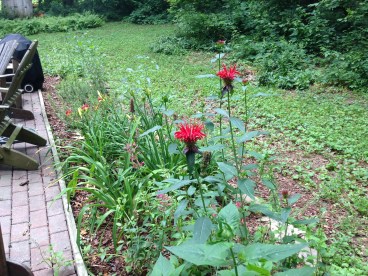
Newly Planted Natives Around Patio
May fourteenth arrived and I was up, dressed, and outside waiting when Sue and her helper, Luke, arrived. Luke, a quiet and responsible home-schooled teenager worked for Sue and happily he was going to work with me, planting and then helping me through the summer. We all unloaded the 200 plus plants and shrubs. As Luke wheel-barrowed loads to the various beds, Sue placed then exactly where she wanted them planted. I hand-carried dozens and placed them next to the beds where they’d grow and thrive. In a couple of hours, we’d arranged the plants in the front of the house, out by the entry drive, and around the patio in the back. Even sitting in their pots, they were an impressive sight.
Between teaching and the rain, it took Kevin, Luke, and me almost two weeks to get them into the ground. When we’d finished we were so proud and happy. Beauty was all around us. Not only did we have dozens of rhododendrons, azaleas, Solomon’s seal, Jacob’s ladder, and white wood aster in our woods but we had the most birds we’d ever seen.
At first Kevin and I thought we might be imagining there were more birds. After all we’d spent a lot of time cutting and building stick and brush piles and wanted our work to have paid off. But as the woods turned green and the brush piles disappeared in the verdant tracery surrounding them, we couldn’t deny that we lived in a bird sanctuary.
From dawn until dusk wood thrushes, scarlet tanagers, indigo buntings, cardinals, blue jays, titmice, wrens, woodpeckers and many others sang and sang. The wood thrushes are our favorites. Their fluty floating sound is a tonic, a calming peace-filled melody one never tires of hearing. Not only did we have bird song, but also we had ruby throated hummingbirds sipping from the Agastache flowers around the patio.
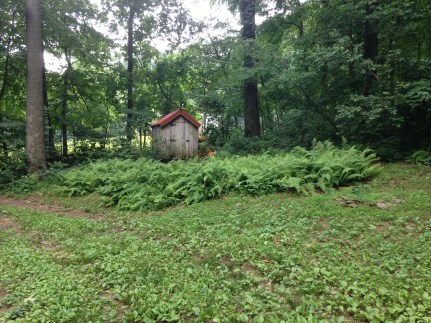
Native Ferns and Favorite Wood Thrush Spot
In the evening we’d sit on our Adirondack chairs and watch as wood thrush parents brought their fledglings out to learn how to find insects under the leaf duff. They’d come within feet of us, safe in this place. We could hear and see Baltimore orioles that nested from their hundred foot high branches in the tops of our Hickory trees. Everywhere there was more – more life, more sound, more happiness.
Now when we arrive home after a long miserable traffic-filled commute from the big city of Baltimore, we come home to a sanctuary, a home-spot retreat that rejuvenates and restores us. We come home to a native habitat, a real Garden of Eden that we created with the help of our neighbor arborist and newfound friend.
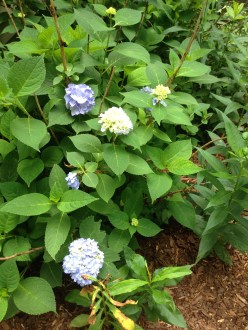
Endless Summer Hydrangea
Post Script:
If you’re interested, listed below is Sue’s plant list.
Section #1 – Driveway entrance – Right side:
American Holly – female – 3 BB
American Holly – low, spreading – 2
Summersweet – pink – 9 containers
Virginia sweetspire 9 containers
Coneflower 12 containers
White wood aster – 12 containers
Jacob’s Ladder — 12 containers
Driveway entrance – Left side :
Rosebay rhododendron – 12 containers
Gable azaleas – 12 containers
White wood aster -12 containers
Jacob’s Ladder -12 containers
Section #2 – front of house – both sides :
Viburnum nudum – 24 containers
Highbush blueberries – 24 containers
Foamflower – 36 containers
Dwarf Winterberry – 3 containers
Virginia sweetspire -15 containers
Blue lobelia – 24 containers
Section #4 – Garden adjacent to deck :
Clustered Mountain mint – 5 containers
Bee balm – 5 containers
Various herbs :
Rosemary
Lavender
Chives
Oregano
 Seeking The Wild