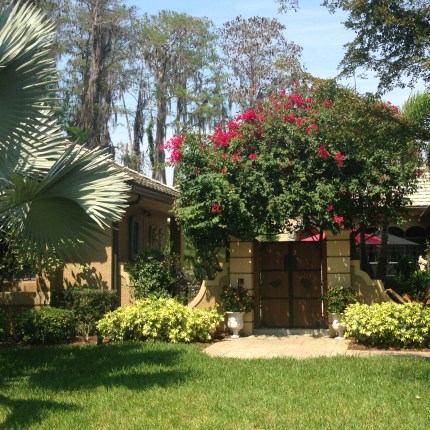
I just came back from visiting my parents in Southwest Florida where it was eighty degrees in March with a constant cool breeze. My parents live in a golf club community where homes vary from condos to mansions, costing from $175,000 to $5,000,000. not including maintenance fees, golf privileges and club membership dues. The 2000 acre enclave, called Fiddlesticks, is surrounded by six foot high chain link fencing topped with barbed wire. This is thickly covered with taller shiny leaved Euonymus bushes that were just coming into fragrant white-flowered bloom. So as I cycled or walked or drove around the inside perimeter road, the only thing I saw on my visit was the lush foliage waving in the breeze. Just outside the fencing, a construction company is building a canal into which water will be drained from adjacent land that will become the newest to-be-built golf community. It’s easier to build on dry ground.

Fiddlesticks Home
The Fiddlesticks property is stunningly beautiful. Many species of palms — royal, chamel, and saw palmetto live here along with cypress trees draped with hanging moss. Bougainvillea climbs up trees and around doorways and walls. Sometimes it stands alone, a ten-foot bower of dark pink. Dense plantings of begonia, alyssum, Tradescantia ‘Purple Queen’, hibiscus, impatiens, and petunias line roadways, swirl around houses, surround trees, congregate at corners, and form islands. Color, scent, and texture are everywhere. Lawns are edged, manicured, and irrigated with underground sprinklers fed by recycled wastewater from the community. As I rode my bike each morning in and out of the different ”villages” and around the golf courses, I couldn’t help thinking, how lovely. This gated and guarded community is only one of many in the area. How nice it would be if most of us could live in such a place. But most of us don’t.
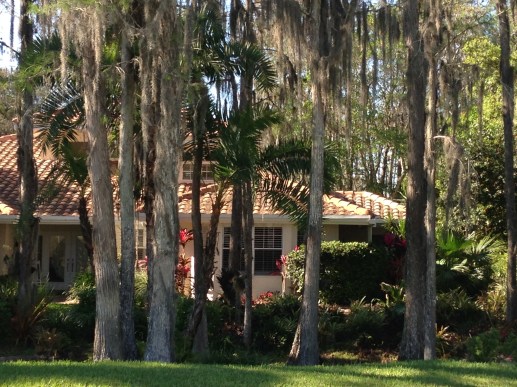
Fiddlesticks Home
One mile outside the gates of Fiddlesticks is the “real world.” Eight lanes of traffic sprawling on and on bordered by one unattractive shopping center after another. There are no trees or flowers, not a scrap of nature anywhere. This vast suburban sprawl goes on for miles in every direction. One marvels at the ability of so many stores to stay in business. One marvels that we perceive we need so many things. Tucked amid and behind the commercialism are the small tract houses and trailer parks of the not so-well-to-do. In their neighborhoods a scraggly palm leans here and there; sometimes a pot of orange geraniums or pink impatiens sits on a porch or stoop.
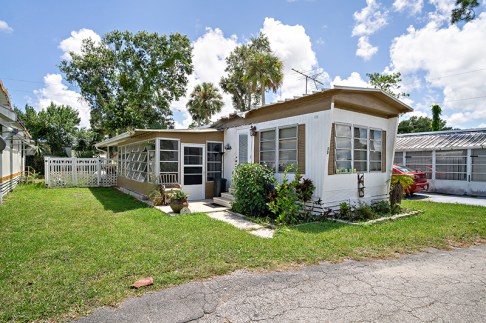
FL Trailer Park
I’ve never seen a more vivid picture of how wealth equates to plenty of comfortable, beautiful space and lack of wealth equals lack of space, beauty, and comfort. Those who have, have the best places. Those who have not, have the worst ones. I guess it’s the American way–exaggerated in this particular locale to the point of unpalatable absurdity. In a culture that equates success with money and money with a nice place to live, our newer cities are bound to look this way. What happened to open space and parks?
Unfortunately, many American city parks and even some suburban ones have degenerated to meeting places for criminal activity and dumping grounds for old furniture and tires. They are unsafe, scary places. These planned green places originally were built as space for us to reconnect with nature and recharge our inner and outer selves. Why have they failed? Are the many trees and bushes to blame because they are good hiding places for muggers and rapists? Or is it that we don’t have enough police and security people patrolling should trouble arise? Perhaps it is because we don’t use then enough because they are dangerous, and they are dangerous because we don’t use them enough — a vicious cycle.
Jane Jacobs, who wrote The Death and Life of Great American Cities, believes that in order for public spaces to be dynamic, safe and people- filled, they must intersect. She says in an interview in 2001,” In a real city or a real town, the lively heart always has two or more well-used pedestrian thoroughfares that meet. In traditional towns, often it’s a triangular piece of land. Sometimes it’s made into a park.” This kind of park is not pushed off to the outskirts of a town or city; it is an integral part of it. And that makes it both user friendly and safe.
In Southwest Florida, a few county and state parks sit along the Gulf of Mexico where those who can afford the five-dollar parking fee may swim and sun themselves. However, another park, the Six Mile Cypress Slough Preserve is free and volunteer guides will take you on a ninety-minute walk through a preserved cypress slough (a moving swamp) filled with birds (some endangered), plants, and animals that wouldn’t be in the area otherwise. The park closes at dusk and large steel gates make sure no one can enter to make mischief or to hunt for alligators. Again the problem of open space attracting troublesome behavior.
Perhaps these predators in our parks are trying to tame the wilderness, exerting control over our natural world. Or are they dominating that of which they are afraid? Perhaps their psychoses require an outlet, and dark, brushy spaces are a conducive environment for heinous acts. Or maybe drug addiction prompts them to prey on victims in the easiest places, those empty and unpatrolled. Whatever the provocation, parks evoke a wilderness in an urban environment that harkens back to when primitive man began to “tame” it.
Thousands of years ago man tamed the wilderness, cutting down the trees and cultivating the earth. This huge leap in the way we lived removed us from one place and put us into another. We separated ourselves from the natural world, took ourselves out of it psychically and physically. Even though we still prayed to gods and goddesses, made sacrifices to ensure good crops and prosperity, we “created” our own food, rather than “searching it out” in the wilderness.
When the Romans arrived in the Netherlands around 150 B.C., they found a people that they described as blue skinned because of the cold, swampy conditions of their environment. At that time, the Netherlands was a series of terps (manmade mud hills) amid swamps and lakes. It was cold, damp, dreary and rainy. The “Nederlanders” ( below the land), as they are still called, and their land were quickly passed over by the conquering Romans. Who would want to live in such a place? Yet through incredible ingenuity and imagination, the Nederlanders developed their bit of land into a thriving place by manipulating too much water into a maze of dikes, waterways, and locks. By the twentieth century, they had increased the size of their country’s landmass by twenty-five percent. And by inventing and using windmills they were able to grind grain, process lumber, operate the locks and eventually produce electricity.
One might argue from this example that landing in the better place does not always ensure having the better life. It is human imagination together with a positive attitude and cooperative spirit that can create a productive and comfortable living space out of a swamp.
Take the Yucatan village, Nueva Vida (New Life) as a modern example of what man can do if so motivated. This village was begun as an experiment at the edge of the Calakmul Reserve as an attempt to save what was left of the wilderness reserve. For centuries, the natives had slashed and burned the dense forests in order to grow rows of corn. Every three years they moved on to a new place because the poor soil was used up. Nuevo Vida has changed that cycle by not cutting down all the trees and not growing corn. Instead, these ancestors of the Mayans live in the forest, clearing only a small area of land. They grow crops, plants, and trees that thrive in this environment — lime and papaya trees, bunched plantings of cilantro, lettuce, and chaya (a high protein leaf crop). The cooperative of thirty-six families works together composting, cultivating, building cisterns and high peaked houses, and gathering medicinal herbs from the forest. Recently they began beekeeping. Where once they subsisted, they now thrive – in the same place but with a different understanding.
Finding a new and different understanding of how to live has prompted humankind to create utopian societies particularly in the nineteenth and twentieth centuries. Some of these “utopias” were inspired by religion, others were inspired by political ideas, and still others by aesthetics. Some such as, the Branch Dividians in Waco, Texas or the People’s Temple in Guiana began innocently and ended in tragedy. Others resembled tidy perfectly neat towns like Columbia, Maryland which was the first entirely planned city built in the late 1960s and early 1970s by James Rouse. Everything in Columbia was pre-planned and approved from street signs to house colors and construction materials to commercial areas and landscaping. Critics called it “Milton Bradley Town” after the maker of the board games Candyland and Chutes and Ladders.
Utopian societies created from religious ideals such as the Shakers have vanished, but the Amish culture still survives and thrives. The Amish believe in living a simple, plain life close to God and the earth. This belief informs their idea of living a kind of heavenly existence on earth. Although some of the Amish have adopted the use of modern conveniences such as cars, computers and telephones, they have picked and chosen which things and how much they will be incorporated into their lives. They may use electricity at their work places but not always in their homes. One thinks of the Amish as a group both unwilling to change and uncertain of change. This is not true. More and more Amish are going into business. In 1990 in Lancaster County, Pennsylvania the Amish owned 1000 businesses. Now they own 2000 businesses. Unlike “regular” American businesses whose failure rate is 50%, the Amish have a 5% failure rate. And this is while doing business on their own terms within the values and beliefs of their religion, culture and life style.
The Amish who work at and own the Amish market near my home in southern Pennsylvania use telephones and computers at their market, but many don’t at home. They still dress in plain black clothes with no buttons or zippers and only bath on Saturday evenings. Most Amish live on family farms where they grow their own food and keep dairy cows and pigs. Extended families living together is the norm. Theirs is a tight knit community where they know and help one another with child tending, harvesting, and building. This dependence on each other fosters their unique lifestyle and helps them to grow and prosper. Although they have become merchants by opening Amish markets that cater to consumer-minded Americans, they retain their core values and beliefs in the non-material. It’s an interesting contradiction.
For example, my sister recently attempted to buy some outdoor wooden furniture from the Amish market owners. Initially, they were delighted to sell several pieces to her until they learned that the furniture had to be shipped to Holland where my sister lives. As Matt, the Amish owner, explained to my sister, they had no idea how to do this nor did they wish to do it. My sister couldn’t understand this thinking. Being a businesswoman herself, she thought she was expanding their market. Her friends in Holland would want to buy Amish furniture too once they saw my sister’s. When she explained this to Matt, he said he didn’t want to expand his market. He said it would be too stressful to ship furniture to Holland. He didn’t care about the money. What was he going to buy with the extra income? What did he need? He was contented with what he already had.
I wonder if Matt would say the same thing if he wasn’t Amish and lived in a trailer park next to a Saks Fifth Avenue in southwest Florida? Out side of his Amish community Matt would quickly become a member of the ‘have nots.’ Inside the Amish community, he is has all that he needs. He feels he is prosperous. I wonder if mainstream American culture is capable of forming communities where people work together like the Amish or the Mexicans in Nueva Vida to create a fairer, less destructive, more beautiful, more prosperous place? I wonder if we, as individuals, have the courage to work and to do business within the limits of our values and beliefs? How many of us have the courage to say, “no”? I wonder if we are capable of imagining a society where no bad places exist?
 Seeking The Wild