
Dolly Sods West Virginia
Adventure Calls
After I’ve been cooped up in my office for too long, I yearn for an adventure that doesn’t involve hosiery or cell phones. I long for the rush of a wilderness adventure with all its real and imagined dangers. One where I’m camping along the Yukon River in Alaska one hundred miles from anywhere, watching grizzly bears come down to scoop up twenty-five pound salmon with their paws. Or one where I’m backpacking in the Appalachian Mountains and a black bear sniffs around my tent. But I don’t want too much danger. Not like the adventure two mountain bikers had in California when they encountered a mountain lion while mountain biking.
They were riding along a narrow brushy mountain trail, talking about life and the scenery when suddenly a mountain lion leaped out and swatted one of the women off of her bike. The mountain lion chomped down on her head, dragging her into the brush as her friend grabbed hold of her legs and pulled, screaming at the predator. Luckily another biker came along and heard the screams. He ran into the brush, picked up his bike, and threw it at the mountain lion all the while yelling as loudly as he could. It worked. The lion slunk away and the injured woman was flown to shock trauma. Later that same day rangers found the remains of another man also taken by a mountain lion, perhaps the same one. The fellow who saved the day told the National Public Radio correspondent that he’d never go mountain biking alone or in that part of the mountains again. I wouldn’t either; that’s too much adventure for me.
I think we forget that there is danger in the wilderness, in the woods and in the mountains of this country. We’ve developed so much of it into cities, towns, farms, and suburbs that we forget another world is out there. And it’s not tame. I’ve been reading Annie Dillard’s, Living Like Weasels. She tells a story about a naturalist whom a weasel bites on the hand: “The man could in no way pry the tiny weasel off, and he had to walk half a mile to water, the weasel dangling from his palm, and soak him off like a stubborn label.” What a terrifying picture I had in my head after reading that. Or the story I read in Adirondack Life magazine about a group of college students who tried to ascend 46 Adirondack high peaks (over 4000 feet) during a nineteen day Christmas vacation. They didn’t make it. One of them fell on a steep slop and luckily only sprained an ankle. Still it took all day to get him out with the others carrying his equipment through snow so deep they “found themselves walking on the tops of small trees.” People die in the Adirondack Mountains in the winter.
I don’t want a wilderness adventure that intense. I don’t want to be traumatized or injured. I don’t want to come out damaged, psychically or physically. I want a wilderness adventure that will reconnect me with nature, one where I will be astonished and amazed, exhilarated and perhaps a little bit frightened. I want a wilderness adventure like the one I had backpacking in the Dolly Sods Wilderness Area.
It is Memorial Day weekend and my husband, our dog, Jo, and I go backpacking every Memorial weekend in Dolly Sods. Dolly Sods, West Virginia is a special place because it looks exactly like the northern Canadian tundra although it is only five hours away from Baltimore, Maryland. Timbering and fire changed the entire ecology of the mountain’s ridge in the 1800’s. Before that happened, Dolly Sods was covered with seven to nine feet of humus and a red spruce and hemlock forest where, according to the Dolly Sods web site, “the average tree was four feet in diameter.” After the forest fires and timbering, the rich land became a thin rocky soiled moor covered with bogs, streams, and dwarfed, bent evergreens about six feet high and 100 years old. In 1975 Congress designated it a wilderness area. Congress didn’t need to tell us it was a wilderness. We already know.
We love going to Dolly Sods at the end of May because anything is possible. Sometimes it’s warm and the wild azaleas are blooming, fragrant flame orange. Sometimes we hike across glacier-like snowfields three acres wide and two feet deep. We have to be prepared for snow or rain or mosquitoes and 75 degrees.
We arrive mid afternoon and hike down the Blackbird Knob Trail a couple of miles to Red Creek. Red Creek is about twelve feet wide and in most places no more than six inches deep. We camp by its banks, eat freeze-dried shrimp, and homemade spaghetti and drink cabernet. We are back in heaven.

Red Creek
The next day we hike five miles further along the trail through the forest and back out into open land. I love the openness and the views especially after the cloister of the woods. We camp again beside water, this time a small brook with steep 3 ½ foot clay banks
At about 5:00 AM I wake up. I feel as if I’m floating, as if I’m sleeping on a waterbed. And in a way I am. It’s pouring, and the floor of our tent is sitting on an inch of water. I awaken my husband. About an hour later at first light, the rain becomes a drizzle. We gulp down some granola and water, pack up our camp and walk to the water’s edge. The brook has risen to the top of both banks and it’s rushing, not with too much force but enough to knock us over. We hike up stream and find a spot where the water looks calm but is four feet deep. If we walk across we’ll be soaked and the clothes in our packs are already damp. We can’t afford to walk seven miles in wet clothing when the air is 50, maybe 55 degrees. It’s perfect hypothermia weather.
So we take off our clothes and boots and walk across naked with our packs on top of our heads like African women carrying their laundry. The water is surprisingly warm. Jo swims across and then shakes on the opposite bank as we dry off, get back into our clothes and boots and hike on. At the next stream, we do the same thing. It begins to rain lightly as we got closer to Red Creek. I am feeling quite macho, high on adrenaline, and into the whole wilderness experience.
When we arrive at Red Creek, it has turned into a raging river, twice as wide, who knows how deep, large boulders sending waves of foaming water into churning whirlpools. Three guys stand soaking wet, on the other side yelling at us. We can’t hear them over the roar. They yell again as we venture onto a boulder at the water’s edge. “Don’t try to walk across. You’ll get swept down stream. We barely made it.”
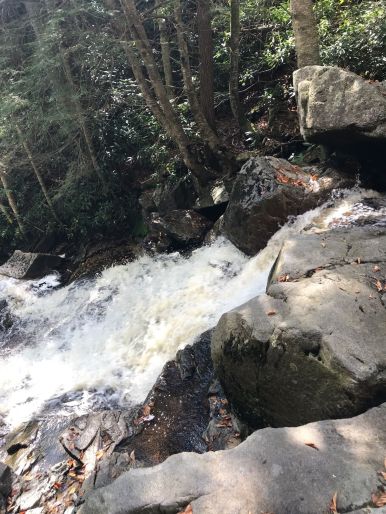
My husband wants to get across if we can. He has power cord, a very strong thin rope only 1/8 inch in diameter and a carabiner, a steel D-shaped coupling link used in rock climbing. He ties a rock to one end of the power cord and throws it across to the guys on the opposite bank. They catch it on the third try. Then they throw it back to us. We construct a pulley, using the carbiner tied in the middle to ferry our backpacks across. It works.
Now to ferry a person. I go first. This time I can’t take off my clothes, not with three guys standing there. I’ll have to be wet the last two miles. I keep my boots on too. No telling what’s under the water. I hope the guys are strong enough to pull me across fast because there is a terrifying rapid in the middle of the creek where the latte colored water churns and rises and swirls like a hungry thing. It has slung each backpack out like a pea in a slingshot ready to shoot it down stream. I am shaking as I wade into the water and grab onto the cord. I get to the middle. The current sucks my feet off the creek bottom, pulls them down stream and I am suddenly on my stomach, my legs strung out like the tail on a kite. I hang on as the cord stretches and stretches. All I can see is me being swept away like a twig or a leaf bouncing from rock to rock, unable to grasp anything that can stop me. I can hear my husband yelling, “Pull. Pull.” And they do. Just as I think I can’t hold on, the cord relaxes and my feet feel the river bottom. I have made it.
Jo, our dog is next. My husband ties her up with a makeshift harness of webbing straps and clips her onto the carabiner. He’ll go across with her, holding onto the dog with one hand so her head won’t go under and holding onto the power cord pulley with the other. The guys begin to pull. Jo’s head is above the water. They hit the mid-stream rapid. The cord stretches out and out and snaps. My husband and Jo go flying downstream bobbing and turning under water. I scream, “Hold onto the dog. Hold onto the dog.” I know if he lets go she’ll be swept away and be gone. My husband grabs onto a rock, pulls himself and Jo into shallow water and they are out of danger. But they’re on the wrong side. I’m shaking as we re-throw the cord and tie it back together. We try again. I can hardly bear to watch. They hit the bad spot; the guys pull faster. The cord holds. They are across. Shivering, we hug, and laugh and kiss each other. We’ve done it.
After we get back to the car, change, eat, and have a beer, we are feeling quite triumphant. We’ve had an adventure, a real wilderness adventure. It was scary and challenging and daring. And we had made it. We feel like pioneers who have survived a flood, modern day adventurers who’ve made the summit. We can’t wait to tell our friends and our families. I talk about it for weeks.
 Seeking The Wild